The ultimate password against fear
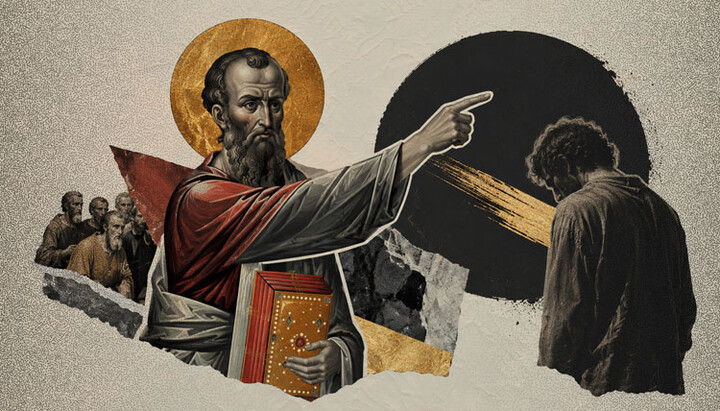
Anathema from the Apostle Paul. Photo: UOJ
The apostolic reading for the 13th Sunday after Pentecost (1 Corinthians 16:13–24) is the final chord of one of the Apostle Paul’s most forceful letters. In these brief closing verses, Paul builds a vertical axis that keeps the community from collapsing into chaos.
For Paul, the test of whether relationships within the community are true is love: “Let all that you do be done with love” (1 Cor. 16:14).
For Paul, love is not an emotion but an ontological property of God revealed in Christ.
Earlier, in Chapter 13, he gave us his hymn to love. Here, he elevates it into an absolute imperative. Any spiritual practice, hierarchical structure, or theological dispute that exists outside love loses its legitimacy and becomes sin.
“If anyone does not love the Lord Jesus Christ, let him be anathema. Maranatha” (1 Cor. 16:22). Here anathema is not directed at those who have made a mistake in doctrine, but at those who do not love Christ. Sin is betrayal of Love. Maranatha – Syriac for “Our Lord is coming” or “Come, Lord!” – was one of the earliest liturgical watchwords of the first Christian community. Paul is, as it were, reminding us that the Church lives in eschatological tension. All of her history is moving toward the Second Coming. The expectation of the Judge sobers pride and puts an end to quarrels within the Church.
Therapy for spiritual neurosis
“Watch, stand fast in the faith, be courageous, be strong” (1 Cor. 16:13). In Greek, these words sound like a call to military steadfastness in the face of approaching chaos. Christian courage is the opposite of ancient Stoic pride. The Stoic relies on his autonomous will. The Christian is courageous because he is rooted in faith – that is, in trust in God.
The Corinthian community was deeply neurotic. Its members constantly compared themselves with one another, chased after “super-spirituality,” and suffered from an identity crisis. Paul offers them his own therapy.
First comes the command to “watch.” At its core, this is a basic law of spiritual hygiene. It demands unceasing self-examination: “Where is my mind right now? Are my motives pure, or are they being driven by a wounded ego?”
Second come the words: “Greet one another with a holy kiss” (1 Cor. 16:20). In a fractured, quarrelsome community, Paul demands a physical sign of mutual acceptance. It is a psychosomatic sealing of forgiveness. You cannot kiss your brother “with a holy kiss” while continuing to sue him outside the church walls or despising him for holding different views.
Unity amid raging chaos
For us, Paul’s words are close for other reasons as well. Today, when external pressure, internal divisions, the threat of persecution, and the fear of war paralyze people’s will, the Apostle leads us back into our spiritual heart. “Be courageous, be strong.” Do not divide people into “ours” and “theirs.” Remain faithful to God even when you are hated for it.
And in an age of polarization and hatred of enemies, the command “Let all that you do be done with love” sounds like the only way to preserve the Church’s very ontological essence. If fear, resentment, or hatred drives love out of us, then our faith is vain and our life has been lived in vain.
When external and internal crises – whether the divisions in Corinth or the upheavals of our own time – destroy the supports we are used to relying on, the human psyche naturally regresses to its most basic defense mechanisms: aggression, splitting the world into black and white, isolation, or, on the contrary, the search for totalitarian fusion with a group.
But Paul offers us another way. Above all, it is a way beyond neurosis through the decentering of the ego. The Corinthians suffered from what modern psychology might call narcissistic expansion: they measured themselves against one another by their spiritual gifts and sought ecstatic experiences as a means of self-assertion. Paul’s call to love shifts our attention away from our own fears and inner dramas toward the highest goal and meaning of human life. The human psyche becomes stable when a person stops serving his own ego and begins serving a meaning greater than himself.
The courage to face reality
The Apostle calls us to the “courage to be.” In conditions of uncertainty, a person becomes reactive – fear drives his actions. Christian courage is the ability to endure reality without collapsing into panic or hatred. It is a state of inner freedom born of deep trust in God. Rooted in love, the Christian becomes invulnerable to the chaos outside.
Paul leaves the community face to face with an ultimate choice in which compromise is impossible.
Stripped to its essence, Christianity according to Paul comes down to a severe but saving triad: continual awareness – watchfulness; rootedness in trust in God – courage; and the total embodiment of love as the one fabric that holds existence together.
Beyond all earthly disputes
When external institutions collapse, when ideological madness tries to tear the Church and society apart from within, the conclusion of Paul’s epistle sounds like an absolute psychological and spiritual compass. It reminds us that in a world gripped by entropy and fear, the victor is not the one who has amassed the greater administrative power or the stronger arguments, but the one who has preserved the ability to “refresh the spirit” of another person.
Paul’s uncompromising Maranatha is a reminder that the end of history has already been decided.
And on the threshold of that end, the only thing that carries the weight of being is the measure of our capacity to love. Everything else is merely the noise of a passing world – a clanging cymbal over the scorched field of human pride.
Read also
The help God never asked for
Uzzah wanted only to keep the Ark of the Covenant from falling into the dust. Why did this well-intentioned act cost him his life, and who was really responsible for his death?
Freedom begins when there's nothing left to take
Fear of persecutors takes root in our attachment to possessions. We turn to St. Basil the Great to understand why the prefect's threats held no power over him.
The bride in the window frame
The author of the earliest account of St. Thecla’s life was defrocked. Yet it was his book that preserved the only ancient description of the Apostle Paul’s appearance.
Drinking priest, or the flip side of parish life
In his epistle, the Apostle Jude describes a scene familiar to anyone who has seen a church meal turn into a drinking party.
A lesson from a speechless donkey
The famous seer struck his donkey three times for refusing to go forward. All the while, she was saving his life – and seeing what he could not.
The time when the soul ripens
Modern society has turned youth into a cult and old age into a period of merely “living out one’s days.” The Christian perspective reveals the profound spiritual meaning of our later years.