The bitter tears of a wounded creation
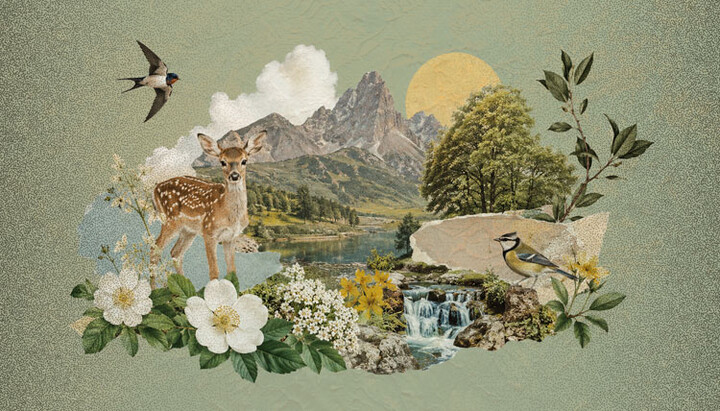
The beauty of God's creation. Photo: UOJ
“Man – that has a proud ring to it,” a writer once declared, and we have long grown used to repeating the phrase without giving it much thought. But behind that pride, a strange and cruel picture of the world has taken shape. Man placed himself at the center of the universe and decided that everything around him existed solely for his comfort, his appetite, and his entertainment. We crush, drill into, burn, and exhaust the inanimate world simply to make our own lives a little easier.
And we torment the living world in even more sophisticated ways. We do not merely slaughter animals for food or work them to exhaustion – we have turned their suffering into spectacle. Circuses with whips, cramped dolphin tanks, hunting for sport and trophies, cockfights… The human ego has swollen so enormously that there seems to be no room left on this planet for the rest of God’s creation.
And our minds, accustomed to simplified textbook formulas and excuses such as “survival of the fittest,” sincerely fail to see anything wrong with this.
But if we set aside the cold logic of the consumer and look at the world through the experience of the saints, an entirely different truth comes into view.
The voice of stones and the elements
The most important thing we need to grasp with the heart is this: for the living God, there is no dead matter. With Him, everything is alive.
It is we who, having lost our sensitivity and our connection with the Creator, divided the world into “living nature” and “raw materials.” When Christ says that “God is not the God of the dead, but of the living” (Matt. 22:32), this concerns not only the ancient forefathers but all creation.
What seems to us to be nothing more than a stone or a mindless force of nature has, before God, its own voice and its own response.
The raging sea has no human brain, yet when Christ commands the wind and the waves, they fall silent. Rocks have no ears, yet St. Mark of Thrace responded to the will of God, spoke a word – and the mountain moved in obedience to the elder.
The Creator did not abandon this world to spin on by sheer inertia. He has His own deep and hidden relationship with every flower, every rocky slope, and every bird.
If we think that some May beetle or earthworm is simply too small and insignificant for God to remember, it is worth looking at ourselves from the outside. Our human mind, for all its pride, appears far simpler and more naive before the higher angelic powers than an ant does before a scientist.
God’s creative power holds absolutely everything in His hands – from distant galaxies to the tiniest microorganisms.
If that Love were to let go of the world for even a moment, everything around us would simply dissolve into nonexistence. Everything we know about the universe is only a narrow image reconstructed by our minds. In truth, we know almost nothing about the real depth of creation.
The guilt of the fallen gardener
All our conceit about being “superior to nature” is merely a sickness of the soul poisoned by pride. While we indulge our self-importance, the world around us quietly suffers and weeps.
The Apostle Paul spoke of this with extraordinary force: “For the earnest expectation of the creature waiteth for the manifestation of the sons of God. For the creature was made subject to vanity, not willingly… in hope… that the creature itself also shall be delivered from the bondage of corruption into the glorious liberty of the children of God” (Rom. 8:19–21).
Think about it: animals, trees, and rivers did not sin. They did not start wars. They did not invent cruelty. They were drawn into this cycle of pain, disease, and death only because man stumbled – the very being who was meant to be the careful gardener and guardian of this home.
When Adam lost harmony with God, the whole world cracked with him. Animals began to fear man and attack one another, the earth brought forth thorns, and death entered the world.
But if all creation awaits liberation, what exactly is it hoping for?
It hopes that redemption will restore joy to it as well – that in its own time it too will share in that new, radiant, eternal life promised by the Creator.
God became Man to save us from darkness and death. But it is through man that He also heals the rest of creation. Communion with God is not our private monopoly. The entire animal world, in ways wondrous and invisible to us, senses its Creator in its own way.
The Psalter tells us that even young ravens cry out to God when they seek food (Ps. 146:9), and that young lions ask Him for their nourishment (Ps. 103:21). God Himself reminds man of this in the Book of Job: “Who provideth for the raven his food? when his young ones cry unto God, they wander for lack of meat” (Job 38:41).
Scripture tells us again and again: animals are not merely “protein-based organisms.” They are living creatures with their own souls and destinies.
Millions of dogs, cats, and birds live in this world, and among them no two are exactly alike. Each has its own temperament, its own habits, its own little joys and fears.
Could all this astonishing diversity really have been created only to flash briefly into existence, endure pain at the hands of human callousness, and then disappear forever?
There is a Mystery in nature that we do not know how to read. It is an intimate conversation between God and those He has created.
The friendship of saints and animals
When a person purifies the heart and fills it with love, the world around them begins to heal.
Saints of every age found an astonishing and deeply moving language with the creatures we are accustomed to calling “wild animals.” There was no training involved. The animals simply recognized in the saint something of Adam’s original warmth – a home in which there was no fear and no threat.
Paul of Thebes lived in the desert, and every day a raven brought him half a loaf of bread. When the elder died, two enormous lions came out of the sands, dug his grave with their claws, bowed, and quietly departed.
Gerasimus of the Jordan saved a lion by removing a thorn from its paw, and the animal became his faithful companion. It lived at the monastery, helped with the work, and when the elder reposed, the lion could not bear the separation. It lay down on his grave and died of grief.
Can such devotion really be dismissed as nothing more than “soulless instinct”?
St. Sergius of Radonezh shared his last ration of bread with a wild bear deep in the forest. Wolves, hares, and bears came to the hut of St. Seraphim of Sarov. The saint stroked them, fed them from his hand, and treated them like members of his own household.
Father Seraphim said that animals feel everything; they simply cannot speak, and that harming them without necessity is a sin before God.
The saints saw in every living being a thought of the Creator. They knew that to wound a creature is to wound the Heart of the One who made it.
St. Silouan the Athonite wrote with extraordinary tenderness: “The Spirit of God teaches the soul to love every living thing, so that it does not even wish to pluck a green leaf from a tree without need. Thus the Spirit of God teaches love for all things, and the soul has compassion for every creature…”
To the end of his life, St. Silouan remembered with pain how, in his youth, he had accidentally scalded a bat or killed a fly for no reason, and how afterward he wept and begged God’s forgiveness for that senseless cruelty.
To modern man, this may seem eccentric: to weep over a fly!
But it is precisely in such sensitivity that a truly living and compassionate heart reveals itself.
The loss of simple human compassion
So what has become of us, we who declared ourselves “masters of the Earth”?
In losing sensitivity, we have also lost simple human compassion.
We have turned nature into one vast production line. We cut down forests, fill rivers and oceans with plastic, test household chemicals on rabbits, and keep animals in cramped cages for entertainment.
Man has ceased to be a caring steward and become a destroyer.
We can gush over a beloved pet and then walk indifferently past a homeless dog freezing outside. We can justify almost any cruelty in the name of “convenience” or “profit.”
But God did not create the world to be cruel.
The Prophet Isaiah left us an image of the future in which “the wolf also shall dwell with the lamb, and the leopard shall lie down with the kid… and a little child shall lead them. They shall not hurt nor destroy in all my holy mountain” (Isa. 11:6–9).
This is not merely a beautiful fairy tale. It is a reminder of what the world is meant to look like when it is governed by love.
While we live in this difficult world, each of us should stop, if only for a moment.
Stop looking at nature as a “resource.”
Look at the bird passing overhead, the dog by the entrance to your building, the green leaf outside your window – not as biomass, but as a living creation of God, with its own place beneath the sun.
It is time for us to stop “sounding proud.”
It is time to learn to sound gentle, kind, and humble.
To see in the life around us a reflection of God’s care.
And perhaps then our own hearts will become a little warmer – and the world around us a little brighter.
Read also
The Weeping Queen of Blachernae
On the night of the Feast of the Protection, only two people witnessed the miracle in the Church of Blachernae. Everyone else prayed and saw nothing. Yet they, too, received grace.
Deadly spiral of human hatred
The tragedy of Lebanon's civil war lays bare how dehumanization and fear can turn human beings into monsters.
Woe to expectant mothers – or to those of little faith?
God commanded one prophet not to have children, yet told his people in exile to bear sons and daughters. What does this apparent contradiction tell us today?
The help God never asked for
Uzzah wanted only to keep the Ark of the Covenant from falling into the dust. Why did this well-intentioned act cost him his life, and who was really responsible for his death?
Freedom begins when there's nothing left to take
Fear of persecutors takes root in our attachment to possessions. We turn to St. Basil the Great to understand why the prefect's threats held no power over him.
The bride in the window frame
The author of the earliest account of St. Thecla’s life was defrocked. Yet it was his book that preserved the only ancient description of the Apostle Paul’s appearance.