Parable of the Talents: When courage triumphs over fear
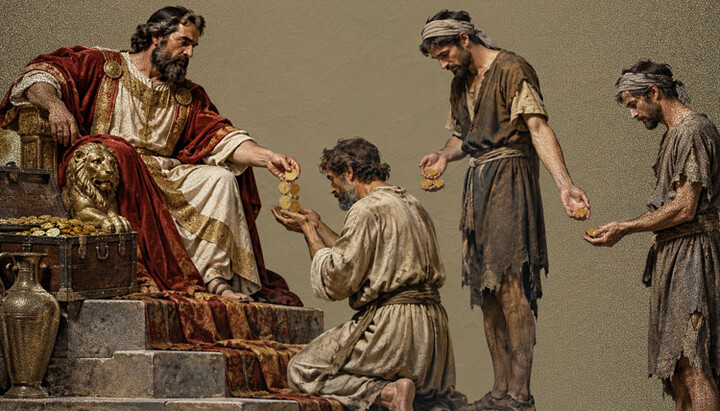
The Parable of the Talents. Photo: UOJ
At first glance, the Parable of the Talents may seem like an everyday drama about money and investment. In reality, however, it unfolds into a philosophical and theological revelation about human nature, freedom, fear and responsibility. The parable addresses some of life’s most fundamental questions: Why are we given life at all, and what are we supposed to do with it?
To grasp the full force of the story, we need to strip the word “talent” of the romantic associations it acquired much later. Today, when we hear the word, we think of a gift for poetry, an ear for music or an aptitude for mathematics. But to Jesus’ listeners, a talent was something very concrete. It was one of the largest units of weight and money in the ancient world, equivalent to roughly 30 kilograms of silver. A single talent represented about 20 years’ wages for a laborer.
So when the master of an estate, before leaving on a long journey, gives his servants five talents, two talents and one talent, he is not handing them a little spending money. He is entrusting them with an enormous fortune. Even the servant who receives only one talent is given wealth that an ordinary person would have to work half a lifetime to earn.
It is also significant how the master distributes his wealth: “to each according to his ability.” There is no mechanical equality here, but neither is there injustice. The master knows perfectly well what each of his servants is capable of. What follows is a psychological and spiritual dividing line.
The servant who receives one talent buries it in the ground. This may seem strange to us, but by the standards of the ancient Near East, his behavior was extremely prudent. Burying money was considered one of the safest ways to protect it: if robbers broke into the house, they would not find the treasure. Under the legal norms of the time, a person who buried property entrusted to him could be absolved of liability if it was nevertheless stolen. From the standpoint of law and security, this servant acted impeccably.
And that is precisely why the master’s harsh condemnation would have shocked the parable’s first listeners. Christ directly rejects the morality of passive caution – the attitude of “better safe than sorry” – and demands a willingness to take risks.
The astronomical capital of divine trust
In theological terms, a talent is far more than an ability to write poetry or run a business. It symbolizes divine grace, existence itself, time, the gifts of the Holy Spirit and God’s trust in man.
Significantly, the talents are given before the servants have done anything useful at all. It is an unconditional act of generosity and love on the part of the Giver. Man does not create the original good himself – he receives it as a gift and becomes not its owner, but its steward, guardian and cultivator.
The first two servants demonstrate what theology calls synergy – cooperation between God and man. Grace does not turn a person into a passive recipient. It does not abolish human will. On the contrary, it kindles it, demanding wholehearted engagement and boldness. Multiplying the talents here is not about commercial profit or capitalism. It is about spiritual growth – the ability to bring more love, light and meaning into the world than were there before you.
The third servant, however, makes a fatal mistake. He sees the gift not as an expression of trust but as a dangerous burden that must be disposed of as quickly as possible and eventually returned exactly as it was received. He freezes grace, isolating it from the world.
The anatomy of one’s own personal hell
The master’s return is a metaphor for the Last Judgment and the Second Coming. And here we encounter something remarkable: the master praises the first and second servants in exactly the same words. One is rewarded for multiplying five talents, the other for multiplying two. The verdict is identical: “Enter into the joy of your lord.”
The tragedy of the third servant, meanwhile, is essentially a vivid anatomy of hell.
The outer darkness into which he is cast appears not so much as an external punishment as the consequence of his own choice. He had already distanced himself from the master by constructing in his mind a terrifying, tyrannical image of him: “I knew you to be a hard man, reaping where you have not sown.” He projected his own fears and grievances onto God, created a cruel god for himself and ultimately became imprisoned in his own sense of righteousness and isolation.
From the standpoint of ancient metaphysics, all life is a continuous movement from potentiality to actuality, from possibility to realization. A talent buried in the ground remains nothing more than dead potential. It does nothing, produces nothing and remains an ordinary piece of metal. The first two servants transform potential into real action – they enrich existence. The third chooses decline and nothingness.
In the spiritual life, it is impossible to stand still and simply “preserve” what one has. If you are not moving forward, you inevitably begin to slide backward. The failure to increase love and meaning becomes a loss at the very level of being.
The trap of total, illusory security
This parable is a powerful manifesto on overcoming fear. The third servant is paralyzed by anxiety. He is so afraid of taking a wrong step, making a mistake, failing or disappointing someone that he decides to do nothing at all. It is what Jean-Paul Sartre called “bad faith” – an attempt to flee from one’s own freedom, refuse to choose and shift responsibility onto others or onto “circumstances beyond one’s control.”
The first two servants venture into the open sea of risk. Any commercial enterprise in the ancient world carried the possibility of robbery, shipwreck or ruin. Yet they accept the challenge because they understand that real life exists only where there is courage to step into the unknown.
The third servant chooses absolute security instead. In trying to protect himself from possible failure, he kills action itself and chooses a symbolic death even before the master returns.
Modern philosophies of the gift contain an important idea: a gift truly becomes a gift only when it sets in motion a chain of reciprocity and creativity.
If a person receives a gift suspiciously, seeing it as a hidden trap or obligation, the gift turns into poison. The third servant sees the talent not as a sign of his master’s love and trust but as evidence that could eventually be used against him. He returns it with the words, “There you have what is yours.” It is a gesture of profound resentment, alienation and refusal to enter into relationship.
In essence, the parable presents us with two fundamentally different ways of relating to reality, to God and to ourselves.
The first is the way of trust and creativity. A person sees the world and his own life as a realm of possibilities, with God as a loving Father and co-creator. Such a person is not afraid of making mistakes because he knows that the very impulse to act, the movement of the heart and will, has value. Time becomes a precious resource – an opportunity to create, love and transform the world around him. The result of such a life is joy, fullness and profound participation in God’s design for the world.
The second is the way of fear. A person looks at reality from inside a bunker. God appears to him as a stern, demanding and fault-finding supervisor waiting for an opportunity to catch him making a mistake. The primary goal of life becomes not creating something new but minimizing losses and finding excuses for one’s own passivity. Time is experienced as a burdensome wait, while every gift becomes a heavy responsibility. The result is barrenness, self-isolation, deep inner bitterness and the feeling that life has passed you by.
The law of continual spiritual growth
At the very end of the parable come words that often trouble readers because they seem paradoxical and even harsh: “For to everyone who has, more will be given, and he will have abundance; but from him who does not have, even what he has will be taken away.”
Yet there is no injustice here. This is not a sentence but a statement of a law of human spiritual life.
Every system – whether the mind, the body or the soul – follows the same principle: what is not used withers and atrophies. If a person does not exercise his muscles, they weaken. If he does not cultivate his mind, his thinking deteriorates. If he closes his heart to love and refuses to risk giving warmth to others, his capacity for love eventually withers at the root.
A person who actively uses what has been entrusted to him – knowledge, emotions, strength and time – grows richer, deeper and stronger with each passing day. More is “given” to him. But the person who locks his life away in a chest out of fear eventually loses even the small spark of life he once possessed.
The Parable of the Talents reminds us that the greatest sin is the sin of an unlived life – refusing to become the person you were created to be and refusing to share with your Creator the joy of creation.
Read also
The help God never asked for
Uzzah wanted only to keep the Ark of the Covenant from falling into the dust. Why did this well-intentioned act cost him his life, and who was really responsible for his death?
Freedom begins when there's nothing left to take
Fear of persecutors takes root in our attachment to possessions. We turn to St. Basil the Great to understand why the prefect's threats held no power over him.
The bride in the window frame
The author of the earliest account of St. Thecla’s life was defrocked. Yet it was his book that preserved the only ancient description of the Apostle Paul’s appearance.
Drinking priest, or the flip side of parish life
In his epistle, the Apostle Jude describes a scene familiar to anyone who has seen a church meal turn into a drinking party.
A lesson from a speechless donkey
The famous seer struck his donkey three times for refusing to go forward. All the while, she was saving his life – and seeing what he could not.
The time when the soul ripens
Modern society has turned youth into a cult and old age into a period of merely “living out one’s days.” The Christian perspective reveals the profound spiritual meaning of our later years.