From the leader of robbers to the teacher of monks
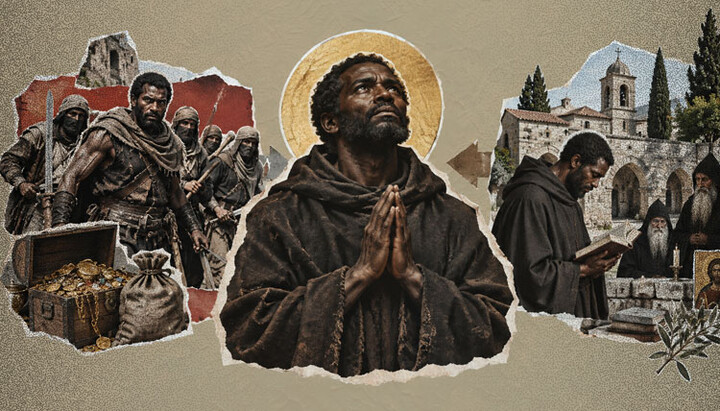
The sands of the Nitrian desert preserve the memory of distant events, when hundreds of seekers of spiritual endeavor flocked to remote Egyptian monasteries. We often think that a penitential turning point can instantly erase a person's deep-rooted habits. We imagine that turning to God instantly washes the soul, immediately transforming a fierce sinner into a dispassionate man of prayer.
The history of the ancient Church shatters these naive expectations against a stone. The life of the venerable Moses the Ethiopian reveals an entirely different reality. The liberation of his heart from entrenched passions required nearly three decades of severe labor, where every step forward was accompanied by bitter defeats, sleepless nights, and extreme exhaustion of the flesh.
The power of the Nile valley
Before coming to the Scetian desert, this Ethiopian giant struck fear into villages along the river. Bishop Palladius of Helenopolis preserved a vivid episode in the Lausiac History, revealing the superhuman strength of the future monk. Wishing to take revenge on a shepherd who had interfered with a nighttime raid, the leader of the robber band took a sword in his teeth, placed his clothes on his head, and swam across the flooded Nile at the very peak of the flood. Finding his enemy absent, he slaughtered four prize rams, ferried the carcasses back, sold the hides, and contentedly drank away the proceeds with his accomplices.
After Moses came to God, his mighty energy did not vanish. It merely changed its direction to one that was beneficial and grace-filled.
One day four armed robbers broke into the elder's cell, unaware of exactly whom they had broken in upon. The venerable one did not draw a weapon or shed blood. He effortlessly bound all four of them, hoisted them onto his shoulders like heavy sacks of straw, and brought the criminals to the church for the brotherhood to judge. The astonished robbers, recognizing in the monk the legendary chieftain of the Nile robbers, abandoned their trade, sincerely repented, and took monastic vows.
Six years of sleeplessness
However, taming the passions of the flesh proved considerably more difficult than binding robbers. Lustful thoughts tormented the young monk with such fierce force that he was on the verge of fleeing from Scetis. His experienced spiritual father, Abba Isidore the Hospitable, advised him to intensify his fasting and prayer rule.
The venerable one plunged into severe asceticism. For six years in a row he spent his nights without sleep, standing motionless in prayer in the middle of his cell.
Yet these years of ceaseless struggle brought no visible result. Lust continued to sear Moses's soul, yielding nothing to his efforts in prayer.
Then the ascetic changed his approach. He abandoned his prayerful seclusion and began secretly serving the infirm elders, going around the desert cells and carrying water from a distant spring. One night at the well the devil struck him a crushing blow with a club across the lower back. The monk, who had fallen as if dead, was found only the next morning. For a full year the venerable one lay bedridden, barely able to move, and only after this did lust finally lose its power over him.
A basket of dry sins
Thus the seasoned warrior became a teacher of meekness. Mockery of his dark skin no longer touched him. When pagans or monks laughed at his appearance, the Ethiopian elder received the insults with calm joy, feeling not the slightest offense.
When the brotherhood of Scetis gathered to judge a monk who had stumbled, the venerable Moses long refused to come to the trial. Persistent requests compelled him to rise. He took a worn basket, filled it with dry sand, hoisted it onto his back, and walked in small steps toward the assembly. In response to the questions of the astonished monks, the elder gave a simple answer: "These are my sins, pouring out behind me, yet I do not look at them, and now I have come to judge the sins of another." The brotherhood, upon hearing these words, instantly forgave the erring monk.
The end of the Egyptian elder's earthly journey was a precise fulfillment of the Gospel words. When a band of barbarians drew near to Scetis, the venerable one refused to flee. He reminded his disciples of the Savior's warning that all who take the sword will perish by the sword (Matt. 26:52). The elder blessed the brotherhood to flee to safety, while he himself remained to meet death together with seven faithful disciples. A monk who had hidden nearby witnessed seven shining crowns descend upon the bodies of the fallen monks. Thus the man who had shed blood in his youth redeemed his past through a martyr's death.
Read also
The Weeping Queen of Blachernae
On the night of the Feast of the Protection, only two people witnessed the miracle in the Church of Blachernae. Everyone else prayed and saw nothing. Yet they, too, received grace.
Deadly spiral of human hatred
The tragedy of Lebanon's civil war lays bare how dehumanization and fear can turn human beings into monsters.
Woe to expectant mothers – or to those of little faith?
God commanded one prophet not to have children, yet told his people in exile to bear sons and daughters. What does this apparent contradiction tell us today?
The help God never asked for
Uzzah wanted only to keep the Ark of the Covenant from falling into the dust. Why did this well-intentioned act cost him his life, and who was really responsible for his death?
Freedom begins when there's nothing left to take
Fear of persecutors takes root in our attachment to possessions. We turn to St. Basil the Great to understand why the prefect's threats held no power over him.
The bride in the window frame
The author of the earliest account of St. Thecla’s life was defrocked. Yet it was his book that preserved the only ancient description of the Apostle Paul’s appearance.