Young Mother and Sleeping Christ
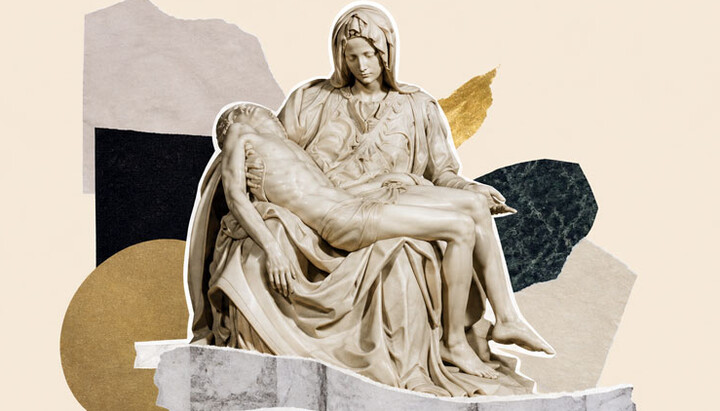
The Vatican Pietà. Photo: UOJ
In a chapel of St. Peter's Basilica, we gaze through thick glass at a sculpture of white marble. Our eyes travel upward across it as though climbing a hillside. At the bottom are heavy folds of fabric cascading over broad knees. Christ's body lies across them, His head tilted back, one arm hanging lifelessly. Above Him is the bowed face of the Mother of God – serene, contemplative, and strikingly young.
Something seems wrong. The Son of God was already in His thirties when He died. Yet His Mother looks barely twenty. How can that be? Could the great master really have made such an elementary mistake?
The most beautiful sculpture in Rome
In late August 1498, a contract was signed in Rome. The patron was French Cardinal Jean de Bilhères de Lagraulas, ambassador of King Charles VIII. He wanted a sculpture for the Chapel of Santa Petronilla at the old St. Peter's Basilica, where he intended to be buried. The contract described the commission as "a marble Pietà, that is, the Virgin Mary holding the dead, naked Christ in her arms."
The sculptor, Michelangelo Buonarroti of Florence, was just 23 years old. The young artist's guarantor was the banker Jacopo Galli, who promised the cardinal that the finished work would be the most beautiful marble sculpture in all of Rome. It was a bold promise, especially given Michelangelo's limited experience. But Galli was not mistaken.
Michelangelo personally selected the marble from the quarries of Carrara in the Tuscan mountains. The work took about a year.
The subject itself had come from far away. The Pietà was still relatively uncommon in Italy, but it was well known in northern Europe, particularly Germany, where it was called the Vesperbild, or "Vespers image." The image was associated with Good Friday worship. In these northern depictions, the Mother of God was usually portrayed as an elderly woman with a face worn by suffering. Michelangelo adopted the northern subject but gave it an entirely original interpretation.
The ageless Virgin
Why did Michelangelo portray Mary as so young? His contemporaries asked the same question. Ascanio Condivi, Michelangelo's pupil and biographer, recorded the master's explanation: "Chaste women retain their freshness much longer than those who are not chaste." The remark was recorded half a century after the Pietà was completed.
There is another possible explanation. Michelangelo knew Dante's works well. While in Bologna, the young sculptor read The Divine Comedy aloud to his patron. The final canto of Paradiso opens with St. Bernard's prayer to the Most Holy Theotokos: "Virgin Mother, daughter of your Son." Perhaps this very line inspired the sculptor's image of a Mother of God whose youth seems to defy time.
Whatever the explanation, Mary's youthful appearance was a deliberate artistic choice – and not an entirely unprecedented one.
Other artists had also depicted the Virgin as young. But in marble, beside the lifeless body of her adult Son, the contrast becomes especially striking. It is as though time itself has no power over the Most Pure Virgin.
The Virgin's enormous knees
Walk around the statue, and the entire composition reveals itself as a pyramid. Its apex is Mary's head, while its base consists of the broad folds of fabric spreading out below.
Look more closely at the proportions, and another apparent inconsistency emerges. Imagine Mary standing up. She would be more than six feet tall, perhaps considerably taller. Otherwise, the body of a grown man simply could not fit across her lap.
Michelangelo conceals this exaggerated scale beneath an avalanche of drapery. The fabric falls in heavy waves, disguising the proportions and creating the illusion that everything is perfectly balanced.
Christ's body, meanwhile, bears surprisingly few signs of suffering. The wounds from the nails and spear are barely indicated, and there are no marks from the crown of thorns. Before us lies not so much a tortured martyr as a man who has simply fallen asleep in His Mother's arms.
Now consider Mary's hands. With her right hand, she supports Christ's body through the fabric, without touching it directly. Her left hand is open, palm upward, as though inviting us to look: Here He is.
Giorgio Vasari could scarcely contain his admiration for the sculpture: "It is truly a miracle that a stone, originally without any form, could be brought to a perfection that nature can scarcely achieve in living flesh."
A signature on a sash
A narrow sash runs diagonally across Mary's chest. Carved into it are the Latin words: "Michelangelo Buonarroti, Florentine, was making this." It is the only work the master ever signed in full.
Vasari tells the story of how the signature came to be. One day, Michelangelo overheard visitors from Lombardy praising the statue and attributing it to "our Hunchback of Milan," the sculptor Cristoforo Solari. That very night, Michelangelo locked himself inside the chapel with a lamp and his chisels and carved his name into the sash.
It is a wonderful story, but scholars have their doubts. The sash falls so naturally across the Virgin's chest that it was most likely designed from the outset to accommodate the inscription.
Notice the final word: "was making," rather than "made." Ancient sculptors sometimes signed their works this way, as though leaving them forever unfinished. Against the backdrop of the dead Christ, that sense of incompletion sounds almost like a promise: the story of this masterpiece is not yet over.
Sacrilege on Pentecost
On May 21, 1972, Pentecost was being celebrated at St. Peter's Basilica according to the Western calendar. At around 11:30 a.m., a man named László Tóth climbed over the barrier. He pulled out a geologist's hammer and began striking the statue, shouting in a frenzy that he was Christ.
The attacker managed to deliver approximately fifteen blows. The Virgin's left arm broke off at the elbow, her nose was shattered, and an eyelid was damaged. A firefighter named Marco Ottaggio subdued the assailant. That same day, Pope Paul VI prayed beside the damaged statue as television cameras recorded the scene.
Restoring the masterpiece required painstaking work. The missing sections were reconstructed from dozens of fragments. The nose was rebuilt from three pieces. The forearm was secured with a steel rod. A blue mark left by the hammer on the left eyelid was removed with ordinary adhesive tape, without solvents. Fine cracks behind Mary's neck, however, were deliberately left visible as a reminder of the attack.
The sculpture behind glass
Since March 1973, the Pietà has stood behind bulletproof glass. Before that, it had traveled to New York aboard the ocean liner Cristoforo Colombo, enclosed in a steel container designed to remain afloat even if the ship sank. The sculpture arrived without a single scratch. After that journey, however, Pope Paul VI prohibited it from ever being taken abroad again.
In 2024, the old glass, which had grown cloudy over time, was replaced. The new protective barrier can withstand up to 26 direct blows from a hammer or an ax.
Yes, we can no longer approach the masterpiece up close. But we can still see everything Michelangelo intended us to see.
The youthful Mother, untouched by time. The enormous lap that holds her grown Son. The open palm. And the artist's name, followed by a verb suggesting an action never quite completed.
Every one of these apparent inconsistencies turns out to be part of a single vision: the Son has fallen asleep in His Mother's arms, and she waits calmly for Him to awaken.
Read also
Orthodox books from a Uniate printing press
In the 18th century, Uniate monks at Pochaiv printed books used in prayer by Orthodox Christians and Old Believers alike.
The story of the honey brotherhood
The Mogilev Brotherhood began with members pooling money to brew honey drinks for feast days – and eventually grew to have its own printing press.
Golgotha in the midst of a pogrom
In the autumn of 1938, the Jewish artist Marc Chagall painted the crucified Christ. Synagogues burn and refugees flee around the cross, while the Crucified One Himself is wrapped in a prayer shawl.
Stories of the Early Church. Level of governance: patriarch
How did several episcopal sees rise above the rest, why did the Church’s administrative map come to mirror that of the empire, and is the patriarchate a sacred form of Church governance?
A Chronicle without an author
We are accustomed to calling The Tale of Bygone Years the work of St. Nestor. Yet another monk left his signature on it, while the chronicle itself passed from one generation of scribes to the next.
How a wedding stopped a war
The young princess of Slutsk was married off to keep two powerful noble families from drowning the city in blood. Soon afterward, a Uniate metropolitan complained that Orthodoxy had been reborn in Slutsk.