Collapse of Babel's tower of globalism
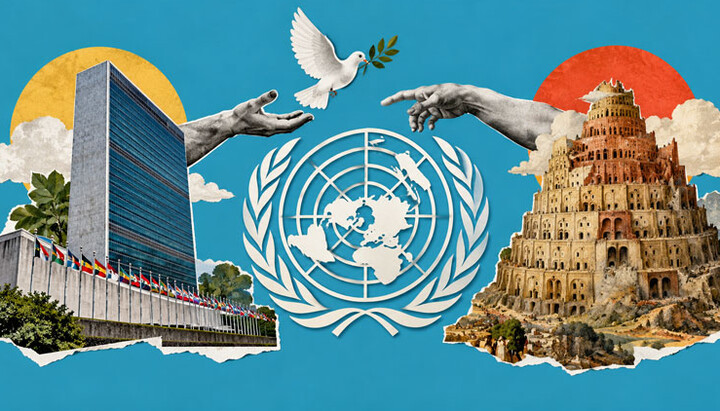
The UN Tower of Babel. Photo: UOJ
October 24 is United Nations Day. As a rule, the media sprinkle this day with empty words about a single global home. But if you strip away the pompous gloss and look at the shining UN tower through the prism of ancient history, a familiar silhouette emerges before your eyes: the Tower of Babel.
The story of that tower has been repeated at the UN almost word for word – only the scenery has changed. Instead of fired bricks, we took international conventions. Instead of bitumen, financial tranches and credit regulations. And the ancient Semitic language was replaced with the bird-like and, as a rule, deceitful language of diplomatic communiqués. But the idea itself remained the same. As before, we wanted to build a perfect paradise on earth by our own efforts, neatly showing the Creator the door.
To understand why this grandiose project regularly comes apart at the seams, it is worth rereading the eleventh chapter of Genesis. The ancient builders of Babylon went out into the plain and uttered their chief, audacious manifesto: “Let us build ourselves a city and a tower whose top is in the heavens, and let us make a name for ourselves.”
The genetic code of Ancient Babylon
In this short phrase lies the entire genetic code of modern globalism. Those people cannot be called atheists in our understanding – they were rather fanatical autonomists. Their idée fixe was to create a hermetic system of security and glory in which there is simply no place for God.
“Let us make a name for ourselves” is not merely pride; it is a hymn to human self-sufficiency. It is an attempt at a raider takeover of heaven and the substitution of the God-manhood with banal man-worship.
Only Babylon has a harsh sociological law: any unity founded on human egoism inevitably breeds squabbling and collapse. In fact, this is precisely the outcome to which this organization has come today.
The inevitable end of human arrogance
The biblical confusion of tongues was not a lightning bolt from the sky or a random natural catastrophe. It was the inevitable end of human arrogance. When people unite not for the sake of the Source of love, but for the sake of their own grandiose “self,” their interests inevitably clash.
Without a single semantic, metaphysical center, a construction site instantly turns into a farce. Yesterday’s comrades begin to speak completely different languages, cease to understand each other’s motives, and the large-scale project collapses with a crash.
The UN and all of modern secular globalism have stepped on the very same rake at full tilt. Yes, it was originally conceived as a noble attempt to keep the world from a third world war after the horrors of 1945. But gradually the system degenerated into a messianic project for assembling a “brave new world” on the basis of secular humanism.
Yet, having severed its Christian roots, this humanism is left hanging in the air, and the world has once again approached the brink of a war far more terrible than all the wars that have come before.
The sacred roots of human dignity
Let us take the main nerve of the modern world order – human rights. In the secular textbook they are presented as something self-evident. As if clever people gathered, agreed to regard one another as valuable, and neatly recorded it on paper.
But this logic has a fatal flaw: what was created by a paper agreement can be crossed out by that same agreement. If the value of human life is not rooted in a vector from above, but rests only on the temporary consensus of officials, it turns to dust at the first change in the political weather.
The whole bloody twentieth century showed with frightening clarity: as soon as the notion of the sacred is washed out of society, a human being instantly turns into a resource, an expendable material, or a figure in a report. Modern life illustrates all of this for us with frightening obviousness.
The Christian view of man is arranged in an absolutely different way. The rights and dignity of the person are inviolable not because experts in Geneva or New York decided so. But because the image and likeness of God is imprinted in each of us.
Christianity in its time carried out a colossal revolution: every human being – a homeless person, a sick person, a feeble person, one useless for the economy – possesses absolute, infinite value. For him the Blood of the God-Man was shed.
The secular world, however, has tried to take for itself the bright Christian fruits – compassion, equality, rights – throwing away the Tree itself as unnecessary. For a while the plucked apples remain juicy by inertia. But without nourishing roots they inevitably begin to rot, turning into their own poisonous opposite – when “rights” become a cudgel and an ideological battering ram.
Conciliar unity instead of unification
In Christian culture, the main antithesis to the Tower of Babel is the Day of Holy Pentecost – the descent of the Holy Spirit upon the apostles.
Babel tries to unite people through leveling, the steamroller of unification, and the erasure of nations, turning humanity into an ideal, obedient biomass. Pentecost acts in exactly the opposite way.
When the apostles began to speak in different languages, no one abolished those languages or forced them to be replaced with a universal Esperanto. Each people heard the main message in their own native, living tongue. Pentecost does not destroy diversity but sanctifies it, creating sobornost – a deep unity in love, where each unique person becomes part of a single whole.
The true peace of a purified heart
Secular institutions are fundamentally incapable of this. They know how to work only with the outer shell: laws, articles, economic incentives. But the root of wars and cruelty lies not in the absence of the right articles in international law, but in the human heart!
Secular ethics long tried to build peace on the basis of “rational egoism”: simply put, war is not profitable. But this naive logic is shattered to pieces every time irrational human passions burst out. Before them, secular humanism is absolutely powerless – for it simply denies the very existence of sin.
Does this mean that we should burn all bridges and abandon international dialogue? By no means. In our broken world, even imperfect secular institutions work as a braking system, keeping society from finally sliding into utter chaos. Supporting initiatives that save people from hunger and war is the direct duty of every Christian.
But it is vitally important to remain sober and not to make an idol of yet another secular utopia. The task of the Church is to remind the world without embarrassment: a lasting peace cannot be built on the foundation of human pride. True peace is not merely a temporary pause between shellings, but the spiritual fruit of a purified heart. Human rights need a reliable metaphysical anchor, and true unity is found not in a global anthill, but in the Catholic (Sobornaya) Church.
The one cornerstone of human history
When the builders of Babel scattered, their unfinished walls long towered above the desert as a silent monument to human folly. Today's project of a global peace without God is likewise becoming covered with deep cracks and collapsing right before our eyes.
Looking at these ruins of illusions, the Christian heart is filled not with malicious glee, but with sincere compassion. For when man-made towers fall, humanity is left with the One Stone that the builders once rejected, but which alone is able to hold this world together – Christ.
Read also
Archpastor's word for weary city dwellers
When exhaustion weighs us down, we turn to ancient sermons to ask profound questions about human destiny and the nature of existence.
Brother of tax collector and brother of Lord
The Gospel is silent about the son of Alphaeus, and commentators have argued for centuries over who he was. And the Church commemorates two apostles named James in close proximity.
Prayer commemorations instead of loving embraces
At every Orthodox wedding, the choir sings a hymn to the martyrs. For families separated by war, these words carry a special meaning.
Honest atheism vs. spiritual hypocrisy
The 70th anniversary of Albert Camus’s Nobel Prize recalls an uncompromising challenge to Christianity. An honest unbeliever brings theology back to the mystery of the Cross.
The valley of trouble and the gateway of hope
One soldier buried an expensive cloak and some gold beneath his tent. Because of this, all Israel lost a battle. Why did one man’s sin bring disaster upon an entire nation?
From love spells to bishop's throne
Antioch’s most powerful sorcerer sent demons against a devout young Christian woman three times – and failed every time. In the end, a demon himself revealed the truth that led to his conversion.