
Shroud and linen cloth: what links two episodes in Mark
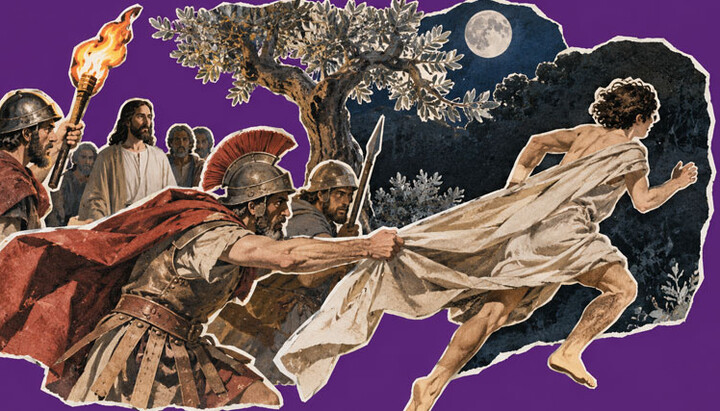
В руках воинов остается кусок льняной ткани, а ее хозяин исчезает в темноте. Зачем евангелист Марк сохранил эту короткую сцену в рассказе о Страстях Господних?
It happened on the hardest night in the Gospel story, when armed men came to the Garden of Gethsemane with lanterns and torches (John 18:3). The disciples fled in fear, and it seems that the narrative should move straight to the trial in the courtyard of the high priest. But the Evangelist Mark suddenly pauses and writes two short lines that appear in no other Gospel.

"Then all forsook Him and fled. And a certain young man followed Him, having a linen cloth thrown around his naked body. And the young men laid hold of him, and he left the linen cloth and fled from them naked" (Mark 14:50–52).
This scene stands out from the usual flow of the narrative. It does not move the plot forward and does not explain the theological meaning of what is happening. Who is this man who, on a cold night — so cold that in the courtyard of the high priest the servants made a fire (John 18:18) — found himself in the garden without outer clothing?
The cloth in which he was wrapped is called a "sindon." This was the name for thin linen fabric. The dead were wrapped in it, but it also served as a light covering over a bare body or as an ordinary sheet. Most likely, the young man was awakened by the alarm of the night: he hastily threw on the first thing that came to hand and ran out at the noise. The soldiers took him for one of the disciples and seized him by the edge of the cloth, but he slipped free and vanished into the darkness.
The Mystery of the Nameless Young Man
The Evangelist does not name this man, and Church interpreters have tried for centuries to understand who he was. The Church has no definite answer to this question, but several versions have taken hold in Tradition and in commentaries.
The best known of them connects this episode with the Evangelist Mark himself. It is supposed that he lived not far from the Upper Room of Zion — perhaps in the very house where Christ celebrated the Last Supper. Blessed Theophylact of Bulgaria cautiously remarks: "This young man was probably from the house in which they ate the Passover." If we allow that the young John Mark heard Jesus and His disciples go out into the night, and later saw a band of men with torches, his impulse is understandable.
In that case, the two lines in the Gospel look like the modest signature of an author who did not dare to place his own name beside the name of the Teacher, but could not keep silent about his presence.
However, the ancient Fathers proposed other names as well. Saint Epiphanius of Cyprus, and following him some other commentators, thought that this young man could have been the righteous James, the Lord's brother. Saint Ambrose of Milan and Saint Peter Chrysologus saw in him the beloved disciple of Christ, who did not want to leave the Savior even when the others had already fled. In more recent times a fourth hypothesis has also been put forward — that it was the resurrected Lazarus who followed Jesus.
None of these versions has been conclusively proven. But the very variety of them shows how strongly this brief detail has affected readers in every age.
The Concealment of the Eyewitness
If we set aside for a moment the dispute over names, another question arises: where did this detail come from in the first place? There is nothing heroic in it. The man did not defend the Teacher, did not enter into a struggle with the persecutors, but simply abandoned his garment and ran away. There would have been no point in inventing such a story merely for effect. This means that only one person could have told it — the participant in the event himself.
Why, then, did his name not make it onto the pages of the Gospel? In scholarship, this device is called "protective anonymity." The oral tradition of Christ's Passion took shape in Jerusalem in the first years after the Resurrection. The city was still home to people who had taken part in the arrest, had sat in the Sanhedrin, and remembered that night.
To name the man whom the guards tried to seize together with Jesus would have meant bringing misfortune upon him.
That is why, in the early account of Christ's last days, not only the young man in the linen cloth remained nameless, but also, for example, the man who cut off the ear of the high priest's servant. By the time the Gospel was written down, the danger to the witnesses may already have passed, but the established tradition preserved a cautious reticence.
One Cloth for Two Days
There is one more detail in this episode that is not immediately noticeable in the Russian translation of the Gospel. The Greek word "sindon" occurs in the New Testament only six times. The same Mark uses it again shortly afterward — just one chapter later, in the account of the burial of the Savior.
When Joseph of Arimathea asks Pilate for the Body of Jesus, he, "bought fine linen, and wrapped Him in the linen" (Mk. 15:46). In the Synodal translation, two different words stand here — "pokryvalo" (covering) and "plashchanitsa" (shroud). But a reader of the Greek original hears one and the same word.
On the night of the arrest, the young man leaves the linen cloth in the hands of the soldiers in order to save his life. The next evening, the lifeless Body of Christ is wrapped in a similar linen cloth. And on Pascha morning, the women who come to the tomb will again see a "young man," but now sitting on the stone in a white garment (Mk. 16:5).
Whether this is a chance coincidence of words or the subtle design of the evangelist, each reader decides for himself.
We will never learn the name of the man who slipped out of the guards' hands in the darkness of the Garden of Gethsemane. But in this brief story one can still feel the nerve of that night: fear, bewilderment, and an attempt to remain with Christ even when everything around is collapsing.