

Who is Gehazi and why is he mentioned in the Great Canon of St. Andrew of Crete?
The Great Canon of Repentance mentions dozens of names, many of which mean nothing to modern people. One of them is Gehazi.
At the very beginning of Great Lent and in its fifth week, the Great Penitential Canon of Andrew of Crete is read in church. The reading of the canon evokes deep penitential feelings in the participants of the services. This is not surprising, since its author, Andrew, Bishop of Crete, theologian, and participant in the Sixth Ecumenical Council, was known among his contemporaries as a sincere man of prayer, possessing a bright gift of eloquence.
This was a highly educated man who received his initial knowledge in rhetoric and philosophy in Damascus, and then in the Jerusalem monastery of Saint Sabbas the Sanctified studied the works of the Church Fathers and Holy Scripture. It is no coincidence that the Penitential Canon contains so many references to Holy Scripture and, in particular, to the Old Testament. These references were well understood by the monks of that time, but are not so obvious to us, unlike the penitential feeling that has passed through the centuries and still brings tears to the eyes of our contemporaries today.

Figures of the canon: Hophni, Phinehas and others
The canon contains many dozens of names. We have heard of many of them, for example, the psalmist David, the prophet Elisha, Moses and Aaron. The path of each of them was accompanied by great trials and inner struggle, which was not easy but ultimately led them to God. But there were others about whom we know little. In the Old Testament they are mentioned as sinners who violated God's will and did nothing to correct their path. Who are Hophni and Phinehas, Ahithophel? Who is Gehazi?
Saint Andrew compares himself and us with them – with those who have not yet embarked on the path of repentance.
One could, of course, object that the words of the canon's author were addressed to the monks of that time, and the path of monasticism suggests renouncing the world and cultivating a penitential feeling. But if any Christian looks into their own soul, what will they see there?
Learning more about the figures of the Great Canon, we will see ourselves better, because there are things that do not depend on the time when this or that text was written, they are eternal and relevant for each of us. The example of Gehazi, who lived in the time of the prophet Elisha, is just such a case.
Gehazi: a servant of the prophet and "vile mind"
Gehazi, or Gechazi (Hebrew – "valley of vision"), is mentioned in the Fourth Book of Kings as a companion and servent of the prophet Elisha, and in the Great Canon of Andrew of Crete his assessment is quite unflattering:
"You have always imitated the vile mind of Gehazi, O wretched soul. Rid yourself of his love of money, at least in old age; escape from the fire of Gehenna, by leaving your evil ways."
The Old Testament story tells that the prophet Elisha was grateful to a wealthy woman from Shunem for her hospitality. Gehazi drew the prophet's attention to the fact that the Shunammite's husband was old and she was childless. Then Elisha told the woman that her reward would be a son. But after a few years, the long-awaited child became ill and died. Then the Shunammite went to Mount Carmel and fell at Elisha's feet.
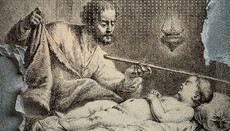
The prophet commanded Gehazi to run ahead and gave him his staff to place it on the boy, while he himself went with the child's mother. On the way they met Gehazi, who said that he had placed the staff directly on the child's face, but the boy did not wake up. Then the prophet Elisha raised the boy himself.
Leprosy for silver
In the next chapter of the Book of Kings we meet Gehazi again. The prophet healed the wealthy Syrian commander Naaman of leprosy, but took no money for the healing. Gehazi, however, returned to Naaman and in the prophet's name asked for payment, taking two talents of silver – a large sum for those times even for a commander – and two changes of clothes.
He hid what he received, reasoning that the wealthy Syrian would not miss it, and that he and his teacher would always find money and clothes useful in their wanderings, and besides, this money could be kept for himself and he could live well in the future. Then he came to Elisha empty-handed. Even when Elisha asked him: "Where have you come from, Gehazi?" he did not confess that he had gone anywhere.
As punishment for greed and deception, Gehazi and his descendants were struck with leprosy: "The leprosy of Naaman shall cling to you... And [Gehazi] went out from his presence a leper, white as snow" (4 Kings 5:27). In addition, he lost the honor of serving the prophet Elisha.
A story with an open ending
It would seem that this act of just retribution ends the story, but at the end of the Book of Kings we meet Gehazi again. He tells King Joram about the miracle with the Shunammite's son. In the 8th chapter of the Fourth Book of Kings he is again called "servant of the man of God."
This is a story with an open ending. It is unlikely that anyone would have let a leper into the royal chambers and allowed him to speak with the king.
Scripture is silent about what happened from the moment when Gehazi justly received punishment from the prophet to his later appearance in the royal court. And this gives hope to us as well.
Gehazi resembles a modern person: he is undoubtedly intelligent, and even the prophet Elisha listens to him; he is observant. Gehazi tries to carry out the prophet’s wishes, although he does not always succeed. He is practical and greedy, for which he was punished. At the same time, he is spiritually immature: lacking in mercy, not always honest, and he does not consider it a sin to lie to a pagan, and later not only to a pagan but even to God’s prophet.
Saint Andrew of Crete used the story of Gehazi to show how the disease of the soul destroys a person and how important repentance is. He calls for abandoning the passion for gain at least in "old age" (spiritual maturity or at the end of life) in order to "escape from the fire of Gehenna," which is symbolically associated with the leprosy that afflicted Gehazi because of his sin.