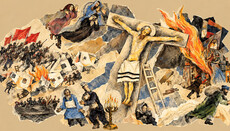

Why is there no Resurrection itself in the icon of the Resurrection?
Western painting depicts triumph, while the Orthodox icon stands still before mystery. The empty cave and abandoned burial cloths speak of God more than any attempt to portray the miracle itself.
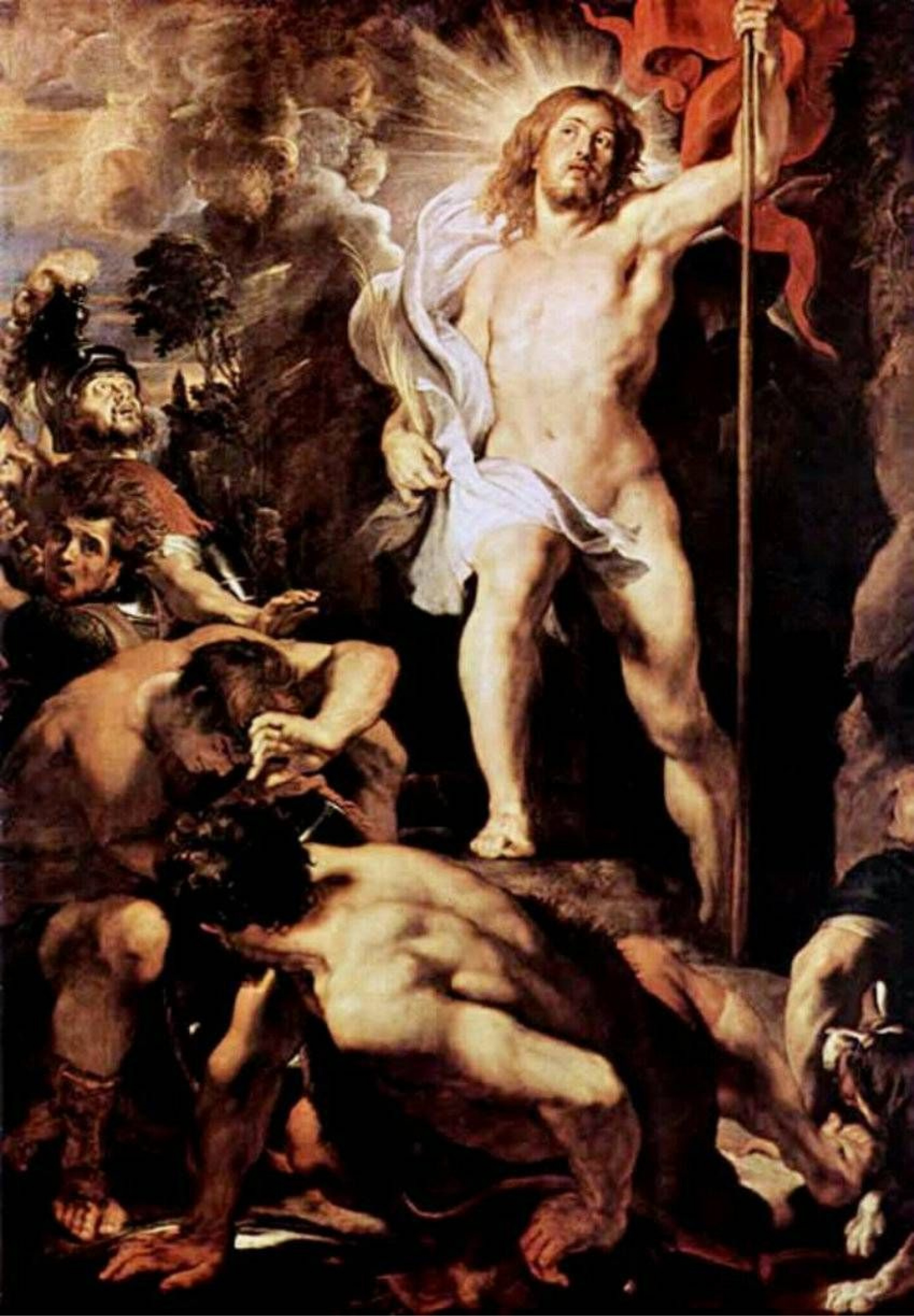
In world art, there are two different paths leading to the same Jerusalem cave. In the first hall of an imaginary gallery, we encounter canvases of Renaissance masters or magnificent Baroque. Here the Resurrection is captured as a resounding victory. Christ in the paintings of Titian or Rubens is like an ancient athlete: He powerfully rises from the open tomb, His muscles are tense, His garments flutter, and in His hand He holds a banner. The guards scatter in all directions, blinded by the radiance emanating from His body. This triumph is depicted as visibly as possible – as a force that can be measured by the eye. This is a celebration of visible might.
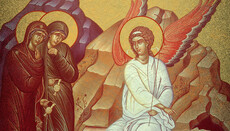
In the second hall, a different atmosphere reigns. Before us is an Orthodox icon of the Myrrh-bearing Women at the Tomb. It often appears small and darkened, but its composition strikes with its austere tranquility. In the very center of the icon we see not the figure of the Victor, but a dark, frightening opening of the cave, inside which the abandoned burial cloths gleam white. On the right, an angel sits on a stone, slightly leaning toward the women who have come. The women themselves stand frozen in hesitation, their hands pressed to their chests. The movement has stopped
In this icon, you will not find the very moment of Christ’s emergence from the tomb. The icon painter does not depict the process of the miracle. He has captured only its aftermath: the empty place of burial, the bewildered witnesses, and the silence that briefly filled the world before the universal rejoicing.
Shrouds as evidence
The women went to the cave early in the morning, when twilight had not yet dispersed. In their hands were heavy vessels with aromatics – myrrh and aloe. The myrrh-bearing women were eager to fulfill a bitter duty. They needed to anoint the dead body, to finish what they had not managed to do on Friday because of the approaching Sabbath. They were prepared to meet death, for death is what we know how to understand, formalize in rituals, and mourn.
Instead of the familiar burial peace, they were met by an empty niche.
The Evangelist John preserved a detail that artists have depicted with special care for centuries. When the Apostle Peter entered the tomb, he saw the linen cloths lying there, and the cloth that had been on Christ's head lay separately and was folded. This detail becomes important testimony.
.jpg)
In many old icons, the shrouds inside the cave are depicted so that they retain the shape of a human body. They look like an emptied cocoon. The body was tightly wrapped in linen strips soaked with a viscous resin-based mixture. The Gospel mentions the approximate weight of these spices – about thirty kilograms. In the air, such a mixture quickly hardens, turning the cloth into a rigid shell.
If someone had stolen the body, they would have carried Him away together with these shrouds. To unwrap Him in the darkness, tearing the adhered fabric from the wounds, would have been senseless and time-consuming. But the shrouds remained lying untouched. He who had been enclosed in them passed through them without breaking their form. The iconographer depicts this empty cocoon as a testimony to an event that took place beyond the limits of our world. The shrouds remained in place, while the One who had been in them had departed.
Why the Angel rolled away the stone
In church tradition, it is accepted that the Resurrection was accomplished in absolute secrecy, when the entrance to the cave was still closed. Christ left the tomb without moving the stone, just as later He would enter to His disciples through closed doors.
Why then did the angel descend and roll away the heavy boulder?
Ancient scholars of the Church, for example Saint John Chrysostom, speak of this simply. The stone was moved aside for the women. They needed to go inside and see with their own eyes: there was no body in the tomb.
The angel opens the entrance for us, people, so that we might become witnesses of the miracle.
At the very moment of the event, there was not a single observer nearby. God accomplished His work in the complete silence of the closed cave. The guards stood outside, they saw nothing. The iconographer possesses remarkable chastity: he depicts only what was revealed to man. He does not try to fill the lack of information with his fantasy. He stops at the threshold of mystery, beyond which no mortal has looked.
Why the icon does not show Christ
This is where the difference between two approaches to the image lies. The Western artist fills the gap with his own imagination. He creates an image of victory that is understandable to us: bright light, defeated enemies, a majestic pose, etc. This is the language of earthly triumph, transferred to Heaven.
The Orthodox iconographer chooses the path of God's voluntary humiliation. He shows us the Creator who renounces any outward display of power. The semantic center of the icon is a dark hollow in the rock, where there is nothing.
It is unusual for us to look for the absence of the main Figure at the center of an image. The gaze wanders, trying to catch hold of an object, but finds only the abandoned shrouds.
This emptiness conveys the essence of what happened more accurately than any external effects. This is space that has been freed because Life can no longer be held in a stone chamber. There is no Christ in the icon because now He abides both everywhere and with each of us at the same time.
Faith in silence
The women in the icon are the only people who came to the Tomb without any claims. The disciples had scattered, Peter had denied Him, the men to one degree or another had expected earthly success from Christ. They dreamed of a leader who would come to power and restore the state. When Jesus died, their ambitions died with Him.
The women, however, went out of a feeling of love. They did not expect victory, they went to serve the Dead One. They did not demand a miracle, and therefore the miracle was revealed to them first.
The angel in the icon points with his hand inside the cave. His gesture is directed toward the shrouds. He says: «He is not here». The women freeze, trying to understand what they have heard. The painter draws their poses with caution: there is no loud exaltation in them, only a quiet trembling and bewilderment. It is a state for which our language still has no precise name.
The iconography of the Myrrh-Bearing Women teaches us an important skill: to regard the absence of something as the main proof.
The most important event in history remained off-screen. Ancient masters preserved this as a given, trusting the unknown more than visual effects.
The dark hollow of the cave, the neatly folded cloths, and the angel pointing into the emptiness all tell us one thing. True faith begins where we agree to acknowledge God’s omnipotence when all familiar hopes have collapsed and new ones have not yet appeared. We are invited to enter this emptiness of the cave after the women and to find there a Life that does not need banners to confirm its victory.