




About how the UOC Council in Feofania "turned into a disorderly gathering"
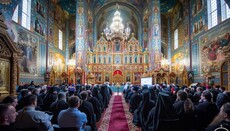
All insults directed at the Council – as if it were a «gathering», «filth», «scum» and so forth – are based not on canons and not on facts, but only on the emotions of their authors.
May 27 marked the anniversary of the UOC Council – and it sparked another wave of criticism from a number of ROC clergy and some Telegram channels. One of the most common accusations against the Council sounds like this: it was convened in violation of statutory norms. Delegates allegedly should have been elected separately, whereas in Theophania an ordinary assembly was initially convened, which had no authority to make any decisions. Hence the conclusion: since the Charter norms were violated, there was no Council in Theophania, and its resolutions are worthless – it was a "disorderly gathering."
Is this so? Let's figure it out.
The procedure for electing delegates to the Council is not prescribed in the UOC Charter. It only states that the Council is convened by the Primate, and the procedure itself is determined by the Synod. And when the assembly concluded on May 27, 2022, at which bishops, clergy and laity discussed current issues, Metropolitan Onuphrius proposed to hold a Council right there, on that very day.
Metropolitan Victor (Kotsaba), who was then vicar of the Kiev Metropolia, recalls:
"When His Beatitude put this question to a vote and all the hierarchs, all the participants of the assembly voted – they thereby testified that those present become delegates of the UOC Council."
Then, according to the UOC Charter (section 2, paragraph 4), a Synod took place, which approved this decision. Thus, everything that happened on May 27, 2022, fully complied with the Charter: the Primate convened the Council, the Synod approved the procedure for electing delegates, the Hierarchical Council approved the list of issues for the Local Council – and, finally, the Council itself took place.
Yes, in peaceful times one could have acted differently: dissolve the assembly, convene the Synod in a month or two, and then after some time convene the delegates again – now for the Council. But everyone remembers well that these were the first months of the war, when mass seizures of churches had already begun, and a real persecution of the Church was unfolding in the media. And with a repeated convocation, many delegates might simply not have been able to reach Kiev.
That is precisely why, as Metropolitan Victor emphasizes, "in many dioceses delegates to the assembly were determined as if they were then to participate in the Council." And even if it wasn't so everywhere – it's clear that even with separate "conciliar" elections, the same people would have traveled to Kiev. Simply because there are not so many active laypeople and priests in our dioceses.
It turns out that all the insults directed at the Council – as if it were a "gathering," "filth," "foam" and so forth – are based not on canons and not on facts, but only on the emotions of their authors.
And here a natural question arises: what is all this for? Could absurd criticism and insults really help the UOC become stronger and more united, help the Church withstand pressure from the authorities and the OCU? Or is the goal directly opposite? The answer seems obvious. But let everyone answer it for themselves.