
Ternopil post on Feast of Intercession: Has calendar reformn failed?
A significant number of believers have rejected the new church calendar introduced by the OCU and UGCC with government support.
One of the authorities' main arguments for imposing the new church calendar was that it would promote national unity. The claim was that the change would bring Ukrainians closer together and benefit the country.
Only a large-scale, objective sociological study can determine whether Ukrainians have actually become more united. But there are signs that, rather than delivering the promised unity, the new calendar has only created new divisions.
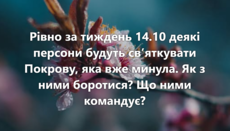
Consider this example. KISTO, a pizzeria in Ternopil, posted the following message on Facebook:
“In exactly one week, on October 14, certain people will be celebrating the Feast of the Intercession, which has already passed. How do we deal with them? What drives them?”
KISTO's Facebook page is hardly popular. Its posts typically receive no more than a dozen likes and a couple of comments. Yet within 24 hours, its post about the Feast of the Intercession had attracted more than 2,500 reactions and nearly 5,000 comments. Clearly, the issue has struck a nerve, sparking heated debate.
And the overwhelming majority disagreed with the author. Some 86% of commenters opposed the post's position. They advised the author to fight on the front lines rather than against believers, pointed out that Jerusalem and Mount Athos celebrate the Intercession on October 14, and recalled that their parents and grandparents had always observed the feast on that date. Many sarcastically suggested that people might as well change their own birthdays while they were at it.
Only 3% supported the author, and their “arguments” consisted largely of insults directed at those celebrating on October 14: “Putin's lackeys,” “Russian sympathizers,” and “Moscow priests.” Some called for these people to be “put on a list,” “stripped of their rights,” or, in reference to UOC believers, “sent packing to Russia.” Another 11% of the comments were neutral or unrelated to the issue.
Significantly, the post was aimed at a Ternopil audience, where UOC communities are few and far between, while the UGCC and OCU, both of which have adopted the new calendar, predominate. Both the authorities and representatives of these denominations insist that virtually everyone has embraced the new calendar. Yet the comments from Ukrainians paint a completely different picture.
What conclusions can we draw? Three very simple ones.
1. A significant number of believers have not accepted the new calendar introduced by the OCU and UGCC with government support.
2. It has brought no “unity” whatsoever. Quite the opposite: it has created yet another fault line dividing Ukrainians, as the clashes in the comments clearly demonstrate.
3. The seizure of UOC churches does not mean that UOC believers have disappeared. They continue to worship as their ancestors did and have no intention of joining another denomination.
Once the authorities grow tired of playing the church card, the results of their church reform may prove even more dismal than they appear today.