Why is Jerusalem “wrong” about OCU, but Constantinople isn’t?
In the eight years since the OCU was established, we have never once heard its leader suggest that the Patriarch of Constantinople is capable of error.
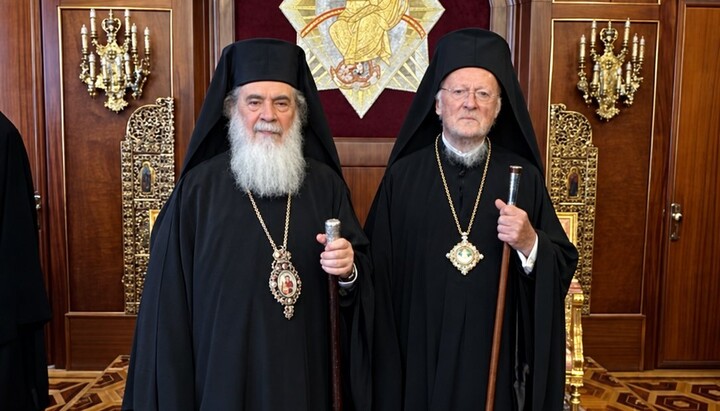
OCU head Serhiy Dumenko has publicly criticized the Patriarchate of Jerusalem. According to him, the Church of Jerusalem and several other Churches are making a mistake by refusing to enter into open communion with the OCU. Dumenko also explained why he brought up the Jerusalem Patriarchate in the first place.
Apparently, the problem is that the authority of this Church is frequently invoked by those he calls “the new false brethren of our Local Church” in the ongoing dispute.
Dumenko summarized his opponents’ argument as follows: only recognition by the Church of Jerusalem and communion with it can determine which Church is genuine and which actions are canonical.
He did not explain who these “new false brethren” are or what makes them “false.” From the context, however, it seems reasonable to assume that he was referring to the clergy and faithful of the Ukrainian Orthodox Church. Indeed, one often hears within the UOC that the refusal of the oldest Local Orthodox Church to recognize the OCU speaks for itself. The authority of Jerusalem is also frequently cited by those who oppose switching to the new calendar and celebrating, for example, the Protection of the Mother of God on October 1 rather than October 14, or Christmas on December 25 rather than January 7.
Dumenko stresses that there is no special status of being “chosen” in the New Testament Church and that any such notion reflects “a misunderstanding of Christian teaching.” Although the Church of Jerusalem was historically the first to be established, he argues, its authority and historical significance do not make it the source of truth. “The source of truth is not any particular Local Church, but Jesus Christ,” he maintains.
The OCU leader goes on to say that the Patriarch of Jerusalem is an ordinary human being, equal to other hierarchs and just as capable of making mistakes. In other words, Dumenko is advocating the equality of the Churches, under which the antiquity of a particular patriarchate – in this case, Jerusalem – confers no special status or privileges upon it.
That argument might be perfectly reasonable were it not for the OCU leader’s glaring double standard. While denying the Patriarch of Jerusalem any special standing, he readily grants precisely that to the Patriarch of Constantinople.
In congratulating Patriarch Bartholomew on the 35th anniversary of his patriarchal ministry, Dumenko describes him as “a merciful shepherd to Orthodox Christians throughout the world.” On another occasion, he calls him “an example of bearing witness to the truth.”
And the central argument advanced by the OCU leadership and its supporters has always been the same: their Church was established not by just any primate, but by the Ecumenical Patriarch himself – the first among Orthodox hierarchs. In their view, this is precisely what gives Dumenko’s organization its special standing.
Yet in the eight years since the OCU came into existence, we have never once heard its leader suggest that the Patriarch of Constantinople might be mistaken.
So the oldest Church in Christendom, the Church of Jerusalem, is not a source of truth and is apparently in error because it refuses to recognize the OCU. Meanwhile, the primate of the Church of Constantinople, which emerged in the fourth century, is held up as “an example of bearing witness to the truth” – with not a word about the possibility that he, too, might be wrong.
So much for ecclesiology.