Metю Luke to Yelensky: OCU answers to Phanar, yet UOC is called dependent?
Yelensky incorrectly claimed that the Russian Church’s charter establishes its dependence on Constantinople.
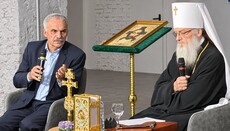
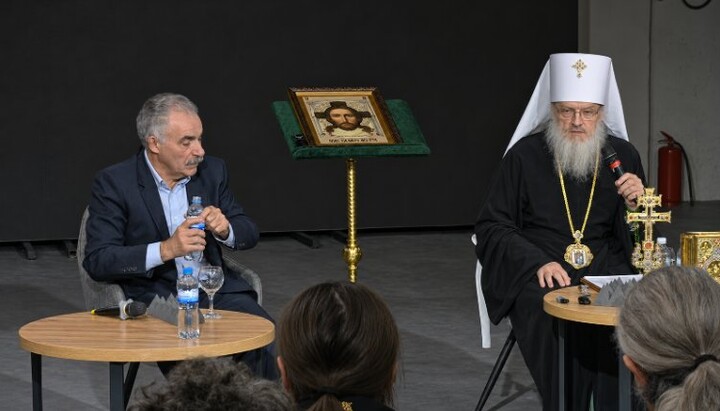
Metropolitan Luke of Zaporizhzhia and Melitopol asked Viktor Yelensky, head of the State Service of Ukraine for Ethnopolitics and Freedom of Conscience (DESS), why the Ukrainian government considers the OCU independent despite its subordination to the Phanar in Istanbul, while treating the self-governing UOC as dependent. The exchange took place on November 13 in Zaporizhzhia during a meeting between the DESS chief and clergy of the UOC's Zaporizhzhia Eparchy.
The metropolitan read aloud a question submitted by the eparchy's clergy. The priests pointed out that the government accuses the UOC of dependence on a foreign religious center, even though it is fully self-governing. At the same time, officials welcome direct interference by the Patriarchate of Constantinople in Ukraine's internal Church affairs.

"Are you aware, as a scholar of religion, that under the terms of the Tomos, the OCU is not permitted to prepare its own holy chrism, cannot establish parishes abroad to minister to millions of Ukrainian refugees, and that the highest court of appeal for the OCU and its bishops is Patriarch Bartholomew, a Turkish citizen?" the question read.
Another eparchial cleric asked why the authorities portray complete subordination to the Phanar, along with the transfer of ancient Ukrainian holy sites to its jurisdiction as stavropegia, as spiritual independence, while declaring the UOC's actual independence a threat to national security.
Yelensky responded that the priests were well acquainted with the OCU's Tomos but less familiar with the charter granted to the Russian Orthodox Church.
"It also says that the Patriarch of Constantinople is above everyone," the official insisted. Yelensky did not specify where exactly the charter contained this disputed provision.
"Whether you call him a Turkish citizen or not changes nothing. He granted the OCU a Tomos on certain conditions: that they do not prepare their own chrism, that their territory is limited to Ukraine, and some other conditions," the official said.
The DESS chief added that the Phanar had granted Tomoses to "the overwhelming majority of Orthodox Churches" under varying conditions. He cited the Russian and Bulgarian Churches as examples. According to Yelensky, the Bulgarian Church obtained patriarchal status through pressure from the Politburo of the Central Committee of the Bulgarian Communist Party.
Metropolitan Luke replied that all decisions within the UOC are made exclusively in Kyiv.
"Everything in our Church is decided in Kyiv. In the OCU, decisions are made in Istanbul. Why is Istanbul considered independence, while Kyiv is considered dependence?" the hierarch asked.
Yelensky called it "untrue" that the OCU's Tomos and Statute give Constantinople the deciding vote. He also insisted that "Constantinople should decide everything in Moscow as well."
"Wait, wait. It says there [in the charter granted to the Russian Orthodox Church] that everyone must recognize the Patriarch of Constantinople as their head," the official told Metropolitan Luke.
According to Yelensky, "in all the documents [concerning the Russian Orthodox Church], Constantinople says it is in charge." He cited the charters of 1589 and 1593.
However, the documents cited by the DESS chief contain no such provisions.
The 1589 charter establishing the Moscow Patriarchate says nothing about the Patriarch of Constantinople having authority over the other Churches. It refers to Patriarch Jeremiah II as the "Ecumenical Patriarch" and "father of fathers" and requires the newly appointed Moscow patriarch to notify Constantinople of his installation. It contains no language declaring Constantinople to be "above everyone." Moreover, the document was drawn up in Moscow by the tsar's chancery in the name of Tsar Feodor Ioannovich.
The acts of the Council of Constantinople in 1593 were signed by the Patriarchs of Constantinople, Alexandria, and Jerusalem. The council recognized the Patriarch of Moscow as a "brother" of the Orthodox patriarchs, "equal in rank and dignity," and assigned him fifth place in the diptychs, after the Patriarch of Jerusalem.
The word "head" does appear in the council's acts, but it refers to Moscow. Citing Apostolic Canon 34, the Patriarch of Moscow is described as the "head of the entire region of Moscow and all Russia."
As for Constantinople, the council merely reaffirmed its privileges of honor equal to those of Rome, citing the ancient canons. The acts contain no requirement for Moscow to seek Constantinople's approval when appointing future patriarchs, nor do they grant the Phanar any right to hear appeals.
The provision Yelensky referred to appears in a different document – the OCU's 2019 Tomos. It explicitly states that the OCU "recognizes as its head the Most Holy Apostolic and Ecumenical Throne."
The Tomos grants all OCU bishops and clergy the right to appeal to the Ecumenical Patriarch. It also requires the Metropolitan of Kyiv to consult the Phanar on major ecclesiastical, doctrinal, and canonical matters.
The OCU receives its holy chrism from Constantinople, and its jurisdiction is limited to the territory of Ukraine. According to the Tomos, the OCU's Statute must "in all respects comply with its provisions."
Furthermore, the first article of the OCU's Statute states that the Church is "inseparably united" with the Church of Constantinople and is connected to the other Churches only through it.
As the UOJ previously reported, Yelensky promised to protect public-sector employees who are pressured into attending meetings to transfer their religious communities to another jurisdiction.