



In the Main Unity, in the Rest Freedom, in all Love: the Dialogue between the UOC and UAOC
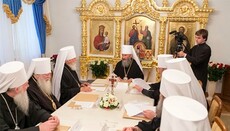
The church schism in Ukraine is a bleeding wound on the body of Christ. Christians who are in canonical isolation do not even know how many soul-saving benefits they deprive themselves of. This is one of the main reasons for the decision of the Holy Synod on the resumption of the dialogue with the Ukrainian Autocephalous Orthodox Church.
If the Church is the mother for all the faithful Orthodox Christians, those who are outside the "Mother Church" are deprived of its "milk", which gives "immunity". In church terminology this is the immunity against delusions as Orthodox Church Fathers call the extreme mispersuasion, the immunity against distorted faith, against the false beliefs on the nature of faith and its practices.
Canonically isolated churches often put forward the belief that they have the same things as in the other local Orthodox churches.
In fact, they do not have the most important thing- the Eucharistic unity with the fullness of Orthodoxy! Have parishioners of the UAOC ever thought over the words about the Church from the Symbol of Faith? Which Church Orthodox Christians believe in? The "national"? But there is no hint in the Creed of the fact that the Church is decisive for its national identity. If you take the original Greek Symbol of Faith, the words of the Church sounds like this: "I believe in one, holy, catholic and apostolic Church." Catholic! Neither national, nor ethnic or folk, but catholic, universal. If you use modern language in regard of the Church - the Church is an international organization with headquarters "on the right hand of God". And separate local churches are its regional offices.
Have adherents of national isolationism ever thought of what they lose, focusing only on the ethnic dimension of their church? After all, fellowship with other local churches is expressed in various forms and in a variety of events. This includes exchange of Orthodox relics, some of which are brought only once in many years. Think of the following: some relics may be brought to a particular local church once in decades! And such a rare event is an outstanding and unique spiritual happening for the faithful Christians of Ukraine. The writer remembers a lasting impression from the visit to Kyiv-Pechersk Lavra in the days of the particles of the Holy Cross being kept there. This is one of the greatest relics, which exists in the Church. A line of believers to the relic stretched for hundreds of meters. For several hours, under the scorching sun, with the Orthodox chants, people carried the memory of the via dolorosa of Christ to touch the sacred object, which became the instrument of our salvation, the symbol of which we wear on the chest. One could hardly imagine more divine feelings. We worship Thy Cross, O Lord! There are tens and hundreds of such relics: miracle-working icons, holy relics, sacred objects related to the history of the Gospel. All of them, reminding of the Savior, are the focus of worship and prayer and bring people peace of mind and comfort of soul.
Can it be that for the sake of folk customs one can sacrifice the opportunity to touch the common Orthodox relics? Can it be that for the language of the worship the very object of prayer and worship is rejected? Can it be that for the sake of the Church autocephalous status one may deprive themselves of communication with the brethren in Christ?
The communion of Churches makes it possible for the UOC clergy to minister joint worship services with representatives of the Serbian, Polish, Greek, Russian and all other local churches.
The communion of Churches enables to carry out a pilgrimage to the holy places, to communicate with the lights of the ascetic life - monks, priests, ordinary believers. It makes it possible to receive a blessing, to receive communion of Mysteries of Christ, to sharing impressions of the Holy Fire descent.
The communion of Churches makes it possible to receive communion of the best samples of the Orthodox Church art. Could it be possible to forget the performance of Divna Ljubojević, a Serbian singer and conductor of Orthodox Christian sacred music, dedicated to 75th anniversary of His Beatitude Metropolitan Vladimir? She seems to mesmerize you with her beautiful and extraordinary voice. Orthodox church music is a truly astonishing beauty of its own: Byzantine chant, famous Russian chant, Kartalino-Kakheti (Georgian) chant, - how many fine samples of the Orthodox singing one can be get to know, while joining the fullness of Orthodoxy.
The communion of Churches enables local churches to hold joint scientific conferences to discuss common theological questions and seek their solution. The Orthodox youth has the opportunity to meet with their peers and strengthen their faith. The World Fellowship of Orthodox Youth “Syndesmos” gives you such a possibility.
And all these features are characteristic of the Ukrainian Orthodox Church. The Holy Synod of the Ukrainian Orthodox Church, in fact, encourages the UAOC in the communion of the church on the basis of universal consciousness. All local churches are in fact part of the Universal (Catholic) Church, which exists on the basis of one principle – communion.
In 2003, the UOC Priest Peter Zuev wrote a very insightful article, "From the World Schism to the Ecclesiological Heresy". It was a response to Filaret’s statement of "two self-contained Orthodox families of churches." In fact, these words are very terrible and fully anti-clerical in nature. Filaret said that the Church might exist in the form of two, independent from one another, groups of local churches, which even wouldn’t communicate with each other. Needless to say, that such a model of the Church is directly opposite to the Universal Church of the holy trinity. Doesn’t this statement of Filaret prove that rich juices of the Church have ceased to feed the mind of the KP for the time of, in fact, self-isolation? It is nothing but self- isolation, because in order to return fold, it is enough to humble your ambitions and admit a gross mistake in dissenting one single Ukrainian Orthodox Church, which gained full autonomy and independence in management in early 90s. That means there were no serious grounds for the schism.
Anyway, the goal of any local church is to prepare representatives of each people for communication with other people in Christ. God sees in every human a person, and then a Ukrainian, a Russian, a Byelorussian, etc.
If the Ukrainian Autocephalous Orthodox Church carries on a dialogue with the KP about a possible union behind the Russian Orthodox Church, it is the wrong way. After all, all the autocephalous churches commemorate at the service all other primates of autocephalous churches, including the Patriarch of Moscow and All Russia. Any way, Russian religious tradition is tightly linked to Ukrainian one, and is part of the Orthodox tradition. To forcefully renounce these relations is, at least, stupid. Any church tradition, any church connection is wealth, which is irresponsible to waste under the secularization of the world. The Ukrainian Orthodox tradition is also linked to Romanian Orthodoxy, Moldavian Orthodox, Bulgarian Orthodoxy. And that's fine, because Church is alive in this mutual enrichment. Every saint, whatever nationality he may be, belongs to one Church. That is why there is no contradiction, when along with Ukrainian saints, our people worship Russian saints, such as St. Sergius of Radonezh and St. Seraphim of Sarov.
The church should be beyond politics and interethnic conflicts. Its purpose is not to claim for zoological "struggle for survival", but to maintain trinity of love, harmony and unanimity. Coming to the church, people should forget about hostility among the peoples, political struggle, hatred and other ill feelings.
Judging from the press conference of the UAOC, after the election of its new Primate Metropolitan Macarius (Maletich), the main problem for it is the communication of the UOC with "Moscow". But it is impossible to break this link, because all Orthodox churches are in communion with each other. This is a church imperative, a duty. To pose the question of breaking church relations, providing nationalist arguments, is the notorious "ethnophyletism", which was convicted as a heresy at the Local Council of Constantinople in 1872.
It is difficult to predict the course of the dialogue between the UOC and UAOC, but one can be sure that if the sides pay attention to the most important in the Church - communion with God, all the other issues will disappear by themselves.