
UOJ-USA publishes scandalous Phanar document on chronicles of OCU creation
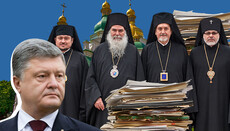
In the document prepared for Patriarch Bartholomew, a Phanar representative described the SBU's surveillance of the Constantinople delegation and Poroshenko's pressure on the course of the "Unification Council."
The Union of Orthodox Journalists of America has published an exclusive document in which the events preceding the OCU's "Unification Council" of December 15, 2018, and the course of the Council itself were described in detail for Ecumenical Patriarch Bartholomew.
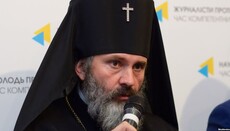
The author of the nearly twenty-page "Chronicle of the Week of the Clergy-Laity Council in Kyiv" is the current Metropolitan Gregorios of Ancyra, who in 2018 served as a patriarchal deacon at the Phanar and assisted in secretarial work for the head of the Constantinople delegation, Metropolitan Emmanuel of Gaul (now of Chalcedon). The document’s metadata shows that it was worked on by Gregorios from December 28, 2018, to January 8, 2019. At the time of publication, His Eminence has not responded to UOJ-USA’s request for comment.
The Patriarch as "guarantor" of the OCU's statute
The main opponent of the Phanariots at the negotiating table was UOC-KP spokesman Eustratius Zoria, whom the author characterizes as a man "very skilled in diplomacy." However, the "Chronicle" reveals that at the decisive moment Zoria himself fell into a trap set for him.
For a full hour the parties argued over a single phrase in the draft – that the guarantor of the statute is the Ecumenical Patriarch. Finally, Zoria asked for the phrase to be explained. Gregorios admits that this was precisely the question he had "been waiting for from the very beginning." Having received Emmanuel's permission, the Phanarist explained: today the new structure contains people who revere the Phanar and the Patriarch as their "benefactor," but tomorrow "ungrateful" people may come and wish to introduce into the Statute provisions that contradict the Tomos. "Who in that case will be the guarantor of the statute's conformity with the Tomos? Of course, it must be the Patriarch," he declared.
In response, Zoria proposed spelling out this provision in detail, which was done. As a result, the role of Constantinople in the OCU's Statute was enshrined even more firmly than in the original draft. By the end of the session Zoria realized this, but it was too late. "Thanks to the elaboration, [the wording] became more binding than the original, but since I myself asked for clarification of this passage and accepted it before everyone, I do not want to change it again. I should have been content with the original," the author quotes him as saying.
Gregorios does not conceal that the Phanar's "concessions" were a tactical device. According to him, they only "demonstrated even more clearly the strength" of Patriarch Bartholomew with regard to the Statute. "Through such practical and partly illusory 'concessions,' the position of the Holy Great Church of Christ was consolidated," he reports to the Patriarch with satisfaction.
"She teaches, and you learn"
During a break, Gregorious ran into Zoria, who asked how the Phanarist viewed the situation. The response, judging by the document, was blunt.
"We did not come here to negotiate, nor to call into question the rights of the Mother Church. She teaches, and you learn. In this case we are not negotiating as equals with equals," Gregorios declared.
According to him, if Filaret insisted on "insane demands," his supporters would "remain in schism." "This is the last chance for the elder Filaret to become a hero. If he misses it, he will end his life as a schismatic," the Phanarist said, adding that the representatives of Constantinople were in the position of "benefactors," not the benefited.
Officials sided with Filaret
That same day, at a meeting with Pavlenko and Yurash, Eustratius Zoria read out a draft communiqué according to which Filaret would become chairman of the Synod and "Exarch of All Ukraine" with the rights of a Primate – to convene the Synod, elect and depose bishops.
In response to this, Metropolitan Emmanuel explained that this was impossible, "because it would constitute an unprecedented act in the ecclesiology of the Orthodox Church and would make us a laughingstock throughout Orthodoxy." The UOC-KP hierarch threatened that without this assurance, no council would take place. He was backed up by the state officials, who Gregorios notes had agreed that they would persuade the elderly Filaret to back out of his quest for power until that moment. According to him, Metropolitan Emmanuel was left alone and proposed first holding the council, and after it acting as they saw fit.
A night in the Presidential Palace
On the evening of December 13, Poroshenko summoned Emmanuel to his residence at eleven o'clock at night. The other members of the delegation waited for him "in unspeakable anxiety and in the cold." The head of the delegation returned only at 2 a.m. "downcast and deeply saddened".
"Unfortunately, we shall fail," Gregorios records Emmanuel saying. "They even asked me to remove my wristwatch, which I kept only by threatening to leave."
In the office, besides Poroshenko, were Filaret and the chief of the security services.
"During the discussion, the elder Filaret was unyielding and inflexible… He also had the President’s silent support," the author quoted Metropolitan Emmanuel as saying.
Notes on paper and a police escort
Due to the "constant surveillance of everything in the building", the Phanariots began communicating with each other silently, using handwritten notes. Seeing the hopelessness of the situation, they decided to inform Patriarch Bartholomew that they were leaving Kyiv. Metropolitan Emmanuel had already purchased tickets by that point. In the morning the delegation sent the Patriarch a draft communiqué.
Upon learning of the departure plans, Pavlenko "in terror" informed Poroshenko. Emmanuel, who had already packed his luggage and called cars to the airport, was asked to stop by the presidential palace. About an hour later, police arrived for the remaining members of the delegation.
"After our initial reactions of perplexity, we all put on cassock and kalimavkion and, having resolved that above all we would prefer the all-sacred interests of the Mother Church, we were led there under escort by a strong police force," Gregorios continued.
On the way, Archbishop Daniel of Pamphilon, himself Ukrainian by origin, lodged a protest with the escorts against the "forcible conveyance" and informed the US Embassy of what was happening. Metropolitan Amphilochios of Adrianople, in turn, contacted the Greek Foreign Ministry. At the palace the Phanariots were led into an operations room. Before entering it, the delegation’s mobile telephones were taken and they were subjected to bodily searches.
In the room were Poroshenko, Pavlenko, and one of the chiefs of the security services. There Emmanuel informed his companions that they were being detained and forbidden to leave the country.
"I am not going to sell the dignity of the Patriarchate"
A telephone conversation then took place between Poroshenko and Patriarch Bartholomew, which, according to the author, was heard by all those present.
"I honor you and respect you, but I am not going to sell the dignity of the Patriarchate to any Filaret. And if you are not in a position to impose order upon him, I am sorry, but my people must depart," the head of the Phanar declared. After this, Poroshenko stated that if the Council did not take place, "there is a possibility of military intervention by Russia, which will see our weakness." "Then correct the situation immediately," the Patriarch replied.
Poroshenko read out a draft letter that Filaret was to sign: in it the head of the UOC-KP renounced any positions in the new structure except permanent membership in the Synod. The President personally went to Filaret, and the signed document was brought back by Pavlenko in less than an hour.
However, the surveillance did not end there. When the Phanariots went to a restaurant to discuss further steps, "throughout the ‘meal,’ more than ten secret agents moved around us, making little effort to conceal their secret character," Metropolitan Gregorios writes.
Leaving no way for retreat
On the evening of December 14, Metropolitan Gregorios demanded that the UOC-KP and UAOC legally dissolve themselves before the Council, stating that otherwise Emmanuel would not come down to preside. When Zoria proposed doing this at the Council or after it, the Phanarist refused.
The document's author frankly explains his plan to the Patriarch: "If something had gone wrong at the Council, they would have had a way out – to return to their former state. With the dissolution, this path of retreat would be closed, and they would be bound."
Metropolitan Gregorios, together with a Greek-speaking priest, drafted a text that dissolved as legal entities all structures of both groups "down to the smallest parish." "Have no doubt that without these documents he will not come down, and you will be disgraced to the ends of the earth," he warned.
"He is about to sign"
However, on the morning of December 15, Filaret refused to sign the decision on the dissolution of the UOC-KP. Viktor Yushchenko, the Speaker of parliament, and Poroshenko went to persuade him, but to no avail. The author describes these hours in terse strokes: "Bitter cold. Snow. Protests began from participants waiting at the Saint Sophia. Draconian security measures. The army and police operated jointly."
Around one o'clock in the afternoon Emmanuel came out to assess the situation, and Poroshenko, according to Metropolitan Gregorios, "made a pleading gesture," asking: "I beg you, do not leave now. Everything is already prepared. He is about to sign." Shortly afterward, "breathless and tearful" Eustratius handed the head of the delegation the signed document, and the Council began.
Let us recall that on December 15, 2018, at the "Unification Council," the OCU was created from two schismatic structures – the UOC-KP and the UAOC – and headed by Met. Epiphany Dumenko. On January 5, 2019, Patriarch Bartholomew issued a Tomos of Autocephaly to the newly created OCU. A month before the Council, the Synod of the UOC recognized the Phanar's decisions on Ukraine as canonically void. Filaret Denysenko left the OCU shortly after the Tomos was received and revived the UOC-KP, in which he remained until his death on March 20, 2026.
As the UOJ reported, according to OCU "hierarch" Daniil Kovalchuk, the conflicts between the Phanar and the authorities at the "Unification Council" were so acute that members of the Constantinople delegation left for the airport but were brought back under escort.