“Dostoyevsky takes against any wars and revolutions”
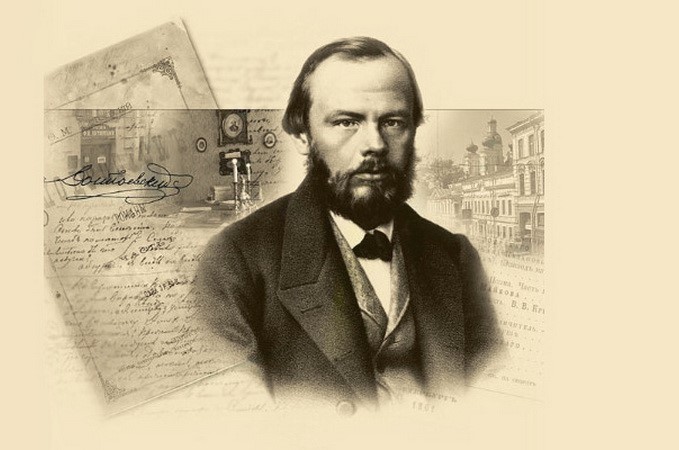
What did Ukrainian writers say about Dostoyevsky? Indicative is a quote of Oles Gonchar with reference to Ivan Franko: “He is one of those who, according to Franko, plagued and woke up our conscience, on top of that – this impact of his works continues until now, he does it even today thanks to his creativity, urging man to the strictest moral responsibility, to the deepest self-cognition, to the greatest inter-human concord… Dostoyevsky is surprisingly contemporary, his spiritual impacts are unexpected, at times even paradoxical. Doesn’t it impress that it was namely Dostoyevsky, as Einstein admitted it, who helped the scientist… to make his epoch-making discovery – to elicit a Theory of Relativity? This is evidently what great literature can be for people, science and intellectual life of entire epochs.”
Today we will talk with an expert in teaching methodology, teacher of foreign literature of Kostopol secondary school-complex of I-III degrees #6 Burenko Nina Vasilyevna.
Nina Vasilyevna, is Fedor Dostoyevsky with his philosophical views and moral principles in the mainstream currently?
– This question is very important, since today’s cultural and historic epoch is distinguished by the enhanced search of spiritual benchmarks, inner linchpin values, nation-wide moral-ethical and aesthetic ideals. In this case making a turn to the classical literature, Dostoyevsky in particular, is known to be natural and edifying at the same time. That’s why, I believe, the relevance of his views in XXI century is unquestionably proven. After all, the issues of power and freedom, faith and truth, destination of the human being on the earth, achievement of the harmony of the human personality with the world and himself have always been and will be important.
Why did the Soviet ideology criticize Dostoyevsky (who descends from the ancient Ukrainian family, whose grandfather served as a priest in the Ukrainian village), while Lenin called him an “arch-infamous” writer?
– A traditional place in the learning of Dostoyevsky’s works at school was taken by the criticism of the writer for his purportedly erroneous, short-sighted statements with regard to the sense of human existence, particularly his expression “Humble yourself, proud man!” But we should remember that a profound idea of Christian faith consists in love not only for your relatives, close people, friends, but also for your enemies. The robber on the cross next to Jesus Christ’s was the first to enter the Heavenly Kingdom.
Dostoyevsky was dead-set against any wars, revolutions and blood-shedding in general. He was afraid that the end rebels chose did not justify means, i.e. mass carnage for the sake of purportedly fair society. The classic writer was far-reaching to foresee current tyrants would be replaced by others, only carrying different slogans of brotherhood and equality, and would employ the same methods. Therefore, each person should start with himself relying on his measure of faith. It is by no chance that the Holy Scriptures say: “What good is it for someone to gain the whole world, yet lose or forfeit their very self?” (Luke 9:25). Dostoyevsky was the first to unveil the problem of split personality: on the one hand, an individual is a slave (against “power that be”), on the other – he is a tyrant (with regard to those who are weaker). In his works the writer made an insight not only social disparity between people, but also moral. All these things cannot but arouse interest with us, Orthodox Christians.
I am convinced none of the other writers has been able to penetrate into the mystery of a human soul. None has had such a difficult road to God, to the Triumph of Orthodoxy as a sole and true faith on the earth. He warned against a dreadful threat of living in a spiritless world, whatever amenities and temptations it might offer.
Hence, Dostoyevsky can be undoubtedly called a prophet, because he was communicating the Logos and was endowed with the future prediction. It was Dostoyevsky who showed us how dangerous the violation by man of fundamental Christian Commandments can be, revealed the essence of the permissive society being “an illness” of spirit and mind, healed by the deep faith.
Nina Vasilyevna, what integrates all literary works of Fedor Dostoyevsky in your opinion?
– A key word of all Dostoyevky’s opuses is “pain” – the pain for a human being. The writer affirmed one should have love for a particular person rather than the mankind as a whole, since such love is not binding. Besides, he spoke about catharsis, i.e. purification through pain. He himself experienced lots of hardships and bereavements. His path to God led through doubts, renouncements, yet was finally admitted that if truth lay beyond faith in God, he would choose God nonetheless!
What do you think is a moral maxim of Dostoyevsky’s works?
– Dostoyevsky continually tried to get across to readers moral responsibility of a human for everything which is going on in the world. We all have to improve ourselves spiritually and live by God’s Commandments. The writer wrote there is only one law – the law of morality and nothing outside morality. The highest evil for Dostoyevky was an attempt of people to establish good without God. The character of his novel “Karamazov Brothers” Dmitry said true words: “Here is Satan fighting against God, the battlefield being human hearts.”
The interview was done by protopriest Dionisiy Burenko
Read also
A shepherd boy with a letter from Christ to French king
In the summer of 1212, thousands of pilgrims carrying staffs waited for the sea to part before them. Later chroniclers added ships, slave traders, and a pope's lament to their story.
Facade of bones and facade of light
Antoni Gaudí spent forty-three years building a church in Barcelona, knowing that this construction was for the ages.
Trial of a dead pope
Once in Rome, the body of a deceased pope was seated on the throne and put on trial. The accusation relied on a church canon that had once saved his see.
Monastery built in defiance of king
When Orthodox believers in Minsk were left with just one church, townspeople decided to build another – and even a royal decree did not stop them.
Young Mother and Sleeping Christ
Michelangelo carved a Virgin Mary who looks younger than her Son – and signed his name in marble for the only time in his life. Neither of these peculiarities was accidental.
Orthodox books from a Uniate printing press
In the 18th century, Uniate monks at Pochaiv printed books used in prayer by Orthodox Christians and Old Believers alike.