Shepherd boy carries letter from Christ to French king
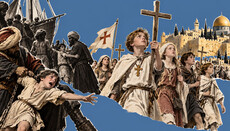
In the summer of 1212, thousands of pilgrims with staffs waited for the sea to part before them. Later chroniclers added ships, slave traders and a papal sigh to their story.
About fifty medieval texts mention the mysterious Children's Crusade that passed through Europe in the summer of 1212. Historians trust only those sources written before 1250. This boundary was not drawn by chance. The farther a chronicler stood from the events, the younger the participants of the march became in his account, and the more terrible its ending turned out to be.
That is why it is more correct to study this story from the end: from the later, most vivid accounts to the dry records of contemporaries.
The villains appeared later than the children
In the second half of the thirteenth century, the tragedy found its culprits. Vincent of Beauvais wrote that the children were ruined by the Old Man of the Mountain, a mysterious lord from the East. In Roger Bacon, the crowd is led away by some evil man. In Matthew Paris, no one returns home.
Each subsequent narrator knew less about the year 1212 than his predecessor, yet spoke with greater confidence. One modern researcher observed that the creators of myths are always sure they are right. Another summed it up even more briefly: from chronicle to chronicle, the participants of the march grew ever younger.
Hugh the Iron and William the Pig
The most detailed version was left by Alberic of Trois-Fontaines. He began his chronicle in 1232, twenty years after the events. Alberic has everything a good plot needs: ships, a storm, a slave market, and even retribution.
What, then, is the essence of this mysterious story? Two merchants from Marseille, Hugh the Iron and William the Pig, promise to take the children to the holy places. Two of the seven ships are wrecked near the island of San Pietro. The remaining children are sold in Bougie and Alexandria. The merchants are later hanged, though for an entirely different crime – a conspiracy against Emperor Frederick II.
The names of the villains sound as if they were invented by a fabulist. Perhaps they are simply nicknames of the kind given to merchants in port cities.
But no source earlier than Alberic writes about the Marseille ships. From his account grew the popular story of a twelve-year-old shepherd who led thirty thousand children to the sea. These figures wander from book to book, but they cannot be found in the early chronicles.
Words the pope may never have uttered
Another famous scene takes place in Rome. Pope Innocent III learns of the children's march and says with a groan: «These boys reproach us: they run to reconquer the Holy Land, while we sleep».
The phrase is too literary. It was recorded by Albert of Stade, who began his chronicle in 1240. By that time the pope had been dead for 24 years. How the chronicler knew of his words is unknown. Historians have long disputed their authenticity.
But something else is well known. Innocent III did indeed call Europe to a new crusade, and it took place a few years later. In the spring of 1212, on Pentecost, papal processions walked through the streets. People sang: «Return to us the True Cross». Many researchers see in these prayers a possible impetus for the events of that summer.
Who really walked to the sea?
The early chronicles paint a far more motley crowd of crusaders. The Cologne Royal Chronicle speaks of many thousands of "boys from six years old and upward, up to full maturity." They went in groups of twenty, fifty, a hundred, often against their parents' will. The Marbach Annals add that not only children set out on the road, but adults as well, and married women together with maidens.
The key to the riddle is the Latin word the chroniclers used to describe these people. It is usually translated as "boys" or "children." But in the Middle Ages the same word was also used for servants, farmhands, and "little people" in general, who had neither land nor social standing.
In the late 1970s, historians suggested that the "children's" march was in fact a march of the poor.
Later the pendulum swung back. Contemporaries, it seems, still saw the participants as a distinct age group. There were many children in the crowd, but they were not the only ones. The march of 1212 was a march of the poor and the young, while adults, farmhands, and girls walked alongside the teenagers.
Letters for King Philip
The earliest account of the French leader of the crusaders also looks legendary. An anonymous chronicler from Laon reports on a shepherd named Stephen from near Vendôme. Christ appeared to him in the guise of a pilgrim and gave him letters for the king.
Stephen led the procession from Chartres to Saint-Denis. This is the abbey near Paris where the French kings were buried. They were going there to see Philip II Augustus; the shepherd did not even intend to go to Jerusalem. The king made his decision quickly: he ordered the "boys" to go home. This chronicler does not say a word about Marseille.
The promise of a dry path
In Germany the march had its own leader – a boy named Nicholas of Cologne. The Annals of Scheftlarn convey his promise: the sea, as once for the people of Israel, would grant the travelers a dry path.
These people saw themselves as a new Israel. They recalled the events of the Exodus. They believed that if God had once already led His people through the waters, then He would do so again. They entered Genoa with crosses, staffs, and satchels. This was the equipment of a pilgrim; a warrior does not set out on campaign like that.
The Genoese annals were kept by Ogerio Pane, a contemporary of these events. He recorded that at the end of August 1212 more than seven thousand men, women, boys, and girls came into the city. He gave the number "by the estimate of a worthy man." The chronicler had not counted the crowd himself and honestly said so.
But the sea did not part.
After this the early sources fall silent. The Cologne chronicle reports that some of the pilgrims were turned back in Piacenza, others in Rome itself. Of the many thousands who set out, only a very few returned. What happened to the rest, contemporaries did not know and did not invent.
Twenty years later this historical void was filled with merchants and ships, thirty years later with a sigh of the pope, and later still with an eastern villain. The story grew more coherent, while its participants grew ever younger. But the outcome of events was one and the same: thousands of poor people believed that the miracle of the Exodus would be repeated for them, reached the shore, and saw no dry path. Thus ended the sad story of the "Children's" Crusade.