
Mystery of two dates: why Ostrog Bible printed twice
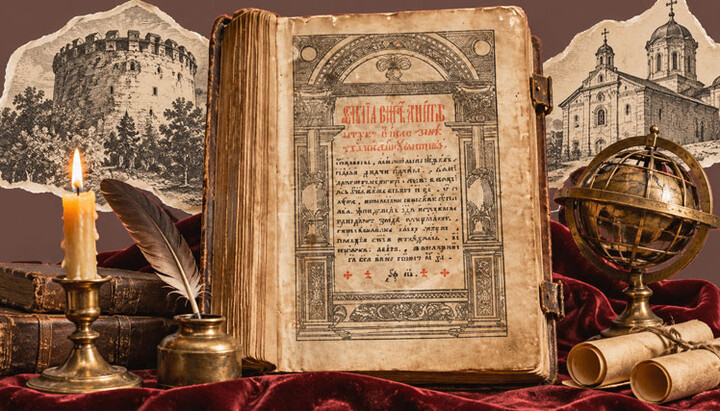
В конце знаменитого фолианта стоят две разные даты, а в его корешках находят человеческие волосы.
If you open the Ostrog Bible from the end, you can easily get confused by the colophon of the folio. Some copies give 12 July 1580, others 12 August 1581, and in some volumes both dates coexist, with the typesetting differing on those leaves.
The book did indeed appear in 1581, but the path to that date, and tracing the fate of each surviving volume, resembles an investigation with many blank spots.
Compiling the first collection of biblical books
The Ostrog Bible is a heavy folio printed in two colors, black and cinnabar red. Its 628 leaves hold 1,256 pages of dense text. It is the first complete Bible printed in Church Slavonic. Before it, people used separate books of Scripture or handwritten compilations that took years to copy.
The publisher explained in the preface why such a labor was needed. He introduces himself to the reader: "I, Constantine, named Basil in holy baptism, by the grace of God Prince of Ostrog, Voivode of Kiev." The prince connects the idea of the book with the calamity of his time, the "ruin of the Church of Christ."
He needed a verified text of the Bible capable of defending the Orthodox tradition in disputes over the purity of the faith.
But as soon as the publishers began their work, it turned out that there was no ready model for the typesetting. In the same preface, the prince laments that in all the Slavic lands not a single complete book of the Old Testament could be found. Manuscripts were gathered from monasteries and princely libraries.
A circle of scholars in Ostrog, in Volhynia, labored over collating the texts. The work was probably directed by the rector of the local school, Gerasim Smotrytsky.
Two different publication dates
At the press in Ostrog then stood Ivan Fedorov, a master who had already worked in Moscow and Lviv. He wrote the Bible's afterword himself, recording the place and the day the labors were completed: "in my God-protected native city of Ostrog, in the land of Volhynia," "in the year 1581, the month of August, the 12th day."
Where, then, does 12 July 1580 come from? It seems the printing house produced a trial print run or part of the edition, after which errors were noticed in the text. The typesetting was redone, individual leaves were replaced, and the main bulk of the books came out thirteen months later. When assembling the book blocks, the binders apparently mixed up old and new leaves, and so volumes with a double date appeared.
Marginal notes in the folio
Every surviving volume of the Ostrog Bible preserves on its margins traces of its owners, from which one can see how the folio passed from hand to hand and what it cost.
The original price of the Bible is unknown, but a note from 1643 survives on the Lviv copy. The local priest Antony Dubetsky wrote in the book that he had bought it for 36 zlotys. By seventeenth-century standards this was a considerable sum: a sacred book was valued on a par with a good horse.
Two centuries later the folios already required restoration: the outer leaves were falling out from frequent reading. The seminarian Klement Vakhnianyn copied the lost pages by pen into two copies at once. And in the third Lviv volume, Ivan Franko left a note, as the writer did not pass by this monument of early printing.
Other clues are kept by a copy from the Lilly Library in the state of Indiana. Crosses stand in the margins – perhaps this is how they marked the places where the reading of the Bible aloud was interrupted. In violet ink, the names of the owners are written out in the same place. And upon examining the binding, a lock of human hair was found in the spine. Whose it was and why it was placed there has never been explained.
Finds in the Cells of Athos
It would seem that after four centuries all the surviving volumes have long been accounted for. But monasteries know how to keep secrets. On the Holy Mountain of Athos, three previously unknown copies of the Ostrog Bible were found at once, and each has its own separate history.
The first volume belonged to St. John Vishensky. A polemicist who sent stern denunciations of the supporters of the Union from his Athonite seclusion, he checked his arguments precisely against this edition.
The second copy is connected with the school of St. Paisius Velichkovsky. Before reaching the Holy Mountain, the book was kept in the Moldavian monastery of Neamț, where the elder, together with his disciples, revived the translations of the Fathers.
The third folio preserved a donation inscription: in 1754, Hieromonk Callistus Menovsky gave it to the "Black Vyr" skete. For centuries the books wandered from cell to cell and remained invisible to catalogues. No one can vouch that in some remote skete there is not still lying another unaccounted-for volume.
The Surviving Print Run
The Ostrog Bible is rightfully considered the pinnacle of Ukrainian book printing. In the 18th century, it was this text that formed the basis of the Elizabeth Bible of 1751, which is still read at Orthodox services to this day.
The exact print run of the Ostrog edition is known to no one. Estimates range from one thousand to three thousand copies.
We are accustomed to seeing in the Ostrog Bible merely a literary monument. But as soon as one opens it, this monument turns into a living witness of history – with two release dates, crosses in the margins, human hair in the spine, and the hundreds of destinies of its owners and readers.