
Who first introduced parish registers in Orthodox churches, and when?
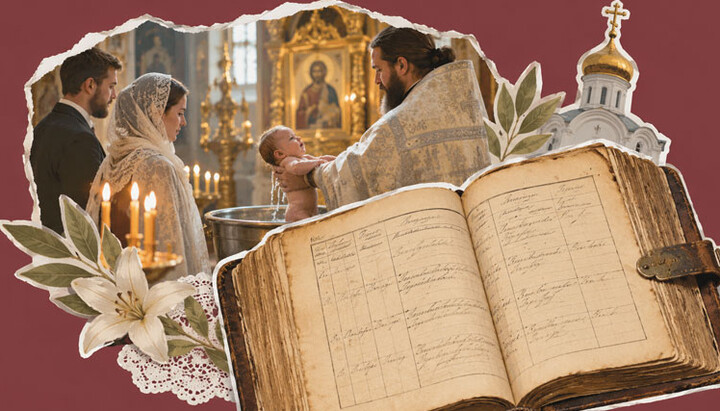
Old records of marriages, births, and deaths preserve amusing oddities, rare illustrations, and genealogical clues that help us reconstruct family histories.
"In the Year ___, in the Month of ___, on the ___ day, in the City of ___."
This is what a blank entry template looked like in the 1646 Trebnik (Book of Needs). On paper, everything was simple: fill in the date, enter the infant's name and the godparents' surnames, and the report for church authorities was ready. But anyone who has ever opened an actual 18th- or 19th-century parish register in an archive quickly realizes that such perfect order existed mainly in the printed template.
Consider a death record from an Odesa archive dating to 1824. Captain Isidor Bely had died. The cause of death was recorded succinctly: he had died "naturally." But the age column contained an astonishing figure: "153 years old!" A clerical error? Hardly. The parish priest, Nikanor Kotelevsky, confirmed the figure twice – first in the original entry and then again in an official extract.
To understand how the parish registers we use today to trace our ancestors actually worked, we must first unravel an old myth.
The phantom decree of 1632
Search online for the origins of Orthodox parish registers, and you will almost immediately encounter an answer confidently endorsed by AI: "In the Dnipro region, parish registers were introduced by order of Petro Mohyla in 1632." It sounds authoritative, and the name of the supposed founder lends it considerable weight. There is just one problem: no one has ever seen the hierarch's decree.
Historians do not cite this document because it simply does not exist in the archives. A quick check of the dates reveals another inconsistency. In November 1632, St. Petro (Mohyla) had only been nominated for the see of Kyiv; his episcopal consecration did not take place until May 1633. Perhaps popular tradition simply conflated the year of the future metropolitan's election with his later reforms, but that remains speculation.
The real trail leads somewhere else entirely. The Council of Trent had already introduced mandatory records of baptisms and marriages for Catholic parishes in 1563, while the Roman Ritual of 1614 laid out detailed instructions for maintaining such registers. The Kyiv Metropolia needed its own response to the demands of the age. That response came fourteen years after the supposed decree.
The book few could afford
In 1646, the aforementioned Metropolitan of Kyiv published his Trebnik. It contained a model for Orthodox parish recordkeeping, explaining how to document baptisms, marriages, burials, and parish membership.
This might seem like the obvious starting point. But what followed is a story familiar to anyone who has encountered institutional reform.
Saint Peter's Euchologion turned out to be monumental, bulky, and expensive. A village priest often simply could not afford to buy it.
According to researchers, the 1646 templates remained more of a recommendation than a widely adopted practice. One revealing detail is that the later Small Trebnik published by Bishop Zhelyborsky – a much more affordable volume for ordinary clergy – no longer included any model parish registers.
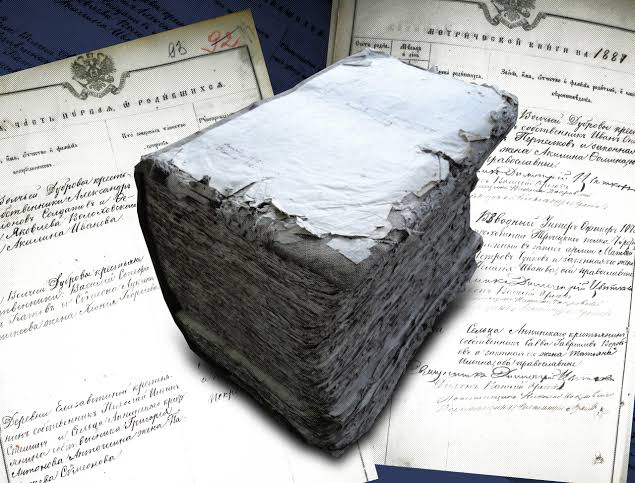
Meanwhile, actual recordkeeping had already outpaced the printing presses of the major cities. In Zamość, a register belonging to the St. Nicholas Brotherhood has survived under the title Prototypon Onoma. It contains 918 entries written in Cyrillic between 1630 and 1699. It is the oldest surviving Orthodox parish register from Ukrainian lands, and it was already being maintained before Metropolitan Petro's Trebnik appeared.
Debate over the dates continues. According to other accounts, records began even earlier, in 1600, in the village of Sykhiv and at Lviv's cathedral church. In the Dnipro region, however, the earliest surviving registers date only to the beginning of the 18th century. Local historians attribute this gap to the repeated devastation of the region.
A tavern-keeper in the margins
The more closely one examines surviving 18th-century registers from the Dnipro region, the less they resemble dry government records. They are chronicles of local life, often produced with remarkable artistic care: elaborate initials, decorative title pages, flowers in the margins, and delicate miniature illustrations. Some pages depict scenes from Scripture, while others show churches, weddings, childbirth, or funerals.
Sometimes the illustrator's imagination wandered in an entirely different direction. A parish register from Holy Trinity Church in the town of Kuzemyn, Hadiach district, contains a signed miniature caricature titled "The Golden Tavernkeeper." It portrays the owner of a local tavern. Clearly, the man had nothing to do with the Church or its parish records. Who decided to immortalize the tavernkeeper in a church register, and when, remains a mystery.
These notebooks also reveal the social structure of a parish without the need for much explanation.
Priests carefully wrote the surnames of wealthy families in elegant calligraphy. Parents sought out churchwardens, prosperous neighbors, or householders with large families to serve as their children's godparents. And when a particularly long-lived parishioner died at the age of 98 in the late 18th century, as many as five or seven priests might gather to conduct the funeral.
Clerical errors on scraps of paper
A newcomer visiting an archive to research family history often expects old parish records to be as accurate as modern civil registration documents. Instead, the researcher quickly encounters bureaucratic confusion.
A priest might record someone's surname in one place and a nickname in another. Causes of death were handled with similar flexibility: one priest would faithfully record the illness, while another would simply use the space to identify the deceased person's family relationships.
The ages of the deceased present a mystery of their own. Parish registers contain centenarians who turn out to have been considerably younger when their ages are checked against baptismal records. Someone might be recorded as having died at 100, but further research reveals that the person was actually only 75 or 85. Ages were often estimated or recorded according to relatives' recollections, and human memory is notoriously unreliable.
We should not be too quick to accuse the clergy of the time of negligence. Consider the workload of a rural priest responsible for an enormous parish, religious services, his own household, and all the paperwork – without a single administrative assistant.
Entries were often added to the registers later, based on hurried notes scribbled on scraps of paper. One weary priest, writing in Church Herald, candidly complained: "When you're recording fifteen hundred souls, you're bound to write 17 instead of 18 once in a while."
Today, when a researcher opens a darkened 18th-century page in search of a great-grandfather, the expectation is to find a precise official record. Instead, the researcher discovers something quite different: the hurried handwriting of an exhausted priest, an extra half-century added to Captain Bely's life, and a cheeky drawing of a tavernkeeper in the margins.
It is precisely these small irregularities that reveal the authentic life of a parish – a life that no printed template could ever fully standardize.