Bill No. 5309: the Church is swung but not yet struck
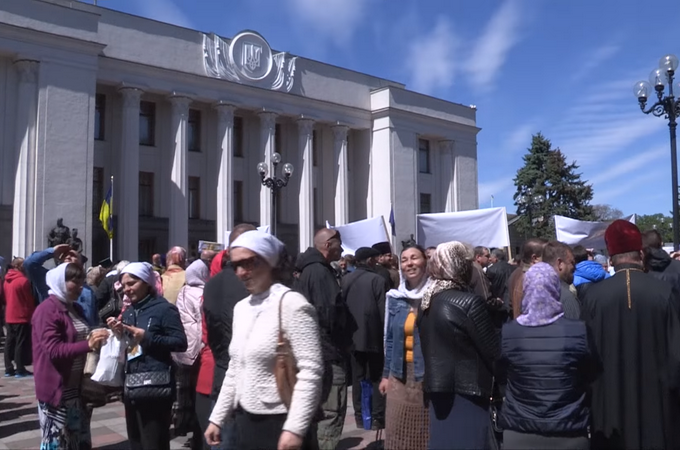
On July 12 the Committee of the Verkhovna Rada of Ukraine on Culture and Spirituality considered and approved this bill, Which proposes to introduce to the Law of Ukraine "On Freedom of Conscience and Religious Organizations" an amendment “regarding the name of religious organizations (associations) that are part of a religious organization (association) whose governing center (management) is outside Ukraine, in the the state which, according to the Law of Ukraine, is recognized as carrying out military aggression against Ukraine and / or temporarily occupied part of the territory of Ukraine.”
What does this approval by the Verkhovna Rada Committee mean? What danger does the bill lurk? And what should the Orthodox do in this situation?
Bill No. 5309 was submitted to the Verkhovna Rada on October 26, 2016, on February 21, 2017, to be put on the agenda of the sixth session. Earlier, on January 17, the Verkhovna Rada approved a calendar plan for the sixth session of the eighth convocation, according to which the plenary sessions should end on July 21, 2017 year. After the approval of bill No. 5309 by the parliamentary committee, it can be included in the agenda of one of the plenary sessions.
However, the Parliament has only a week left. And this week the Verkhovna Rada intends to consider judicial reform (the law on the Constitutional Court), medical, pension and education reform. That means, most likely, draft bill No. 5309 will not be considered at this session and will be transferred to the next one.
The essence of the bill is reduced to two points:
- legally bind one single religious organization in Ukraine to change its name: from the Ukrainian Orthodox Church into the Russian Orthodox Church in Ukraine;
- prohibit the clergy of the UOC to provide spiritual guidance for servicemen.
The text of the bill is composed rather clumsily and illiterately. Its authors are:
- from "Motherland" faction - Alexander Briginets (poet and prose writer), Igor Brichenko (vegetable grower and politician), Ivan Krulko (political and public figure);
- from "Samopomich" faction – Yaroslav Markevich (a fighter of the battalion "Donbass");
- from "People's Front" faction – Alexander Gorbunov (collector of wooden products and businessman), Sergei Vysotsky (journalist), Igor Lapin (company commander in the battalion "Aidar").
Deputies (or whoever wrote the text itself) made a lot of mistakes and absurdities. We will not facilitate their work and point out specific flaws in the text, but as a whole bill No. 5309:
- roughly violates the principle of equality of all religious faiths before the law;
- violates the provisions of the Constitution, which exclude the possibility of establishing special requirements for the name of individual religious organizations;
- violates the provisions of the Constitution, which regulate the right of everyone to profess any religion;
- violates the provisions of the Constitution, which exclude the possibility of prohibiting the spiritual nourishment of clerics of any particular confession;
- violates the provisions of other articles of the Law "On Freedom of Conscience and Religious Organizations" or does not agree with them;
- does not disclose the very notion of "governing center", around which all the fuss is.
As a result, the main scientific-expert department of the Verkhovna Rada made an unequivocal verdict: reject the bill.
In addition, on the basis of the charters of the Ukrainian Orthodox Church and the Russian Orthodox Church, Tomos of Patriarch of Moscow and All Russia of 1990 and other documents, in any non-partisan court it can be absolutely unequivocally proved that the UOC has a “governing center” in Kiev and only in Kiev.
Why did the Committee on Culture and Spirituality still approve such definitely unconstitutional bill?
First, it completely fits the logic of the struggle with the Orthodox Church. The document is designed to identify the UOC with the "aggressor state". And this will make it possible to unleash a broad campaign of violent transitions of church communities to "patriotic" confessions, raise the issue of changing the jurisdiction of such Orthodox shrines as the Kiev-Pechersk and Pochaev Lavra, to drive into ghetto those people who do not share the ideology of frenzied nationalism.
The authors of the bill with Jesuit cunning wrote in the text: "It is not allowed to grant privileges or imposing restrictions on the activities of a religious organization (association) that is part of a religious organization (association) whose governing center (management) is outside Ukraine in the state, recognized by law as having carried out military aggression against Ukraine and temporarily occupied the territory of Ukraine."
Yes, de jure, the UOC will remain equitable with other faiths – with some exceptions. But the change of its name, as the enemies of Orthodoxy wants, will lead to a false opinion about the UOC in the minds of a huge number of people who will consider it to be alien and even hostile to Ukraine, and therefore subject to ostracism, expulsion from all spheres of public life. This will be immediately taken up by such organizations as the "Right Sector", with which the schismatic Kiev Patriarchate makes an official agreement to build together “One Local Church”.
Secondly, if the attempt to ram the bill No. 5309 through the Verkhovna Rada succeeds, it is possible to return to the bills No. 4128 (on church raiding) and 4511 (on control over the UOC from the power) with new forces.
Thirdly – and this seems most likely – endeavors to pass bills No.№ 4128 and 4511 have failed. Both ordinary believers and international organizations rebelled against them, as well as all the Local Orthodox Churches and even the Vatican. In these circumstances, the adoption of bill No. 5309 is still unlikely. But the threat of its adoption can become a bargaining chip in the political game. After all, the authorities must adopt very ambiguous laws on Donbass, on medical and pension reforms, etc. Withdrawal of draft bill No. 5309 may become a payment to certain factions and MPs for their support on other issues. However, the use of the Church of Christ in political games in this way testifies to the level of religious self-consciousness of such members of Parliament.
We, the faithful children of the Orthodox Church, should pray for "the peace of the whole world and for the welfare of Holy God's Churches" and listen to our Church hierarchy. If from the mouth of bishops of God there is an appeal to come again to the Verkhovna Rada for prayerful standing – we must be ready to respond.
Read also
Concubine or daughter? On words that cannot be used about the Church
An archon of the Church of Constantinople likened the UOC to Moscow’s “concubine.” But for St. Epiphanius of Cyprus, “concubines” are heresies.
Shameful chronicle of one week: how the OCU was born
Exarchs under escort, a call from the operations room, and 36 votes for Epifaniy: what a member of the Phanar delegation revealed about the 2018 "Council".
Can UOC eparchies be dissolved before court ruling on Metropolia?
DESS is launching separate proceedings against UOC eparchies, monasteries, and institutions while the case involving the Kyiv Metropolia is still pending.
Two murders, one silence
Zelensky condemned the killing of a Catholic priest in Poland the very same day. A month earlier, a UOC monk was murdered at the Sviatohirsk Lavra – and the president has remained silent ever since.
A bow to Phanar? Why did UOC academy congratulate Constantinople’s exarch?
A delegation from the Kyiv Theological Academy congratulated the Phanar’s exarch, who has remained silent about the persecution of the UOC. Who authorized this gesture, and why did even OCU supporters fail to appreciate it?
“De-Moscowize” for unity: Shevchuk’s recipe for bringing Ukrainians together
The head of the UGCC assures that internal division threatens the country's existence, while simultaneously calling to fight against the "wrong" ones. Is this cognitive dissonance or something more?