Statement by bishops of the Bulgarian Orthodox Church on Ukrainian issue
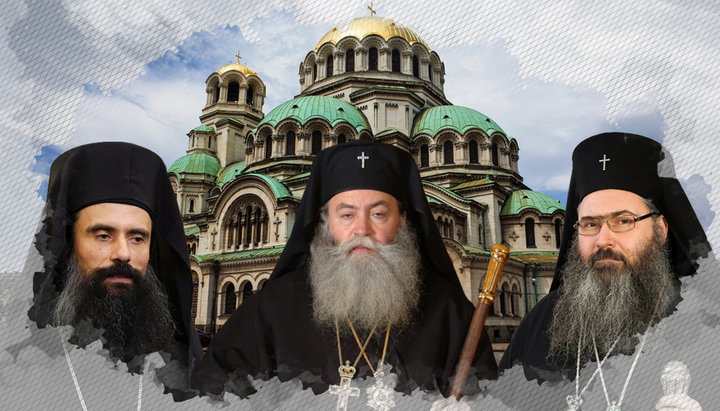
Three Bishops of the Bulgarian Church published a statement on Constantinople’s actions in Ukraine
On October 4, 2018, during the regular session of the Holy Synod of the Bulgarian Orthodox Church, its members considered the alarming situation that has developed in Ukraine due to the Ecumenical Patriarchate’s actions on the canonical territory of the Ukrainian Orthodox Church.
Members of the Holy Synod of the BOC: Metropolitans Gabriel of Lovech, John of Varna, and Daniil of Vidin made an appeal for a pan-Orthodox Council to consider the Ukrainian issue. The full text of the statement is published on the Bulgarian Patriarchate’s official site.
Arguing their position, the metropolitans point to the “inconsistencies between the stated motives of the Patriarchate of Constantinople with regard to unilateral interference in the affairs of a Local Orthodox Church and the real consequences of such interference.”
Representatives of the Ecumenical Patriarchate have stated that they see no reason why their interference in Ukraine will lead to any further Church problems, although it has already led to an obvious strain in relations with the Moscow Patriarchate.
As the hierarchs note, the creation of a parallel ecclesiastical structure, as there was in Bulgaria from 1992 to 2004, would entail the seizure of churches and other Church property of the canonical Church.
“Who will take responsibility for all those people who lives will be threatened in Ukraine when they stand up to defend their holy places—churches and monasteries—in the event that their registration for the canonical Orthodox Church, to which they belong, is cancelled, which Ukrainian politicians openly speak about?” the bishops ask.
The Bulgarian hierarchs also note that Constantinople’s actions—challenging the documented decision of 300 years ago, when the Kiev Metropolia was joined to the Russian Orthodox Church—are inconsistent with the holy canons of the Church.
“It is especially important to remember the 133rd canon of the local Council of Carthage in 419, according to which three years are provided for resolving claims regarding territories belonging to the jurisdiction of a bishop. The 17th canon of the Fourth Ecumenical Council and the identical 25th canon of the Sixth (Trullan) Ecumenical Council determine the statute of limitations for disputes about the accession of parishes to the diocese of a lawful as thirty years,” the metropolitans argue.
The Bulgarian hierarchs also argue that the Ecumenical Patriarch’s incursion into the canonical territory of another Local Church has created “a problem that cannot be solved between the two patriarchates.” In this, they somewhat disagree with the Holy Synod of the Georgian Orthodox Church, which has called for the issue to be resolved precisely between the Ecumenical and Moscow Patriarchates.
Considering the strain in relations between the two patriarchates, if the dispute deepens, “it will move from the current local schism in Ukraine to a schism on a global scale within Holy Orthodoxy, and we cannot agree that the continued unilateral actions of the Patriarchate of Constantinople in Ukraine are the way to overcome the Church schism there,” the bishops write.
In agreement with the Ukrainian and Russian Orthodox Churches, Mets. Gabriel, John, and Daniil also affirm that “the Patriarchate of Constantinople has no right to enter into a foreign canonical territory and begin communications with Ukrainian schismatics, ignoring the only canonical hierarchy in Ukraine.”
“An authoritative solution to the Church dispute in Ukraine can be achieved only within the framework of a pan-Orthodox discussion and the convocation of a pan-Orthodox Council,” the metropolitans emphasize, noting that the Holy Synod of the Antiochian Patriarchate also recently proposed to convene a Synaxis of the primates.
His Beatitude Metropolitan Sawa of Warsaw and All Poland has made the same call.
His Holiness Patriarch Kirill of Moscow and All Russia has also called for a pan-Orthodox discussion on the matter and recently addressed letters to all of the 15 Orthodox primates around the world to apprise them of the reality of the situation in Ukraine, where the faithful of the canonical Church are suffering for holy Orthodoxy.
Read also
Concubine or daughter? On words that cannot be used about the Church
An archon of the Church of Constantinople likened the UOC to Moscow’s “concubine.” But for St. Epiphanius of Cyprus, “concubines” are heresies.
Shameful chronicle of one week: how the OCU was born
Exarchs under escort, a call from the operations room, and 36 votes for Epifaniy: what a member of the Phanar delegation revealed about the 2018 "Council".
Can UOC eparchies be dissolved before court ruling on Metropolia?
DESS is launching separate proceedings against UOC eparchies, monasteries, and institutions while the case involving the Kyiv Metropolia is still pending.
Two murders, one silence
Zelensky condemned the killing of a Catholic priest in Poland the very same day. A month earlier, a UOC monk was murdered at the Sviatohirsk Lavra – and the president has remained silent ever since.
A bow to Phanar? Why did UOC academy congratulate Constantinople’s exarch?
A delegation from the Kyiv Theological Academy congratulated the Phanar’s exarch, who has remained silent about the persecution of the UOC. Who authorized this gesture, and why did even OCU supporters fail to appreciate it?
“De-Moscowize” for unity: Shevchuk’s recipe for bringing Ukrainians together
The head of the UGCC assures that internal division threatens the country's existence, while simultaneously calling to fight against the "wrong" ones. Is this cognitive dissonance or something more?