
What the Razumkov Center’s religious statistics show

The Razumkov Center sociologists have published religious statistics for Ukraine over the past 25 years. Where are the lies, where are the manipulations, and where are the facts that cannot be hidden.
On March 3, 2026, the Razumkov Center published statistics on the religious sphere of Ukraine for November 2025. It is called "Religiosity, confessional affiliation and inter-church relations in Ukrainian society".
How "independent" this report is can be seen from the presence of an introductory word by the head of the State Service for Ethnopolitics (DESS) Viktor Yelensky. And in general, this statistical report is interesting not only for its figures, but also for how they were obtained. The document states that this is the result of a survey of 2009 respondents using the face-to-face method, conducted in territories controlled by the Ukrainian government and not located in combat zones. The declared theoretical margin of error is 2.3%. However, the authors directly warn that the figures are influenced by war, changes in the geography of the sample, migration of millions of citizens, and so on. But even with these reservations, the picture emerges quite clearly: there is an abyss between media narratives about the religious situation in Ukraine and real church life.
Manipulation: how the desired answer is embedded in the question
Respondents were not offered the official name “Ukrainian Orthodox Church” but rather the label “Moscow Patriarchate.” This is a crude and primitive manipulation, since the question already contains a toxic label that few people would want to attach to themselves. The Ukrainian Orthodox Church has not had such a name since 1990, when it received autonomous status. And since the Council held in Feofania on May 27, 2022, the Ukrainian Orthodox Church has been fully self-governing and independent.
Believers of the Ukrainian Orthodox Church do not associate themselves with the Moscow Patriarchate. And even more so, during the war with Russia, no one wants to associate themselves with Moscow. However, the Razumkov Centre formulates the question with an already built-in emotional filter and quite predictably obtains a clearly unrealistic figure of 5.4%. These are the people who, despite the “Moscow” label, publicly stated their affiliation with the Ukrainian Orthodox Church.
Against this background, the Razumkov Centre obtained 42.1% for the Orthodox Church of Ukraine (OCU) and 11.8% for the Ukrainian Greek Catholic Church (UGCC). This would mean that there are twice as many Greek Catholics in Ukraine as Orthodox believers of the Ukrainian Orthodox Church (UOC), and that believers of the Orthodox Church of Ukraine outnumber them by eight times. These are absurd figures. Let us try to understand how they could have been obtained.
OCU as an identification brand
If we analyze the data only for those respondents who consider themselves Orthodox, the picture becomes even more interesting. If in 2020 32.2% of Orthodox respondents identified themselves with the OCU, then in 2025 it was already 72.2% – an increase of more than two times.
But during the same period, the share of those who describe themselves as “simply Orthodox” decreased from 43.1% to 17.4%, while the share of the UOC decreased from 21.9% to 9.3%. The questionable nature of the data regarding the Ukrainian Orthodox Church has already been mentioned. However, the decrease in the number of those identifying as “simply Orthodox,” alongside the simultaneous increase in the share of the OCU, suggests that there was a shift from one category to the other. In other words,
in conditions of war and media promotion of the OCU as a patriotic brand, those who previously identified themselves as "simply Orthodox" now began to call themselves supporters of the OCU, since this looks more patriotic.
This is like the statements that used to sound like: "I am an atheist, but an atheist of the Kyiv Patriarchate."
The OCU project worked in the negative
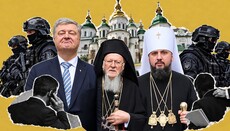
Poroshenko and other OCU founders promised that the new church would unite the Orthodox and strengthen faith in the country. It turned out differently. In the year the OCU was created, 67.3% of Ukrainians identified themselves as Orthodox. Since then, this figure has only declined: 60.0% in 2021 and 58.3% in 2025. A drop of almost ten percentage points in seven years is not unification, it is de-churching
The Lord said: “Let your light shine before men, that they may see your good works and glorify your Father in heaven” (Matthew 5:16). But instead, everyone witnessed the seizure of churches, the beating of believers and priests, unlawful votes, and so on. And yet both Patriarch Bartholomew and the Ukrainian authorities were warned that the creation of the Orthodox Church of Ukraine would lead precisely to this.
Statistical victory and parish reality
The Razumkov Centre report claims that the number of believers in the OCU is eight times greater than that of the UOC. But let’s look at what happens in practice.
According to DESS, as of January 1, 2025, there were 10,118 religious organizations of the UOC in Ukraine and 8,511 organizations of the OCU.
This is despite the fact that between February 24, 2022 (the beginning of the war) and June 1, 2025, 1,285 organizations allegedly moved from the UOC to the OCU. And we know quite well what those “transfers” were. The vast majority were church seizures or manipulations with voting, while in reality the UOC communities didn’t actually move, they were simply forced to find another place for worship.
In other words, the DESS figure is fake; the UOC has far more parishes. Accordingly, OCU communities are far fewer. Taking this into account, we can assume that the UOC has about 11,300 communities, while the OCU – about 7,200.
How can a religious organization that has 42.1% of the population in its ranks have fewer religious organizations than one that has only 5.4%? We think the answer is obvious: it cannot.
Let's analyze further. Perhaps OCU churches are bursting with the number of worshippers, while UOC churches stand empty? No, it's the opposite. This is confirmed by numerous photo and video materials from worship services that fill the Internet. This is also confirmed by the Razumkov Center report. According to its statistics, only 34.5% of those people who associate themselves with the OCU are members of a specific religious community. In the UOC, this figure is 46.4%.
There are more active parishioners in the UOC than in the OCU.
The same picture applies to the criterion of worship attendance. In the OCU, 68.7% attend services, while in the UOC - 80.0%. Moreover, this statistical indicator is considered quite uninformative. A clearer picture is given by the answer to the question: did you attend worship last week. By this indicator, the UOC surpasses the OCU by two (!) times. In the UOC, 47.7% answered this question affirmatively, in the OCU - only 24.8%.
If we combine the DESS and Razumkov Center data, then the UOC has both more churches and more participants in worship. This means that the claim that the OCU's numbers are eight times larger than the UOC's is an outright lie.
What about Greek Catholics?
Regarding the activities of the UGCC, the figures also show a clear discrepancy. The Razumkov Center claims that there are 11.8% Greek Catholics in Ukraine. Let us recall, this is two and a half times more than UOC believers. Let's analyze why this is impossible. This can also be understood from community statistics. The UOC has more than 10,000 according to DESS data (in reality more than 11,000). The UGCC, according to the same data, has about 3,500.
How can the UGCC have twice as many believers and at the same time three times fewer churches?
But what deserves trust in the Razumkov Center report is the growth dynamics for the UGCC. If in 2000 there were 7.6% Greek Catholics in Ukraine, then in 2014 – 7.8%, in 2022 – 10.2%, in 2025 – 11.8%. This is a real and noticeable growth. But what is it due to? The fact that people in Ukraine began to massively convert to Catholicism of the Orthodox rite? Or the fact that after Euromaidan, when many Greek Catholics ended up in top leadership positions in Ukraine, Uniate parishes suddenly began to open en masse in central, eastern and southern regions?
The myth of state religious policy
It is worth mentioning separately the myth that Ukrainian religious policy is built in response to society's expectations. The OCU officially does not have the status of a state church, but in fact the Ukrainian authorities treat it exactly as such. And Razumkov Center statistics show that the idea of a state church in Ukraine is supported by only 30.2%, while 48.3% have a negative attitude towards this idea.
The data suggesting that most Ukrainians in some way support a ban on the Ukrainian Orthodox Church cannot be considered reliable due to the way the question is phrased, calling the UOC a “Moscow Patriarchate organization.” It is entirely natural that, in the context of war, the majority would be against the “Muscovites,” and the authorities would obtain the desired result.
Another argument that debunks this myth is the number of Jews and Muslims in Ukraine. In the Razumkov Center table for 2025, Judaism and Islam are rounded to 0.0% of the national sample. This, of course, does not mean that there are no such communities at all. It's just that there are so few supporters of these religions that they did not fall into the statistical sample.
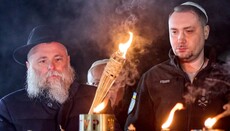
But why then is the largest Jewish menorah in Europe installed annually on the main square of Kyiv? Why does the President of the country V. Zelensky celebrate the beginning of Ramadan in a mosque? Why does the head of the Office of the President K. Budanov celebrate Purim with Jews?
Jews, Muslims and representatives of all other religions have equal rights, but the demonstrative participation of the country's top leadership in religious holidays is not their personal matter, it is state policy. And as we can see, it is determined not by the religious preferences of the people but by something else.
Conclusion
The overall picture is as follows. The Razumkov Center report in the part concerning the UOC is grossly manipulative, and therefore untrue. And this inevitably affects the reliability of the entire study. The OCU "wins" as a patriotic brand, but in reality its figures are "inflated". The OCU creation led not to an increase in the number of Orthodox Christians but to their decline. The real winners are the Greek Catholics. And finally, more and more Ukrainians simply do not consider it necessary to belong to any Church.
Perhaps this is the main thing that everyone should think about: both the authorities and representatives of denominations.