
Vyshyvanka instead of Heaven: When national symbolism overshadows Ascension
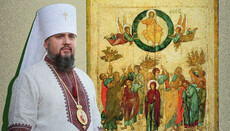
The head of the OCU placed the Ascension of the Lord and Vyshyvanka Day on the same level, called the embroidered shirt “sacred,” and asked Christ for help in war. We examine what is wrong with this rhetoric.
On May 21, 2026, the feast of the Ascension of the Lord, the head of the OCU, Serhiy (Epifaniy) Dumenko, published spiritual reflections on his Facebook page that deserve the closest possible scrutiny. This brief text is not merely a passing post. It is a manifesto of the rhetoric that has long become the hallmark of the OCU head – rhetoric that, step by step, replaces the substance of the Orthodox faith with something else entirely.
“This year’s feast of the Ascension of the Lord, which coincided on the calendar with Vyshyvanka Day, took on a special, unique mood – warm, native, Ukrainian, and bright,” Dumenko writes. He immediately adds that for Ukrainians the vyshyvanka is “sacred” clothing, and that Christ, although He ascended into heaven, remains among us and “urges us to love our people and fight for good for them.” The whole thing ends with the usual request for “victory over the bloody false teaching of the ‘Russian world.’”
Let us take this text apart piece by piece. Because behind each of its phrases stands a problem that cannot be passed over in silence.
The Feast of the Ascension and the Day of a Shirt
The Ascension of the Lord is one of the Twelve Great Feasts of the Church. Saint John Chrysostom says that in the Ascension, our human nature for the first time enters the Holy of Holies itself and sits “at the right hand of the Father.” This is a feast about a radical transformation in the very destiny of man: Heaven, once sealed to us, is now opened. By His Ascension, Christ shows us the road upward – to where we are called to ascend, putting off, in the words of the Apostle Paul, “the old man, which is corrupt according to the deceitful lusts,” and putting on “the new man, which after God is created in righteousness and true holiness” (Eph. 4:22–24).
And what is a vyshyvanka? If we set aside all the pathos that surrounds it today, it is simply a shirt with a traditional pattern. Similar embroidered clothing exists among dozens of peoples around the world: Romanians, Bulgarians, Serbs, Poles, Belarusians, Lithuanians, Estonians, Mexicans, Indians, and the peoples of the Caucasus and Central Asia.
No one denies that the vyshyvanka is one of the recognizable symbols of Ukrainian culture – like borscht, the hopak, or the bandura. But it is an ethnographic symbol, not a theological one. It is simply national clothing.
Can an article of clothing be placed on the same level as the Savior’s Ascension into Heaven? Can a feast in which the gates of the Heavenly Kingdom are opened to mankind be “paired” with a day when people put on the same kind of shirt? The comparison itself teeters on the edge of blasphemy.
Not because the vyshyvanka is bad. But because the Ascension is infinitely greater.
A “sacred” shirt: a return to paganism?
The word “sacred,” which Dumenko applies to the vyshyvanka, deserves special attention. In Christianity, such words are not used casually. The sacred is that which is sanctified, dedicated to God. The Holy Gifts are sacred. A church is sacred. Icons are sacred. Can we call an item of everyday clothing sacred?
Ethnographers and historians of culture know very well where the idea of the “sacredness” of the vyshyvanka comes from. It comes from the pagan past of our ancestors. In the Slavic tradition, the patterns on the collar, sleeves, and hem of the vyshyvanka served as protective charms. It was believed that evil spirits could “touch” a person precisely through the edges of clothing – the neckline, cuffs, and lower hem. For that reason, people embroidered rhombuses, swastika-like crosses, and triangles, which, according to folk belief, drove away unclean forces. The color of the threads, the placement of the signs, the direction of the lines – everything had magical meaning. Red thread meant protection from the evil eye; black signified a connection with the earth and the ancestors. This is a classical magical worldview in which the vyshyvanka functions as an amulet.
For a Christian, what is sacred is what is sanctified by the Holy Spirit through the Church. But the vyshyvanka cannot be sacred. One may love it, wear it with joy, and take pride in the craftsmanship of one’s grandmothers. But to call it sacred means returning to precisely the worldview from which Christianity led our ancestors out over the course of a thousand years.
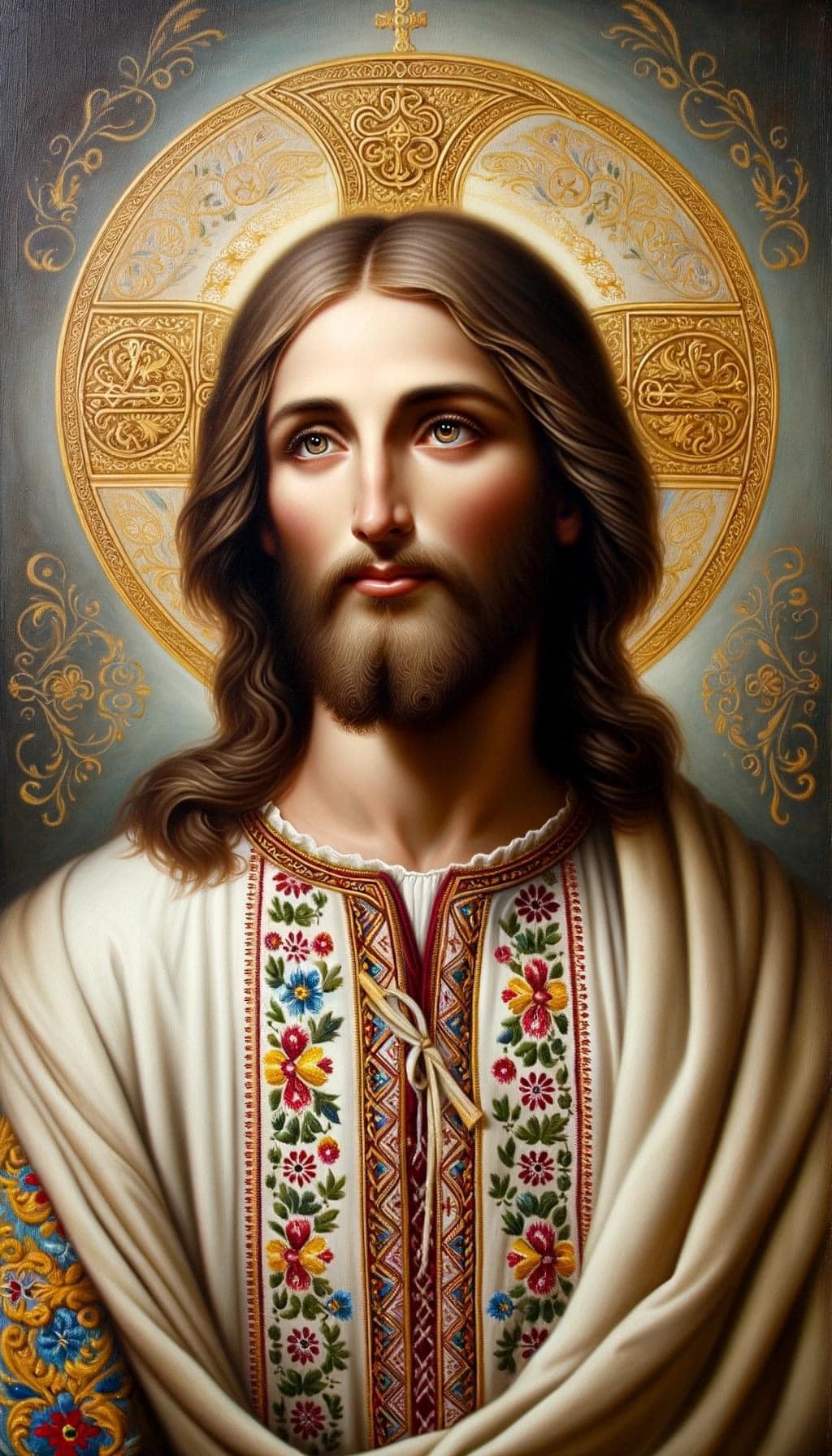
Incidentally, statements about the special meaning of embroidery in the OCU are made constantly. Last year, Dumenko declared that it is “difficult today to imagine” the OCU “without Ukrainian embroidery – without embroidered towels, clerical vestments, embroidered icons.” And the “OCU abbot of the Lavra,” Avraamiy Lotysh, went even further – he published an AI-generated “icon” of Christ in a vyshyvanka.
Ethnophyletism: a heresy condemned by the Church
The third point in Dumenko’s post is the claim that the Ascension “took on a Ukrainian mood.” And here the problem exists on two levels at once.
First, the phrase itself borders on blasphemy: an event of cosmic magnitude is described in the language of a worn-out journalistic cliché – remember that tired phrase “played with new colors”? Second, behind this rhetorical carelessness stands a phenomenon that has a very specific name in Orthodox theology: ethnophyletism.
Ethnophyletism is the subordination of church life to the principle of national or ethnic belonging, an attempt to build the Church not according to the Gospel but according to tribal identity. And it is a heresy directly condemned by the Orthodox Church.
In 1872, a special Council was held in Constantinople, attended by Patriarch Anthimos VI of Constantinople, Patriarch Sophronios of Alexandria, Patriarch Hierotheos of Antioch, and Archbishop Sophronios of Cyprus. The Council was convened in connection with the actions of the Bulgarian Exarchate, which sought to organize church life along ethnic lines. The Council unequivocally condemned phyletism – “that is, distinctions based on tribal origin, national quarrels and strife in the Church of Christ” – and declared that “the defenders of such ethnic discrimination in the Church are alien to the One Holy Catholic and Apostolic Church and are true schismatics.”
What is especially telling is that this resolution has repeatedly been recalled by Patriarch Bartholomew of Constantinople himself – the very same patriarch who issued the Tomos to the OCU. Bartholomew has publicly called ethnophyletism a dangerous disease of Orthodoxy many times and has condemned those who turn the Church into an instrument of national self-consciousness.
And now the head of a “church” structure created by Constantinople itself is doing in his public statements exactly what Constantinople once condemned conciliarity. The Ascension of the Lord – an event of cosmic, universal, and all-human significance – has, in Dumenko’s words, “taken on a Ukrainian mood.”
This is classic, textbook ethnophyletism.
Dragging Christ down: a vector not to heaven, but to earth
But the most important thing in Dumenko’s post is not even the comparison of the feast with a shirt, nor the ethnophyletist accent. It is what he does to the very meaning of the Ascension.
By His Ascension, Christ shows mankind the vertical path: from earth to Heaven. He departs from the earthly in order to open the eternal to us. The Church’s teaching on the Ascension is always a teaching about the elevation of human nature, about man’s upward path to God.
And what does Dumenko do? He brings Christ back down. Yes, he formally mentions that Christ ascended. But immediately he adds that He “remains among us” and “urges us to love our people and fight for good for them.” And then comes the familiar barrel-organ tune about war, about the “Russian empire of evil,” about “victory over the bloody false teaching of the ‘Russian world.’”
In other words, Christ, Who by His Ascension opened for us the road to Eternity, becomes, in the hands of the OCU head, the One Who “helps us win” earthly battles.
This recalls what our land lived through in the first post-revolutionary years.
Icons were carried out of closed churches and put to use: boards bearing the faces of the Savior were turned into tabletops, laid as flooring in public institutions, or used to line mangers in cattle sheds. People walked across holy faces with their feet – not always out of hatred, more often out of indifference. A board is a board, after all; it might as well be useful.
What is striking in these scenes is not the coarseness itself – there has always been enough coarseness in human history. What is striking is the inner transformation that made such things possible. The icon, which once called man to Heaven, became material for household and institutional needs. Holiness became a convenient raw material.
And what Dumenko does with the feast of the Ascension is of the same order, only not in the realm of objects but in the realm of meaning. He takes one of the greatest holy things of Christianity – the event in which humanity received the path to Heaven – and lays it underfoot so that it may be more convenient to walk over it in the desired political direction.
The comparison of the Ascension with Vyshyvanka Day is the same throwing of icons underfoot, only in rhetorical form. And it is far less noticeable – which perhaps makes it more dangerous.
Nor is this the first time the OCU head has instrumentalized Christ, dressing Him, so to speak, in a “vyshyvanka.” One may recall the statement in which the OCU head called the Savior’s words “The Spirit blows where it wishes” a proverb. Such is his “applied,” “Ukrainian” God – a God who can help as a proverb and who “urges us to fight for good.” A God not of Heaven, but of earth.
Obvious parallels
Most Local Orthodox Churches still do not recognize Serhiy Dumenko’s episcopal rank. The Churches of Antioch, Jerusalem, Serbia, Poland, the Czech Lands and Slovakia, Georgia, Bulgaria, Romania, Albania, Macedonia, and Russia – the overwhelming majority of world Orthodoxy – do not recognize Dumenko as a clergyman.
One could regard him simply as a harmless man passing himself off as someone he is not. But that would not be entirely accurate. Through his rhetoric, his manipulations, and his encouragement of violence against other Christians, he inflicts real spiritual harm on thousands of people who trust him. He disorients them in the spiritual world, replaces the content of the Orthodox faith in their minds with national-political content, teaches them to call sacred what is not sacred, and to see in Christ a helper in earthly wars rather than the Savior of the soul.
Imagine an impostor who puts on a doctor’s coat and begins prescribing pills to people. If he were giving them something neutral, perhaps no disaster would follow. But he prescribes serious drugs that do not treat the illness and instead cause irreparable harm. Or imagine a fake trainer who tells athletes that, in order to achieve results, they should not train but eat more cakes and rest on the couch. The athlete believes him – and loses his form, and perhaps his health as well.
Epifaniy is doing exactly the same thing in the spiritual realm. He has put on vestments and begun teaching the people. But often he teaches not what the Church has taught for two thousand years. While calling man to Heaven, in reality he directs his gaze downward – into the plane of national and political passions. Speaking of the struggle against evil, he replaces the struggle against the passions with a struggle against people. Proclaiming Christ, he presents to his flocks not the Savior of souls, but a helper for current military needs. All of this is spiritual medicine that does not heal, but slowly poisons.
Conclusion
The saddest thing in this story is not even what Epifaniy says, but the fact that thousands of people who are sincerely seeking God listen to him. People who love their land, their language, their history – and have every right to do so. Loving one’s homeland is not a sin. Wearing a vyshyvanka is not a sin. Preserving folk traditions is not a sin.
The sin begins when, instead of Christ, you are handed a counterfeit of Him. When, under the guise of a sermon about Heaven, you are trained to think only about the earthly. When you are told that the Savior “helps us win,” rather than that He saves the soul. When you are gradually weaned away from the eternal and offered the temporary in its place, even if that temporary thing is important.
The head of the OCU offers his parishioners a “faith” in which Christ becomes one national symbol among others – alongside the vyshyvanka, the hopak, and the anthem. Convenient, understandable, and useful for the current moment.
Only this is no longer the faith of which the Apostle Paul said: “And now abide faith, hope, love, these three” (1 Cor. 13:13).
It is an imitation of that faith.
Beautifully embroidered – but still an imitation.