
Enthronement of Patriarch Shio: neither pro-Moscow nor pro-Phanar but Georgian
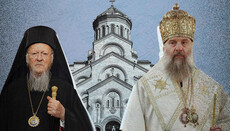
Constantinople representatives did not come to the enthronement, but developed vigorous activity the following week. What lies behind this and what to expect from the new Georgian Primate.
The election of a new Catholicos-Patriarch of All Georgia became an event not only of Georgia's internal church life. In Tbilisi, they didn't simply choose a successor to Patriarch Ilia II; these elections largely decided whether the Georgian Orthodox Church would maintain its cautious policy toward both the Phanar and the Russian Orthodox Church.
Outwardly, everything looked calm. On May 11, 2026, the Council of the Georgian Church elected Metropolitan Shio of Senaki and Chkhorotsku as the new Catholicos-Patriarch. And already on May 12, he was enthroned. Then followed congratulations, divine services, receptions of delegations, and declarations of brotherly love. But behind this external solemnity lies a more complex picture.
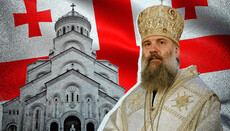
The main question of the week was far from simple: how would the Constantinopolitan Patriarchate react to the election of a man whom pro-Phanar and Ukrainian national-liberal circles had already branded as “pro-Moscow”? The answer came quickly – and proved more eloquent than any statements: Constantinople was absent from the enthronement on May 12.
However, within a few days, the Phanar was acting energetically and very publicly: it sent a delegation to Tbilisi, reminded of its "maternal" significance for the Georgian Church, ensured a public address by Archbishop Nikitas of Thyateira, and arranged a telephone conversation between Patriarch Bartholomew and the new Primate.
It is precisely this sequence – first absence at the crucial moment, then a hurried attempt to return to the frame – that most accurately reflects the real state of Tbilisi-Phanar relations.
Not an unexpected election result
About 1,200 delegates participated in the Council of the Georgian Church, but only 39 members of the Holy Synod voted. Metropolitan Shio received 22 votes, Metropolitan Job – 9, Metropolitan Gregory – 7, and one ballot was declared invalid. A second round was not needed.
Enough has already been said about the election procedure itself, and we cite these figures to show the internal state of the Georgian Church. Yes, Patriarch Shio won confidently but not unanimously. If counting only valid votes, a majority voted for him. But looking more broadly, almost half of the bishops supported other candidates. Note that for a Church where the entire episcopate essentially constitutes the Synod, this is not a technical detail but a reality the new Patriarch will have to face.
At the same time, the election of Metropolitan Shio was quite expected. Since 2017, he had held the position of locum tenens of the Patriarchal Throne and was considered the person closest to Patriarch Ilia II. From the very beginning, Shio made it clear that he came not with a new agenda, but with the intention to continue his predecessor's course.
But it was precisely this continuity that became a problem for those who expected the change of Primate to provide an opportunity to break the Georgian Church's course.
Under Ilia II, the Georgian Church neither recognized the OCU, nor entered into open conflict with the Russian Orthodox Church, nor became a conduit for Moscow's church policy. It maintained its own position: uncomfortable, sometimes irritating to everyone, but consistent. Judging by Patriarch Shio's first steps, he came not to break this line.
In this sense, the past elections were not so much a struggle of positions as a test: is the Synod ready to preserve the model of cautious church sovereignty. The majority answered affirmatively. However, the minority has not disappeared – and while there are few supporters of Constantinople within the Georgian Orthodox Church, they are active and quite capable of becoming an internal channel of pressure on the new Patriarch.
Enthronement
On May 12, Shio was enthroned at the Svetitskhoveli Cathedral. The ceremony took place in the traditional location for the enthronement of Georgian patriarchs, where Patriarch Ilia was also enthroned in 1977. The ceremony was attended by members of the Holy Synod, clergy, believers, and representatives of the Georgian government.
It is noteworthy that there was no official delegation from the Constantinopolitan Patriarchate at the enthronement. This is particularly significant considering how consistently the Phanar strives to be present at such celebrations – especially in those Churches where it considers it necessary to remind of the historical connection and its role in the pan-Orthodox structure.
In this case, the absence was too noticeable. It is understandable that this could be explained by the fact that the enthronement took place the day after the elections, there was little time for delegations to arrive, and so on. But such a version does not explain everything.
Because within a few days, Constantinople was acting quickly and very publicly. This means the problem was not only organizational. The Phanar seems to find itself faced with the fact that the Georgian Synod elected the candidate who would not be most convenient for the Constantinopolitan Church, and the enthronement itself took place before the Phanar could occupy a prominent place in it.
All this, of course, does not mean a break between the Georgian Orthodox Church and the Constantinopolitan Patriarchate. But it does mean distance – and precisely at the moment that was most important for the Georgian Church.
Why the Phanar could not simply remain silent
Constantinople could not allow the absence on May 12 to become the main testimony of its relations with the new Patriarch of Georgia. Had the Phanar limited itself to a written congratulation, this would have looked like a tacit admission of losing influence over the Georgian Church. Therefore, almost immediately after the enthronement, active work followed to correct the situation.
First came a congratulation from Patriarch Bartholomew, in which he speaks of joy over Shio's election, recalls Ilia's ministry, and wishes the new Primate fruitful primatial service "for the peace and stability of the Georgian people," as well as for the development of pan-Orthodox unity in cooperation with Constantinople and other Primates.
On May 16, Patriarch Shio received a delegation of the Ecumenical Patriarchate consisting of Archbishop Nikitas of Thyateira and Great Britain, Metropolitan Maximos of Silivri, and the Grand Syncellus of the Phanar, Archpriest Hieronymos.
It should be noted that chronology is important here, as the delegation was received when the new Patriarch had already been elected, enthroned, and recognized by the Georgian Church and state system. That is, the Phanar entered the process not as a participant in the main act, but as a party trying to restore its place after the main act had already taken place. But Phanar and pro-Phanar media tried to present this not as being late, but as a sign of unity, particularly noting that hierarchs of the Ecumenical Patriarchate would concelebrate with the new Patriarch of Georgia the next day.
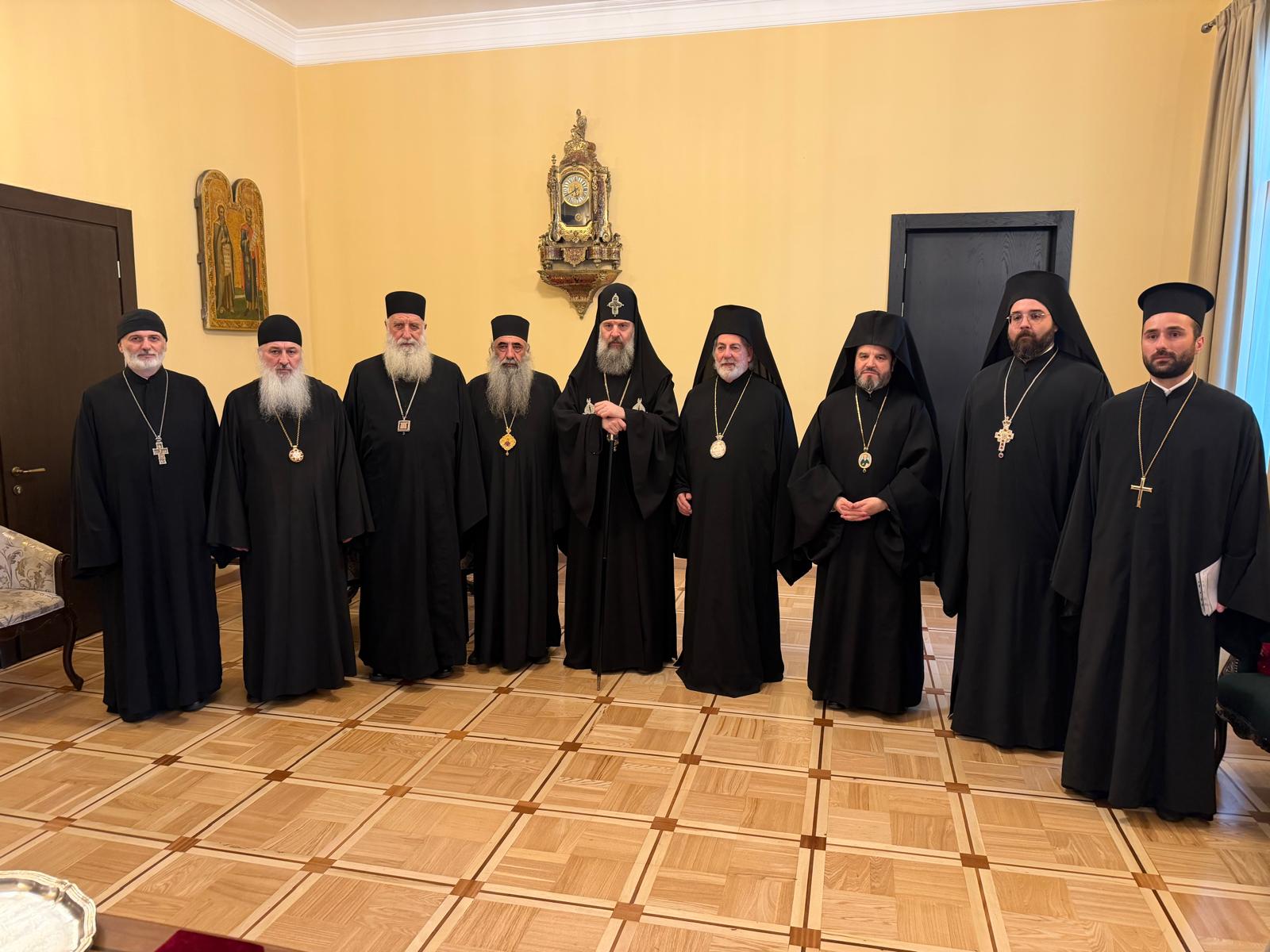
It was precisely this service that became the second key moment after the enthronement. If on May 12 the Phanar was absent from the scene, then on May 17 it was already a visible participant. Moreover, its presence was made as prominent as possible.
Archbishop Nikitas's speech
The most revealing element of the Phanar compensation was Archbishop Nikitas of Thyateira's speech, in which he called the presence of the Phanar delegation a "visible sign of unity" of the Mother Church of Constantinople and the Church of Georgia, as well as unity of faith.
At first glance, this is an ordinary welcoming speech. But in church circles, such formulas are never accidental.
First, Constantinople calls itself the Mother Church in relation to Georgia, thereby expressing not only historical connection but also reminding of Constantinople's claim to a special place in the Orthodox world.
However, for the Georgian Church, which has a strong self-awareness of ancient autocephaly, such a formula can be ambiguous.
Second, the Phanar's presence was presented not simply as an act of courtesy, but as a sign of unity. That is, "we were not at the enthronement, but now we are here."
Third, Archbishop Nikitas spoke on behalf of Patriarch Bartholomew and in his speech tried to set the framework for Shio's future ministry: to be a Primate who remains within the field of the Phanar understanding of pan-Orthodox unity.
Compensation mode
Another interesting detail is the telephone call from Patriarch Bartholomew. On the evening of May 17, he spoke by phone with Patriarch Shio. Pro-Phanar media particularly emphasize that the conversation took place on the occasion of the official patriarchal delegation's presence at the first Liturgy of the new Georgian Primate.
In other words, this call was presented in the media as an element of a unified construction, along with the delegation, Divine service, and Archbishop Nikitas's speech. The general meaning was supposed to be read as follows: the Primate of the Constantinopolitan Church is not personally present, but speaks through messengers, blesses through them, and reinforces contact with a personal call.
This is the compensation mode, whose task is to minimize the negative effect of the absence at the enthronement as much as possible.
One clarification is necessary here: Constantinople’s absence on May 12 cannot be explained by logistics alone. Yes, the enthronement was scheduled rapidly. Yes, it may have been difficult for delegations of the Local Churches to arrive already the day after the election. But if it had been only a matter of logistics, there would not have been such intensive efforts to create the impression that the Phanar was nevertheless present.
It is obvious that Patriarch Shio does not belong to those Georgian bishops from whom one could expect a sharp turn toward Constantinople.
At the same time, calling him “pro-Moscow” is a major mistake. This label is actively used in pro-Phanar and pro-Western circles, but it says nothing about the actual situation. Patriarch Shio’s position may coincide with that of the Russian Orthodox Church on a number of issues, but it is not reducible to agreement with it. The main point is different: Shio is a representative of the Georgian ecclesiastical tradition, which has been largely shaped by the influence of conservative monasticism.
It is precisely this that makes direct pressure on him ineffective for Constantinople. If Shio is portrayed as "pro-Moscow," the struggle against him can be presented as a struggle against Russian influence. But if he is an exponent of the Georgian church tradition itself, then pressure on him will inevitably be perceived as pressure on the Georgian Church as a whole.
Patriarch Shio and the OCU
For Ukrainians, the key question remains: will Patriarch Shio recognize Dumenko's structure?
The answer consists of several components. First, Shio was elected as a continuator of Patriarch Ilia's line. Second, the Synod of the Georgian Church itself does not demonstrate a majority in favor of recognizing the OCU – today it barely has two or three people in its composition ready to support such a step. Third, Patriarch Shio III’s initial liturgical actions show that he pays close attention to the diptychs and canonical statuses.
For example, at his first Liturgy, he did not commemorate Archbishop Stefan of Ohrid, since the Georgian Church has not yet recognized the autocephalous status of the Macedonian Church (Ohrid Archbishopric). At the same time, the Orthodox Church in America is included in the Georgian Orthodox Church's diptych, although the Phanar does not recognize its autocephaly.
It turns out that the Georgian Church can recognize canonicity but not recognize autocephalous status, can have its own order of diptychs, may not consider a Phanar decision sufficient for pan-church recognition. That is, the Georgian Church does not automatically follow Constantinople in the matter of autocephalies but also does not unconditionally follow the Russian Orthodox Church.
Therefore, the Phanar is unlikely to begin with a direct demand to recognize the OCU. Rather, it will act differently: through visits, joint divine services, soft formulas about unity, the theme of "Mother Church," participation in inter-Orthodox events, and gradual creation of an environment where refusal of Phanar logic will look like "inadmissible escalation of good relations."
In this sense, the most sensitive possible lever of pressure on the Georgian Orthodox Church is Abkhazia. Bichvinta and Tskum-Abkhazia are present in the Georgian Patriarch's title because all this is part of church and national integrity.
If the Phanar is indeed dissatisfied with the Georgian Orthodox Church's persistent refusal to recognize the OCU or accept the Phanar model of church primacy, it could theoretically try to use the Abkhazian church question. But right now this looks unlikely, since it would destroy the just-created picture of "unity" with Patriarch Shio and immediately provoke a harsh reaction from the Georgian Church. But as a threat, as a background factor, as a potential instrument of pressure, this factor will remain constantly present.
Why the Phanar acted precisely this way
Constantinople's behavior after May 12 can be described as an attempt to solve three tasks simultaneously.
The first is not to allow the absence at the enthronement to be perceived as defeat or loss of influence. This is why the compensation mode discussed above was launched.
The second is through Archbishop Nikitas's speech, to make it clear that the new Georgian Patriarch cannot be understood outside of his connection with Constantinople.
The third is not to give the initiative to the Russian Orthodox Church. The presence in Tbilisi of Metropolitan Ambrose of Tver and the participation of the Ukrainian Orthodox Church created an alternative picture of inter-Orthodox communion, undesirable for the Phanar.
In the end, Constantinople entered the frame. But – only after the main act had taken place without it. This is precisely where the weakness of its position lies.