UOC Spokesman: Borodiansky’s statement contradicts President’s strategy
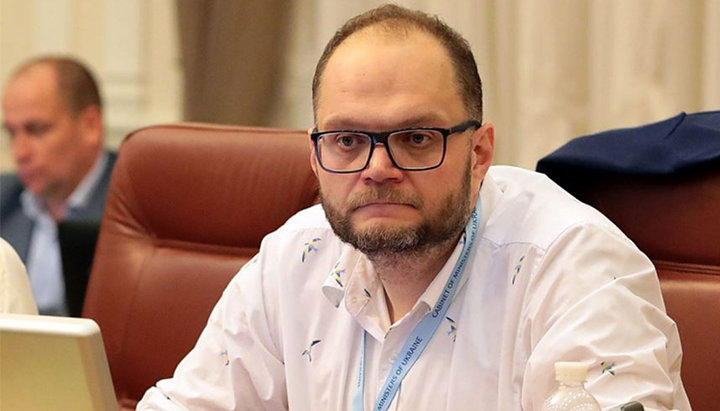
Minister of Culture, Youth and Sports Vladimir Borodiansky. Photo: zik.ua
The desire of the Minister of Culture, Youth and Sports of Ukraine Vladimir Borodiansky to rename the UOC is contrary to the strategy of the President of Ukraine Vladimir Zelensky, noted Archpriest Nikolai Danilevich, deputy head of the Department for External Church Relations of the UOC, in an interview with the online outlet “Apostrophe”.
“At a time when President Zelensky is trying to solve the problem of armed conflict in the East, continuing to create religious problems within the country is not very correct,” said the spokesperson for the UOC. “The President says that conciliation is necessary, including within the country. We want to sew the country, and things like renaming the Church, which are the rudiment of the ideology of the previous government, only harm it."
The clergyman explained what consequences pedaling the idea of renaming the Church could have for the country and its people.
“We understand how this will work in the public mind: Russia is an enemy, which means the Russian Church is also an enemy, so all those who are related to the Russian Church are also enemies. We actually artificially create enemies within the country,” Archpriest Nikolai emphasized. “After all, Ukrainians themselves, citizens of Ukraine, and not imported Russians, as it can sometimes be read in the propaganda media, belong to the UOC.”
The Minister of Culture, as a responsible person, should very carefully speak out on such topics, believes the deputy head of the UOC DECR.
“At the moment, there is not a single legal requirement that obliges the UOC to change its name. The law does not say about the UOC. Under the previous political authority, the Ministry of Culture attempted to mislead people and, using manipulations, said that this concerns the UOC,” he recalled.
According to the spokesperson for the UOC, Borodiansky’s decision was made “as a result of political expediency, the presence of an order from the past authorities, as well as on a tip-off from the bowels of the current OCU”.
"After the creation of the OCU, they deliberately registered with the almost identical name ‘Kiev Metropolis of the Ukrainian Orthodox Church (Orthodox Church of Ukraine)’. And this is despite the fact that in the Tomos they are not called the UOC, namely the OCU or the ‘Holy Church of Ukraine’. There is a contradiction,” said the deputy head of the UOC DECR. “And they did this in the hope that they would rename us, and they could take our name and then the temples.” ...> That is, it is pure raiding, which in the future will again lead to conflicts. Why do this?”
OCU representatives often try to call themselves not by their own name but by the name of the UOC in the media, which misleads people, Archpriest Nikolai stressed.
“This movement on renaming, and accordingly the minister’s statements, contradict the strategic line of the President,” he concluded.
We recall that in November 2019, the Minister of Culture said that he supported the law on the involuntary renaming of the UOC. Later, the First Deputy Minister of Culture of Ukraine Svetlana Fomenko said that in the near future the Ministry of Culture would return to the renaming of the UOC. Borodiansky later stated that one should be held criminally liable for non-compliance with the law on renaming the Church.
According to the religious scholar Elena Kulakevich, Borodiansky’s statements can be perceived as a pressure on the court. “He does not know, for example, that there is a decision of the court, of the Ukrainian court, that the law that forces our Church to be renamed is suspended for today. While the trials are ongoing, the state official does not have the right to speak out on this issue because it can be perceived as pressure on the judiciary,” she explained.
Read also
Khust Eparchy honors memory of St. Job of Uholka
A Liturgy is served in Mala Uholka, a birthplace of St. Job of Uholka, on the saint's feast day.
UOC parish in Cologne donates ultrasound machine to Kharkiv region hospital
In Cologne, UOC believers raised funds for an ultrasound machine for the Kehychivka district hospital in the Kharkiv region.
Shevchuk tells Pope Leo of Ukraine's preparations for "another harsh winter"
The head of the UGCC expressed "special gratitude" to the Pope for his phone calls with Putin and Zelensky.
Berlin hierarch comments on Phanar document published by UOJ-USA
Metropolitan Mark called the information about the 2018 "Unification Council" alarming if confirmed, and expressed hope that Patriarch Bartholomew will reconsider his position.
UOC marks Synaxis of All Saints of Volyn Land at Lutsk cathedral
Metropolitan Serhiy of Ternopil and Kremenets led the Liturgy on the feast day of the Lutsk cathedral of All Saints of the Volyn Land.
SBU detains OCU cleric who organized draft evader's escape for money
In Transcarpathia, law enforcement officers detained a clergyman of the OCU who arranged for a draft evader to be smuggled into Slovakia for $15,000.