Nationalists picket the opening of the Orthodox Film Festival in Dnipro
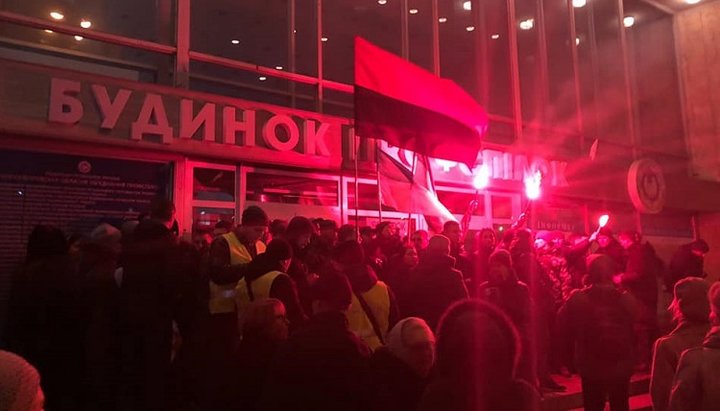
A picket at the House of Trade Unions in Dnipro. Photo: “Nashe Misto”
On January 30, 2020, on the opening day of the XI International Festival of Documentary Christian Films “The Film Assembly on the Dnieper”, organized by the “Lestvitsa” (Ladder) Orthodox Culture Centre, dozens of masked activists with fires and posters “No to the Russian world!” and “Freedom to the prisoners of the Kremlin” held a protest rally at the House of Trade Unions in Dnipro, reports “Radio Liberty”.
According to one of the activists, the protests were displeased with the fact that among the films participating in the festival there are “10 films made in Russia and only one is Ukrainian”.
“There are good Ukrainian films, for example, ‘Myth’ about a participant in the ATO, a famous opera singer,” the outlet quotes the activist. “But they are not offered for viewing. Before the start, there was a provocation: we were not allowed into the building by some “titushki” (men of strong built – Ed.). Just because we speak Ukrainian. The language is as an identifier,” she said.
The picketers, who were described by “Radio Liberty” as “representatives of public organizations, combat veterans in the Donbass, parents of the dead military, volunteers,” blocked the entrance to the House of Trade Unions, not allowing the spectators in, and demanded to present them film licenses. Also, some activists broke into the hall in order to "check whether the films contain pro-Russian propaganda" and "immediately after the announcement of the start of the festival, the Ukrainian anthem was sung".
At the same time, the local newspaper “Nashe Misto” specified that dozens of ultra-right-wing nationalists from the National Corps who “put on masks and burned fires” came to the House of Trade Unions.
In a commentary to “Radio Liberty”, the organizers of the Film Assembly emphasized that all films presented at the festival are outside politics. Among the participating pictures are films from Belarus, Georgia, Russia, Ukraine, Serbia, Armenia, and Azerbaijan.
“We are not here for this. We are talking about cinema, about directors, these are artists. We are not talking about war, because war is a topic that hurts everyone,” said Archpriest Igor Sobko, head of the “Lestvitsa” Orthodox Culture Centre.
We recall that the "International Film Assembly on the Dnieper" was first held in 2010. The main goal of the festival is to popularize documentary film art and create favorable conditions for the development of modern documentary cinema in Ukraine. In addition to film screenings, the festival also hosts meetings with filmmakers. The forum has long been a platform for communication between documentary filmmakers.
The opening film of the “Film Assemblies on the Dnieper – 2020” was a documentary “Our Beatitude” about the Primate of the Ukrainian Orthodox Church, Metropolitan Onuphry of Kyiv and All Ukraine.
Read also
OCU explains why folklore events should be held in church, not in culture house
OCU representatives in Cherkasy explained why they held a concert and a talk about wedding traditions in the seized cathedral.
UOC hierarch celebrates Liturgy at relics of St. Nicholas in Bari
Archbishop Ambrose of Zghurivka, UOC clergy serving in Italy, and KDAiS students prayed at the myrrh-streaming relics of St. Nicholas the Wonderworker in Bari.
Police pledge increased security at UOC Kyiv Metropolia court hearing
UOC lawyers secured additional police presence following repeated provocations and direct pressure on the legal team outside the courthouse.
“Imperialist”: OCU cleric explains why Hieromartyr Vladimir is not venerated
An OCU representative claimed that Hieromartyr Vladimir supported “imperial policies” and was killed over money rather than for his faith in Christ.
Metropolitan Nektarios: Global system seeks to create “universal religion”
The Greek hierarch warned of the dangers posed by the global system.
OCU supporters stage provocation at soldier’s funeral in Polytsi
Relatives of the fallen soldier demanded that an OCU cleric conduct the funeral service inside a UOC church.