Human rights defender: UOC lawyers should sue SBU for unlawful actions
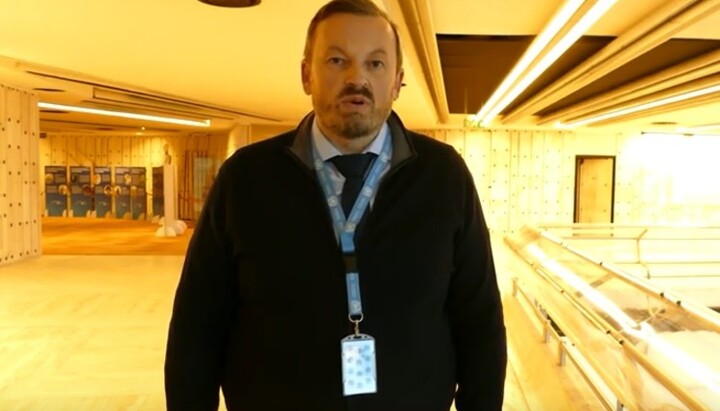
Human rights defender Oleg Denisov. Photo: a video screenshot of the Youtube channel "NGO Public Advocacy".
Lawyers of the Ukrainian Orthodox Church should actively apply to courts over illegal actions of the authorities – this is the only way to draw attention to and receive help from international human rights organizations, said human rights activist Oleg Denisov.
Speaking about searches and other actions of the SBU in monasteries and eparchies of the Ukrainian Orthodox Church, the human rights activist drew attention to the contradictory information about these events.
"On the one hand, the UOC officials – the head of the UOC Information department, Metropolitan Clement, and the abbot of the Kyiv-Pechersk Lavra, Metropolitan Pavel – were quite reticent about these security measures or searches. Thus, there is no problem for international human rights activists, law enforcers acted in a tolerant and balanced manner and there were no violations. On the other hand, in the near-church media such as the UOJ and the Pershyi Kazatskyi, as well as in some comments made by clerics it is seen that there are numerous persecutions and violations of the UOC’s rights," the human rights defender pointed out.
He explained that articles in the media and even statements by the UOC Information Department are not enough to make a court decision or to conclude whether there is or is not systematic discrimination. The conclusion about the existence of persecution of the Church requires clarification: who is the initiator of persecution – the state or certain political circles that consider creating problems for the UOC as part of their political programme.
According to the human rights defender, religious organizations rarely appeal to courts: "So far, there have been no lawyers in any case who would clearly point out what problems exist and what claims they have against the law enforcement agencies.”
"Unfortunately, at the international level we do not see that decisions of local authorities to ban the UOC have been appealed in an administrative court, we do not see that complaints have been sent to an investigator, a judge or in some other way regarding actions on searches or security measures in the Chernivtsi region (broken doors, etc.); victims do not report violations of their rights, lawyers' complaints on these grounds have not been published in the media. Therefore, at the international level, one gets the impression that there are no violations of the UOC's rights but there are some minor misunderstandings," the human rights defender added.
He stressed that if the UOC needs international legal protection, it is necessary to apply more actively to courts, to involve professional lawyers and to bring cases which have been confirmed by facts to the international level.
Read also
Khust Eparchy honors memory of St. Job of Uholka
A Liturgy is served in Mala Uholka, a birthplace of St. Job of Uholka, on the saint's feast day.
UOC parish in Cologne donates ultrasound machine to Kharkiv region hospital
In Cologne, UOC believers raised funds for an ultrasound machine for the Kehychivka district hospital in the Kharkiv region.
Shevchuk tells Pope Leo of Ukraine's preparations for "another harsh winter"
The head of the UGCC expressed "special gratitude" to the Pope for his phone calls with Putin and Zelensky.
Berlin hierarch comments on Phanar document published by UOJ-USA
Metropolitan Mark called the information about the 2018 "Unification Council" alarming if confirmed, and expressed hope that Patriarch Bartholomew will reconsider his position.
UOC marks Synaxis of All Saints of Volyn Land at Lutsk cathedral
Metropolitan Serhiy of Ternopil and Kremenets led the Liturgy on the feast day of the Lutsk cathedral of All Saints of the Volyn Land.
SBU detains OCU cleric who organized draft evader's escape for money
In Transcarpathia, law enforcement officers detained a clergyman of the OCU who arranged for a draft evader to be smuggled into Slovakia for $15,000.