Met. Luke: People of Montenegro thank Vladyka Amfilohije for victory
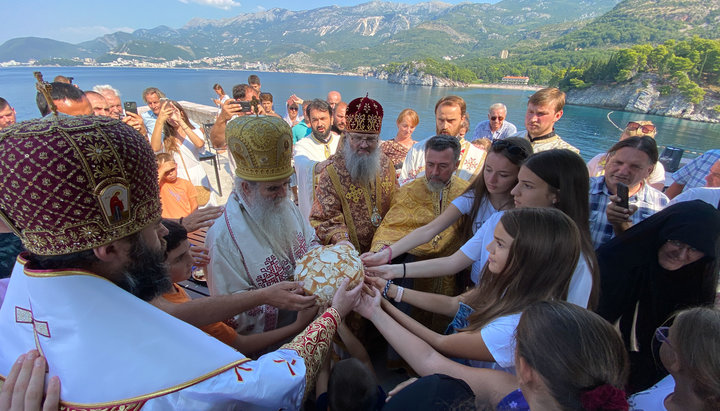
There is a tradition on patronal days in Montenegro – after the service everyone venerates the bread. Photo: the press service of the Zaporizhzhia Eparchy
Hierarchs of the Ukrainian Orthodox Church Metropolitan Luke and Archbishop Diodorus are now on a visit to Montenegro. The bishops concelebrate to Vladyka Amfilohije and the priesthood of the Montenegrin-Littoral Metropolitanate of the Serbian Orthodox Church in various churches and monasteries of the country.
Montenegro has a special atmosphere of ascent and national unity now. For almost a year, there have been large-scale, multi-thousand cross processions in the country, where people have prayed and protested against the authorities' intentions to take away the Church's temples. More recently, the rulers who had fought the Church lost the parliamentary elections held in the country. Montenegro is now forming a new government and, in fact, a new power.
The UOJ managed to contact Metropolitan Luke. We asked Vladyka to share his impressions of his stay in the country, communication with Vladyka Amfilohije, priests and faithful Montenegrins.
– Vladyka, how has the attitude of the clergy and believers changed in Montenegro? Is there a sense of freedom? Do the Orthodox expect that the time of the struggle with the Church has come to an end?
– Both Vladyka Amfilohije and the ordinary faithful believe that God will not leave them and will help them. Opposition leader Zdravko Krivokapić is a professor who teaches not only at the University of Podgorica but also at the Orthodox seminary. He is a deeply religious person. And he has already mentioned that the anti-church law of the previous government will soon be cancelled, the Montenegrins are looking forward to this.
I witnessed how many people approached and thanked Vladyka Amfilohije for his firm position in protecting the Church and thanked him for the victory. We know that Vladyka was always far from politics, did not go to elections and in general never touched on political issues. But when the politicians took up arms against the Church, the Metropolitan called on the entire flock to come and vote.
At the same time, in spite of the fact that President Đukanović is a man who openly threatened to destroy the Church, Vladyka Amfilohije speaks of him with love and believes that the Lord will enlighten him: "I pray that God will bring him to repentance."
– Over the past year, we have seen large-scale cross processions on the streets of Montenegro. Can we say that the struggle of the authorities against the Church was at its advantage? Did it result in more people in temples, at the sacraments?
– Vladyka Amfilohije is convinced that it was beneficial. People were able to prove their faith before God. Not in words, but in deeds. The attempts of the authorities to fight the Church make it possible to see a bright personality in troubled times, and for a believer – first of all, to see this person in themselves.
People for the Church are ready not only to give their vote at the elections but are also ready to give their lives. It is very important.
Have more people become involved in the sacraments? Vladyka Amfilohije and I have served together for three days in a row. But I have not seen a single service with fewer than 50 participants. And this is despite the fact that we served neither in big cities nor in cathedrals but in very small churches. But there were always a lot of people. Montenegrins came and received communion. For me, it even came as a surprise in some way.
And the way the believing people of Montenegro testified to their faith makes me as an archpastor very happy. Metropolitan Amfilohije can safely say to God: Lord, here I am, and here is my flock. And this flock can testify to trust in their master, in their Church, faith in God and adherence to the faith that Christ affirms to us.
Read also
Yelensky’s plan: Why is DESS demanding what the UOC has already done?
DESS is demanding that the UOC take steps it has already taken, while offering no assurance that further demands will not follow. What is behind Yelensky’s ultimatum?
Why OCU hierarchy lacks canonical ordination: what Local Churches say
The OCU head refuses to address invalidity of his ordinations. But almost all Local Churches speak of it – even those that recognized the OCU.
Why nation-first advocates do not call for peace
Ukraine’s population is declining by nearly one million people a year, and experts are warning of the nation’s demographic extinction. Yet the leaders of the Orthodox Church of Ukraine (OCU) and the Ukrainian Greek Catholic Church (UGCC) continue to call for war and mobilization.
The deception that decided the fate of the Tomos
In 2008, the "Filaret problem" derailed Yushchenko's plan. In 2018, Poroshenko solved it in just one hour – with a police escort for the Greeks and verbal promises to Filaret.
Lawyers in the crosshairs: How UOC is being stripped of its right to defense
Activists harass UOC lawyers outside courthouses, call them “traitors” on air, and promise them a “warm welcome” at hearings. The Church’s right to a legal defense is at stake.
How to respond to persecution: Lessons from St. Silouan the Athonite
The Church can and should be defended, but without malice. Why love for persecutors is not weakness but the only way to preserve the Spirit of Christ in the midst of the struggle.