Human rights activist: The ban on the UOC cannot be implemented in practice
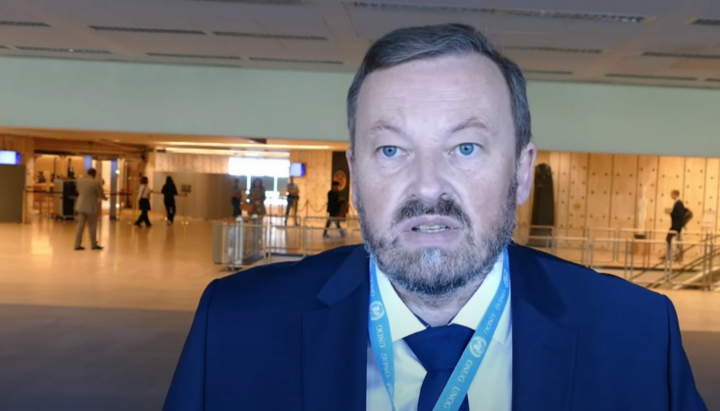
Human rights activist Oleh Denisov. Photo: screenshot from YouTube channel NGO Public Advocacy
The head of the human rights organization NGO Public Advocacy, Oleh Denisov, stated that it is impossible to implement any of the bills aimed at banning the Ukrainian Orthodox Church (UOC) within the legal framework. Denisov shared his video commentary on the Public Advocacy YouTube channel.
Oleh Denisov believes that "even if these laws are passed, it does not mean that the activities of the UOC, which consists of 12,000 religious organizations, will suddenly cease, and people will be unable to pray or use the churches."
Commenting on the draft law initiated by the Security Service of Ukraine (SBU), which proposes to ban a religious organization for "incitement of religious hatred," the human rights advocate asserts that "to implement this mechanism, there must be legally effective verdicts in criminal cases." Additionally, Denisov says that the "authorized body for religious affairs must initiate a lawsuit in court."
"So it will take years, it's not an instantaneous action. Everything needs to be proven. There are also appellate rights and so on. Therefore, in my view, this mechanism is simply unfeasible," says the human rights advocate.
Regarding the potential legal action to terminate the activities of the UOC, Denisov reminds that the Ukrainian Orthodox Church is not a single legal entity.
"Thus, you would need to file 12,000 lawsuits, and in each of these 12,000 cases, members of this religious community should be convicted of some criminal offense. Well, this won't happen; it's unrealistic. It's clear that this law is purely for PR purposes," Denisov stated.
He believes that the law to ban the UOC "serves as a political flag, a trigger to launch a new wave of persecution against the UOC." According to the human rights advocate, "it's a political move that has more of a media character than a legal one."
"From a legal standpoint, these laws are meaningless. They contradict international law norms, and I can't see how they can be implemented in a situation where there is at least some formal legal system," Denisov concluded.
Previously, it was reported that, according to media reports, the Parliament would vote on the ban of the UOC at its upcoming session.
Read also
Dumenko holds "service" at seized UOC church in Boyarka
On September 29, the head of the OCU performed a "divine service" at St. Michael's Church in Boyarka and rewarded the raider-rector.
UOC hierarchs mark 30th anniversary of Holovchyntsi Convent's revival
UOC bishops and clergy of the eparchy congratulated the abbess of the Transfiguration Convent and her sisters on the memorable date.
UOC cleric discusses life of Ukrainian parishes with Hungarian official
A UOC priest and a Hungarian official paid particular attention to issues of practical interaction between Ukrainian parishes and government authorities.
Ukrposhta issues stamp featuring Lavra for Soviet-era reserve's anniversary
The new postal block, issued in a print run of 40,000 copies, depicts the Lavra's churches, bell tower, and ancient frescoes.
Met. Theodosiy links his criminal case to ex-prosecutor named in NABU tapes
A Cherkasy court extended Metropolitan Theodosiy’s preventive measure for another two months – until November 29, 2026.
Stefanchuk: Seeking UCCRO-LGBT compromise on new Civil Code
The Verkhovna Rada speaker said the working group is seeking a broad public compromise as it revises the draft of the new Civil Code.