UOC speaks about phenomenon of Zalestsy where 250 priests grew up
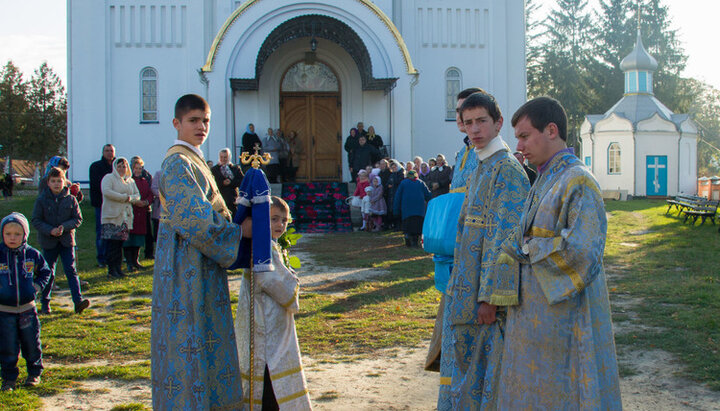
The unique village of Zalestsy, where 250 priests have grown up. Photo: ternopil.church.ua
The village of Zalestsy in the Zbarazh district of the Ternopil region is famous for the fact that in different years about 250 natives have become Orthodox priests. In a commentary to the UOJ about the phenomenon of the unique village, the cleric of the Ternopil Eparchy of the UOC, the rector of the local Holy Protection Church, Archpriest Andrei Garasim, told the UOJ.
“To be honest, the village is like a village. Ordinary people, ordinary parishioners. But there is such a feature – there are many priests. Why – we, people, can only guess. We are not far from Pochaiv, and all the surrounding villages are also famous for many priests, perhaps not in such numbers – some of them have 50 priests and 100 priests each. But we have about 250,” Fr. Andrei noted.
Data on the priests from Zalestsy have been collected from the 30s of the last century and, according to the rector, not everybody was documented – they counted only those whom people remember. Among the natives of the village is a famous clergyman, former secretary of two Patriarchs of Moscow and All Rus’, Patriarch Pimen and Patriarch Alexy, Protopresbyter Matthew Stadnyuk (1925-2020). Here, coming to his grandmother on vacation, Metropolitan Sergiy of Ternopil and Kremenets spent his childhood.
Among the natives of the village, there are also those who went into schism – there are about ten such people, Fr. Andrew said, including the so-called “Bishop” John Shvets, the author of “Akathist to the Heavenly Hundred”, which was banned by Filaret Denisenko.
According to Archpriest Andrei, who has been serving in Zalestsy for 20 years, the first factor why there are so many priests in the village is the proximity to the Holy Dormition Pochaшv Lavra. He explained that for a long time most of the inhabitants of Zalestsev “tried to make it a rule for themselves to walk early to the Lavra – this is 14 km. On the way, they visited our Holy Spirit Skete, and then went to the Lavra: they stayed for the service, confessed, received Holy Communion and walked back."
“This prompted many to such a spiritual life. There were people in the village who knew the Psalter by heart – without exaggeration, they are still remembered. For example, there was one blind person. He was always invited to read the Psalter after the deceased – in our village and many other villages, if a person dies, the Psalter is continuously read, day and night, until the funeral. And this blind man reads the Psalter, and then stops at kathisma 15 and at a certain psalm and asks to go and drink tea. And requests to remind him where he stopped. And then he didn't even need to be reminded – from the same word he continued reading the Psalter.
We also had such an elder, Kliment, called Klim. He was called "the 13th apostle". There were many neighbours' children, and in order to teach everyone to read in Church Slavonic, he gave them two or five kopecks for ice cream: read a kathisma – receive money. And he stood and watched them reading the words correctly, putting the accent correctly. And so he taught the children the Church Slavonic language,” said the priest.
The second important factor is the talented, authoritative rectors who served in the village over the years. According to Fr. Andrei, they attracted young people to the church and sent the most talented of them to study and taught themselves, gave references for the seminary. For example, thanks to Archimandrite Savva, who served in the parish for 22 years, many became clergy in the most atheistic period “when it was very difficult. But he did it!"
“We can talk about each of our priests separately,” the archpriest admitted. “For example, there was also such Fr. Auxentius, a friend of Fr. Matthew Stadnyuk. When he finished pastoral courses at the Pochaiv Lavra, the Second World War began, he was taken to the front. A whole regiment died there, and he and a couple of other people miraculously survived. Automatically everyone, and his home too, was sent a killed-in-action notice. The mother went to the priest, ordered a funeral service, a requiem. And they served over him for a year. But he returned, became a priest and served in one parish for 65 years."
Fr. Andrei added that in the two decades he has served at the Holy Protection parish, about ten boys have already grown up and become priests.
“As for me, a special mystery of God is that the Lord blessed the young men and males so that they went to the pastoral ministry,” resumed Archpriest Andrei Garasim.
Earlier, the UOJ wrote that the hegumen of the Pochaiv Lavra responded to Dumenko's words about the “non-Ukrainianness” of the Pochaiv monks.
Read also
Upper Lavra court hearing postponed
The next court hearing in the Upper Lavra case has been scheduled for November 3.
UOC priest blesses ambulances at Kamianske medical center
A UOC priest in Kamianske blessed ambulances for a medical facility and wished its doctors God's help in their work.
Dumenko to German ambassador: Law targeting UOC also applies to other groups
Epifaniy Dumenko sought to defend Ukraine’s law restricting religious organizations during a meeting with the German ambassador.
Activists bused to court hearings in UOC cases, media say
A minibus has been spotted transporting protesters to and from courthouses where UOC cases are being heard.
Firefighters save historic UOC church from fire in Zakarpattia
A fire broke out at a UOC church in the Tiachiv district, damaging the altar and church furnishings.
Volyn Eparchy faithful collect six tons of aid for Sviatohirsk Lavra
Believers in Volyn collected food and warm clothing for people displaced by the war who have found shelter at Sviatohirsk Lavra.