The Church celebrates the Feast of the Holy Apostles Peter and Paul
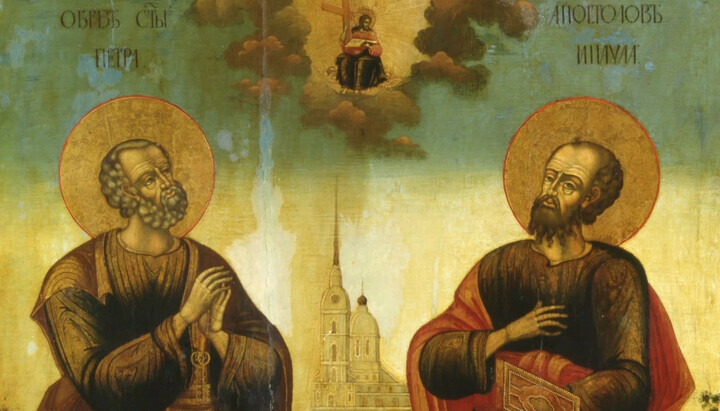
A fragment of the icon of Peter and Paul. Photo: open sources
The day of the holy foremost apostles Peter and Paul is celebrated on July 12 in the new style. It is named in honor of the apostles Peter and Paul, who preached Christianity around the world. Both apostles suffered martyrdom for their faith within a year of each other.
Before becoming a disciple of Christ, Peter was a fisherman. The Lord called Peter and his brother, the future apostle Andrew the First-Called, while they were fishing on the Sea of Galilee.
Peter was the first among the disciples to call the Teacher the Christ, that is, the Messiah. For this, the Lord called him Rock (the name Peter means "rock" in Greek). On this rock of Peter's faith, the Lord promised to build His Church, which the gates of hell would not overcome.
When the high priests took Christ into custody before the crucifixion, Peter denied the Lord three times, as He had foretold. But Peter repented and redeemed his betrayal by becoming a fervent preacher of the Christian faith. He indeed served as the foundation of the Church – the community of the faithful to the Savior.
Two General Epistles of Peter have survived to this day. They are included in the New Testament. Peter addresses his epistles to Christians in the provinces of Asia Minor, strengthening their faith and warning them against the influence of false teachers.
At the end of his life, Peter returned to Rome, where he was captured and executed for his gospel preaching. This happened in the year 67. The apostle was crucified upside down at his own request, as he considered himself unworthy to be crucified in the same way as the Lord.
Paul was not a disciple of Christ during the Savior's earthly life. Moreover, Saul (Paul's name before his conversion to Christianity) was a persecutor of Christians.
Saul was born in Asia Minor, in a city where many residents, being Jews, nevertheless had the rights of Roman citizens, which gave real privileges, the right to special state protection, and the consideration of any accusations in the imperial Roman court. This was relatively rare for the Jewish people with their monotheism. Saul received a good education in Jerusalem and apparently prepared for the position of a rabbi. After finishing his studies, he was given the authority to officially persecute Christians even beyond Palestine – in Damascus.
It was on the road to Damascus that the Lord called Saul to apostolic service. During the journey, a very bright light shone on the future apostle, causing him to fall to the ground blind. He heard a voice saying, "Saul, Saul, why are you persecuting Me?" To his question, "Who are You?" the Lord replied, "I am Jesus, whom you are persecuting."
Christ commanded Saul to go to Damascus, where he would be told what to do next. Saul's companions heard the voice of Christ but did not see the light. The blind Saul was brought to Damascus, taught the faith, and baptized on the third day. At the moment of immersion in water, Saul regained his sight. From that time on, he became a zealous preacher of the Risen Christ.
The Jews were outraged by his conversion to Christ, and Saul had to flee to Jerusalem. There he joined the Christian community and met the apostles. Again, the outrage of the Jews, threats of murder, from which he was saved by his Roman citizenship.
But he had to leave Jerusalem. Saul set off on his first apostolic journey, which lasted from 45 to 51. The apostles traversed the entire island of Cyprus, and it was during this period that Saul began to be called Paul. Together with Saint Barnabas, he founded Christian communities in several cities of Asia Minor.
Paul undertook several more apostolic journeys. He enlightened people with Christ's teachings in Macedonia, Greece, and other lands. Over the many years of his life and preaching, the apostle Paul wrote 14 epistles; they are included in the New Testament.
Paul was arrested more than once and, after his final imprisonment, suffered martyrdom by the sword. He was not crucified because he was not a slave but a Roman citizen. This occurred near Rome in the year 67, during the reign of Emperor Nero.
As previously reported, on July 12, 2023, on the feast of the holy foremost apostles Peter and Paul, thousands of believers came to the Assumption Pochaiv Lavra.
Read also
Ukraine’s Foreign Ministry plans advocacy visits abroad for UCCRO
Members of the All-Ukrainian Council of Churches and Religious Organizations have planned advocacy visits abroad following a meeting with Ukraine’s deputy foreign minister.
UOC priest detained by recruitment officers in Kyiv sent to training ground
UOC priest Maksym Kostiuchenko, who was detained on his way to a church service in Kyiv, has been sent to a military training ground in Chernihiv Region.
25 tons of humanitarian aid from Volyn reach Sviatohirsk Lavra
Around 25 tons of food donated by believers of the UOC Volyn Eparchy arrived at Sviatohirsk Lavra on October 22.
UOC West European Vicariate holds children's camp in Germany
A children’s camp was held in the UOC’s Western Deanery in Germany from October 19 to 23.
Vinnytsia Metropolitan consecrates UOC Intercession church in Luka-Barska
Metropolitan Varsonofy consecrated the Church of the Intercession in Luka Barska, Vinnytsia Region, and celebrated the first Divine Liturgy in the new church.
“Joy of All Who Sorrow” lower сhurch сonsecrated in Korosten
Metropolitan Nikodim of Zhytomyr and Novohrad-Volynskyi presided over the consecration of the church and celebrated the Divine Liturgy at St. Nicholas Church in Korosten.