Expert conducts constitutional and legal analysis of law “on UOC ban”
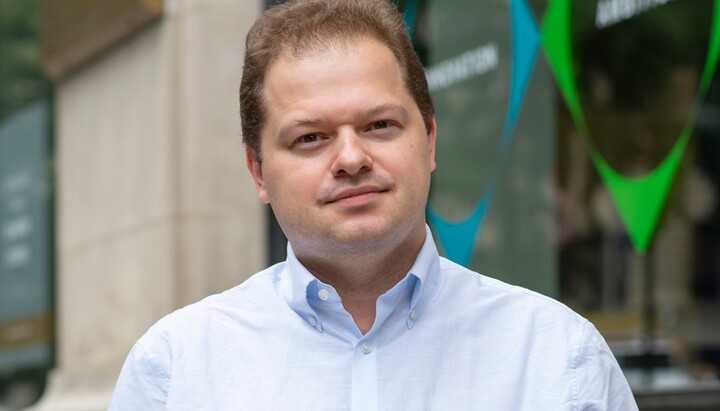
Dmytro Vovk. Photo: Dmytro Vovk’s Facebook
Dmytro Vovk, Director of the Center for the Rule of Law and Religion, Associate Professor, PhD in Law, who specialises in state-church relations, has published an analysis of the constitutional and legal aspects of the law ‘on the ban of the UOC’ on his Facebook page.
The author argues that despite the formal wording, the law is actually created to ban the UOC.
“Firstly, this has been repeatedly declared by its authors and promoters. Secondly, the law (in particular, the criteria of affiliation of a Ukrainian religious organisation with Russia) is written precisely for the UOC. Thirdly, the state has already conducted a ‘religious’ (actually theological) expertise and established the fact of the connection between the ROC and the UOC (even after the proclamation of the UOC's ‘full independence’ in May 2022), which opens the way to the liquidation of the UOC,” Vovk writes.
In his view, the state-appointed group of experts essentially acknowledged that nothing, except the proclamation of autocephaly, would signify the cessation of the UOC communities' affiliation with the ROC. He adds that, based on the provisions of the law, even autocephaly will not save the UOC from being banned if this autocephaly is not recognized by the ROC.
"If the ROC insists that the UOC is part of the ROC, for the purposes of liquidation this will be enough even after the declaration of autocephaly (which, of course, will not happen either in a month or in nine, allotted by law)," he adds.
The expert points out that the law provides for a simplified procedure for the liquidation of UOC communities, and this may lead to the rapid banning of many organisations.
Despite the need to individually ban thousands of religious communities, this law grants the prosecutor's office the authority to file lawsuits for liquidation, with all cases to be considered by the Kyiv Administrative Court of Appeal under a highly simplified procedure for notifying the parties.
“Such a mechanism, which involves not the meme ‘one DESS lawyer’, but the system of the Prosecutor's Office, allows a quick filing of lawsuits and obtaining a decision on the liquidation of key organisations within the structure of the UOC (metropolitanates, important parishes, etc.).
In addition, the trials should not last too long, because the only thing the court has to establish in order to make a decision is whether the religious organisation is really affiliated with the ROC, which, one can assume, will be done by referring to the relevant expertise that has already been conducted by the state. Given the recent practice of the Supreme Court, there will be no problems in this regard,” the message says.
The author further criticises the procedure of the expertise, which determines whether a religious organisation is affiliated with Russia. He points to its bias and the possibility of abuse, since neither the qualification nor impartiality of such expertise is mentioned in the law. The appointment of experts is in the full discretion of DESS, which supports the OCU.
"Claims have already been made to the objectivity of the preliminary expertise on the UOC-ROC relations because the expert group was formed by DESS on a principle reminiscent of a meeting of imams deciding whether to close a local synagogue. Secondly, the law allows for the liquidation of UOC communities for any violations 'concerning the establishment and operation of religious organisations,' i.e. for any, even minor violations of the law,” he claims.
The lawyer notes that the law contradicts international standards in the field of religious freedom. Religious freedom is not subject to derogation under the International Covenant on Civil and Political Rights (ICCPR) and cannot be restricted on the grounds of national security (Article 18 of the ICCPR).
He points out that religious organisations can be dissolved on the grounds of national security (Article 22 of the ICCPR), but not because of their religious affiliation, rather due to illegal activities that must be proven by the state.
"If we eliminate purely theological arguments (spiritual independence, etc.), we are left with about 40 criminal cases against current and former UOC clerics, their relatives, and closely associated believers (e.g., members of public organizations linked to the UOC)," he explains. According to him, some of these cases involve serious offences, but they differ from what is traditionally associated with threats to national security.
"Even if we add another 100 criminal cases at various stages of investigation and trial, it is impossible to unequivocally conclude that liquidation is the only adequate sanction," adds the human rights advocate.
He also mentions the unconvincing justifications for such a ban as sanctions for spreading the ideology of the "Russian world" since the law does not clearly define this concept.
The author also believes that the law may raise concerns among Ukraine's international partners.
Vovk recalls that not only far-right American politicians but also the U.S. Commission on International Religious Freedom and several major international human rights organisations have commented on the law.
"It can be expected that the law will be discussed in September at bilateral meetings with the European Commission, where the compatibility of Ukraine's legislation with EU human rights standards and values will be reviewed," writes the lawyer.
At the same time, in his opinion, the basic logic from international partners will be that this is not Ukraine's biggest problem, and given many other more complex challenges, this law might be overlooked. In particular, he suggests that the involvement of Russian diplomats and the ROC in promoting the narrative of "persecution" of the UOC in Ukraine might encourage European diplomats to avoid criticizing the law to avoid aligning with Russia.
In conclusion, the Director of the Center for the Rule of Law and Religion states that the adoption of the law indicates Ukraine's movement toward closer cooperation with the Orthodox Church of Ukraine (OCU).
"The model established in Article 35 of the Constitution (separation) has long existed only on paper, and since 2014, Ukraine has been moving toward a more traditional cooperative model of state-church relations, typical of Orthodox countries. The adoption of the law gives momentum to this movement," the analysis states.
At the same time, Dmytro Vovk believes that there is no political consensus on this issue.
"Opposition politicians, some second-tier ruling politicians, and officials responsible for religious affairs are promoting the idea of rapprochement with the OCU. However, for various reasons, such a scenario does not seem fully acceptable to President Zelensky's team," he suggests.
As reported by the UOJ, the Main Scientific and Expert Department of the Verkhovna Rada of Ukraine expressed concern about the possible consequences of adopting Law No. 8371, which introduces the verification of UOC religious communities for their ties with Russia.
Read also
Met. Meletiy consecrates house of worship for UOC community in Dankivtsi
Members of the persecuted UOC Intercession parish in Dankivtsi have converted a house into a place for communal prayer and worship services.
OCU eparchy sells church center site to developer for housing
The OCU’s Volyn Eparchy sold land intended for a spiritual center to a private developer planning to build townhouses and residential buildings.
SBU names UOC priest’s wife a suspect in Cherkasy region
The SBU accused Matushka Kateryna Prykotenko of “spreading enemy propaganda” through correspondence with parishioners.
UGCC cleric calls Russian Orthodox literature dangerous for clergy
While examining the causes of divisions within the UGCC, Yustyn Boiko concluded that Russian Orthodox literature had influenced Greek Catholic clergy.
UOC will play major role in achieving peace, says Vadym Novynskyi
UOC Protodeacon Vadym Novynskyi believes the Church will help bring about reconciliation within Ukrainian society after the war ends.
Catholic media outraged by forcible conscription of Uniate cleric
The Vatican’s Apostolic Nunciature has demanded the return of a forcibly mobilized Greek Catholic cleric.