Death of the Albanian Church Primate: What’s next?
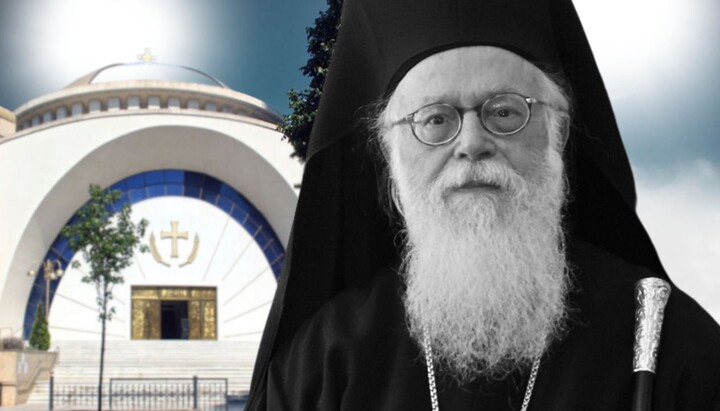
Archbishop Anastasios. Photo: UOJ
On January 25, 2025, at the age of 95, Archbishop Anastasios of Tirana, Durrës, and All Albania (Yannoulatos), Primate of the Albanian Orthodox Church, passed away.
His passing marks the end of an entire era in the history of the Albanian Church and raises several important questions, including the election of a new Primate and the potential influence of external forces on this process.
The Legacy of Archbishop Anastasios
Archbishop Anastasios was born on November 4, 1929, in Piraeus, Greece. In 1992, he was elected as the Primate of the Albanian Orthodox Church and played a key role in its revival after decades of persecution under the communist regime. Under his leadership, over 150 new churches were built, monasteries and other religious sites were restored, and a system of spiritual education and charity was established.
Moreover, Archbishop Anastasios was an undeniable spiritual authority for Orthodox Christians worldwide and maintained excellent (even friendly) relations with the Primates of the Local Orthodox Churches – from Constantinople to Moscow. His departure is undoubtedly a significant loss for all of us.
Key Points in Electing a New Primate
Naturally, the passing of Archbishop Anastasios raises the question of electing a new Primate.
According to the statute of the Albanian Orthodox Church, the election of a new Primate is carried out by the Holy Synod, composed of ruling metropolitans. One of them will become the Archbishop of Albania:
- Astios (Bakalbashi), Metropolitan of Berat, Vlorë, and Kaninë
- Ioann (Pelushi), Metropolitan of Korçë, Pogradec, Kolonjë, Devoll, and Voskopoja
- Dimitrios (Dikbasanis), Metropolitan of Gjirokastër
- Nicholas (Hyka), Metropolitan of Apollonia and Fier
- Antonios (Merdani), Metropolitan of Elbasan, Shpat, and Librazhd
It is evident that these elections will not only interest Albanians but also other Local Churches. Therefore, the question of potential influence by the Constantinople and Moscow Patriarchates on the election of the new Primate is highly relevant, and here Constantinople has a certain advantage.
Constantinople's role and influence
This is because it was Constantinople that effectively initiated the revival of the Albanian Church in the 1990s after its near-total destruction by communists in the 1960s. Constantinople granted it autocephaly and, by right, serves as Albania's Mother Church.
Furthermore, in 1992, it was at the suggestion of Patriarch Bartholomew that Archbishop Anastasios was elected as Primate. Thus, formally, the Albanians owe Constantinople if not everything, then almost everything.
However, despite this, Archbishop Anastasios became one of the most uncompromising critics of the creation of the Orthodox Church of Ukraine (OCU). He even called for a Pan-Orthodox Council on the matter and repeatedly expressed support for the persecuted UOC.
Additionally, the Synod of the Albanian Church raised the most substantiated objections regarding the canonical legitimacy of the ordinations and the legalization of Ukrainian schismatics, while also voicing support for the UOC. Therefore, it is reasonable to assume that the synod members, who signed a statement nearly five years ago questioning the actions of the Constantinople Patriarchate in Ukraine, have not changed their stance.
In the matter of sympathies toward Constantinople among the Albanian hierarchs, the national factor – which often plays a more significant role than adherence to canon – can almost be ruled out. Among the candidates for the position of Primate of the Albanian Church, only one is of Greek ethnicity: Metropolitan Dimitrios of Gjirokastër. However, due to his age (born in 1940), it is unlikely that Metropolitan Dimitrios will take the throne of Tirana.
Another factor that might work against the influence of the Constantinople Patriarchate is the controversy surrounding the ordination of Archimandrite Theophan (Koya). On July 25, 2023, his episcopal ordination took place in the Church of St. George at the Phanar, led by Archbishop Elpidophoros. However, the Synod of the Albanian Church strongly opposed this ordination, repeatedly labeling Theophan a schismatic.
Neither Archbishop Elpidophoros nor Patriarch Bartholomew heeded the objections of the Albanian Synod at the time (perhaps due to frustration over the Albanian Church’s refusal to recognize the OCU), which likely did not sit well with the Albanians.
Another issue worth considering is the controversial statements made by Phanar cleric Archimandrite Romanos (Anastasiadis). The pro-Phanar website *fosfanariou.gr* published an article titled “Anastasios of Albania in the Quagmire of the ‘Russian World’”, where Archbishop Anastasios was referred to as a "gatekeeper of the Russian Church" who "not only refuses to recognize the OCU but also supports the narrative of the ‘Russian World.’”
The matter escalated to the point where the Synod of the Albanian Church called on the Phanar to address the insults made by their cleric. However, the controversial archimandrite refused to apologize for his remarks, while the Synod of the Constantinople Patriarchate chose to remain silent.
In the current church climate surrounding the recognition of the OCU, there is no doubt that Constantinople’s influence on the election of the new Primate in Albania will be significant. The Phanar will undoubtedly attempt to leverage the leadership transition in the Albanian Church to revise its previous position, especially if the new Primate is inclined toward closer relations with Constantinople.
This potential pressure from the Constantinople Patriarchate and other Greek Churches could affect both the elections and the subsequent policies of the Albanian Church regarding its relations with other Local Churches, particularly in the context of the Ukrainian issue.
If the new Primate aligns with Constantinople, this could lead to the recognition of the OCU and a deterioration of relations with those who have not recognized it – primarily the Russian Orthodox Church (ROC), which is also likely to attempt to influence the outcome of the upcoming elections.
On the other hand, maintaining a neutral or previously negative position on the matter could strengthen ties with those Churches that opposed the structure led by Epifaniy Dumenko.
Conclusion
The upcoming elections are critical for the future destiny of the Albanian Orthodox Church and its position within global Orthodoxy.
The death of Archbishop Anastasios marks the end of an era for the Albanian Orthodox Church. The election of a new Primate will undoubtedly shape the Church’s development and its relations with other Orthodox Churches.
It is likely that external forces, particularly the Constantinople and Moscow Patriarchates, will attempt to exert significant influence on this process, potentially determining the direction in which the Albanian Church will move in the coming years.
Read also
The Council of Crete: a decade of unity in name only
Constantinople marked the anniversary of the Council of Crete with a theological conference in France. They spoke about the unity of Orthodoxy, although over the past years there has noticeably been less of it.
Yelensky’s plan: Why is DESS demanding what the UOC has already done?
DESS is demanding that the UOC take steps it has already taken, while offering no assurance that further demands will not follow. What is behind Yelensky’s ultimatum?
Why OCU hierarchy lacks canonical ordination: what Local Churches say
The OCU head refuses to address invalidity of his ordinations. But almost all Local Churches speak of it – even those that recognized the OCU.
Why nation-first advocates do not call for peace
Ukraine’s population is declining by nearly one million people a year, and experts are warning of the nation’s demographic extinction. Yet the leaders of the Orthodox Church of Ukraine (OCU) and the Ukrainian Greek Catholic Church (UGCC) continue to call for war and mobilization.
The deception that decided the fate of the Tomos
In 2008, the "Filaret problem" derailed Yushchenko's plan. In 2018, Poroshenko solved it in just one hour – with a police escort for the Greeks and verbal promises to Filaret.
Lawyers in the crosshairs: How UOC is being stripped of its right to defense
Activists harass UOC lawyers outside courthouses, call them “traitors” on air, and promise them a “warm welcome” at hearings. The Church’s right to a legal defense is at stake.