Separation of souls at the Last Judgement
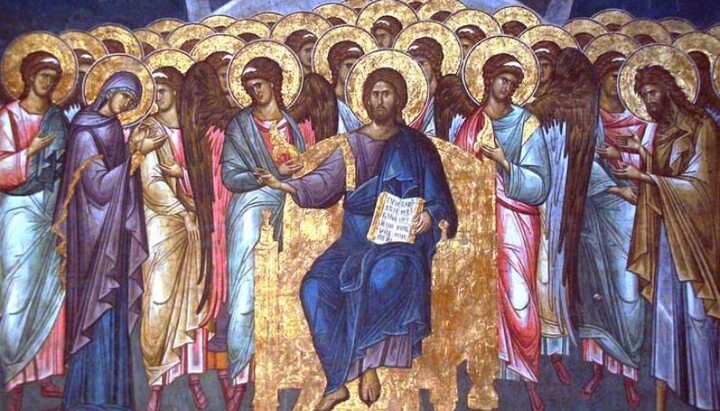
The Last Judgement. A fresco in the Visoki Dečani Monastery. Photo: wikipedia.org
In the Gospel reading for Sunday, the Savior gives us an example of how humanity will be divided into two camps: those who will remain with God in eternity and those who will go with the devil to hell. If this parable is read in isolation from Christ’s other parables, it might give the impression that the Kingdom of God is attained by simply accumulating good deeds. However, the Gospel makes it clear: the division will be between the “good” and the “evil”, the “tares and the wheat”, meaning it is about the “separation” of souls based on their inner qualities, not merely outward actions.
This is a crucial point, and failing to grasp it might lead us to be deceived in our expectations, causing us to be surprised that someone like me – so “good,” “positive,” and “kind” in every respect – could end up in hell. For what? Why? The answer is simple: one can give alms "for personal gain", do good deeds while delighting in one’s own “goodness”, or help others while feeding one’s pride and vanity. The manifestations of good deeds that the Lord speaks of in the parable of the Last Judgement are, above all, a projection of the inner state of people who lived by Gospel commandments not because they were earning paradise, but because these commandments became their natural state of soul. These Christians simply could not live otherwise.
Many of the abodes prepared for the righteous, which the Savior mentions in the Gospel, differ from one another in the same way that the souls of different saved people differ from others.
Just as identical fruits from the same tree at a market might vary in price depending on their size, so too the souls of the saved occupy different places in Eternal Life depending on the “size” of their holiness. We see this distinction, for instance, in the Church’s hymnography, where, in glorifying all the saints, the Church assigns the highest degree of holiness – after the Mother of God – to the martyrs, followed by the venerable saints, and so on (see the Octoechos).
Similarly, on the mirrored opposite side of hell, the greatest degree of torment is reserved not for pagans or even those who lived satanically in ignorance of God, but rather for those who knew Him, believed in God, perhaps even “served” Him with “self-interest” in mind, yet consciously, with full awareness of their actions, went against the Truth and blasphemed it in word, deed, and their very lives. This is the blasphemy against the Holy Spirit, which, according to the Savior’s words, cannot be forgiven under any circumstances. The life of St. Macarius the Great bears witness to this.
One must understand that God does not look at external deeds, but at the struggle of the inner warfare. It is by this result that the measure of holiness is determined. The greater the progress, the greater the capacity for communion with God; and the greater this capacity, the higher the measure of holiness, the brighter the crown of righteousness, and the more significant the "reward". One could put it more simply: each person will be glorified according to their love for God.
For the greater the love, the stronger the desire to be with the Beloved. And the stronger the desire, the greater the feats, the deeper the humility, and the brighter the grace bestowed.
Following this tradition, the Fathers of the Church divide the saved into three ranks: "servants", "hirelings", and "sons". These three spheres of heavenly abodes correspond to the three-part structure of the temple. St. Maximus the Confessor writes that the first part of the future Kingdom will include all those sanctified by grace to some degree (the saved); the second, inner part, will be for those who, in their earthly life, ministered with all three powers of the soul (the perfected); and the third, behind the inner veil, will be for the sons of God who have become gods by grace (the deified).
St. Seraphim of Sarov saw three categories of the saved, which he called “the betrothed”, “the chosen”, and “the called”. The first, according to the elder’s testimony, are those who attained the highest degree of holiness, whose souls shine like lightning with the fullness of grace. “The chosen” dwell in abodes resembling heavenly monasteries, where they partake of the sweetness of communion with God and enjoy the bliss of paradise. However, the fate of the third group, St. Seraphim described in rather grim terms. There is no bliss there, though it is not hell either. "They will have a little bed, dressed in simple shirts, and they will always be in sorrow. These are the negligent and lazy, those who were only occupied with their own affairs. How bleak it will be for them, they will sit, rocking back and forth, in one place." Upon saying these words, Elder Seraphim wept bitterly. (Chronicle of the Seraphim-Diveyevo Monastery. Seraphim Chichagov. p. 324).
If this is not yet hell, then what must hell be like? What awaits those who lived, thought, felt, and acted like demons? It is terrifying even to imagine. All of Church tradition, the Gospel, and the works of the Fathers and Teachers of the Church unequivocally teach us that the reward will correspond to one’s life and the inner disposition of the soul. The measure of judgement will be the Word of God, which penetrates deep into a person, reaching even to the division of soul and spirit.
Today, the devil, through liberal "theologians", with all his might, seeks to implant a satanic understanding of "Divine love". He lulls the soul with his lullabies:
Sleep, my lovely infant,
Sweetly sleep, my light.
The torments of the sinful—
Are but a dreadful sight.
Sleep. Love knows no judgement,
She has but one decree:
She levels all things equally,
Like the bottom of the sea.
Devils will become angels,
And sing in paradise.
No sin, no eternal death,
The Lord will say, "I love you, rise."
“Everyone will be saved, everyone will enter paradise, everyone will be ‘fine’” – this devilish mantra can nowadays be found even in the writings of Orthodox theologians. Yet it is utterly incompatible with what the Holy Fathers see in their state of contemplation, with what the Savior teaches, and with what John the Baptist warned about.
It would be the most foolish mistake to hope that God will somehow miraculously save us, unexpectedly, without any effort or participation on our part.
Therefore, to avoid bitter weeping and gnashing of teeth in outer darkness, it is better to live now with the utmost strictness towards ourselves, paying attention to all that happens within us, purifying the soul through repentance and tears. With heart and mind in ceaseless prayerful labor, let us stand before God, humbly asking for the mercy of His grace.
Read also
The Time of the Soul's Ripening
Modern society has turned youth into a cult and calls old age a period of "living out one's days." The Christian view reveals the deep spiritual meaning of one's later years.
Faith is not a checker piece in a spectator sport
Arguments about faith on social media increasingly resemble no-holds-barred fights. We turn to a saint who, sixteen centuries ago, knew how to speak to those interested only in turning theology into a combat arena.
The metropolitan who fought with a pen
St. Cyprian of Kyiv was robbed, expelled, and barred from his see. He answered with letters, books, and canons – and before his death, forgave everyone.
Loneliness under one roof
Spouses can share a home for years, raise children, and faithfully attend church – yet remain strangers to each other.
The cross – the deepest healing of the human soul
Emotional exhaustion and anxiety have become a way of life. Ancient Christian tradition offers an unexpected way out – embracing one's own cross.
The Prophet Elisha and the mystery of the Bethel massacre
The story of the prophet Elisha and the two bears seems to be the harshest in the Bible. But in reality, it carries a profound theological meaning.