

The cost of following Christ: family or civil death?
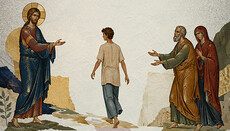
A crowd followed Christ, expecting the Messiah to claim His throne. Instead, He turned to them with a startling command to “hate” their own families.
The crowd moving along the road from Galilee to Jerusalem behind Christ must have looked like a spontaneous procession. The Jews were waiting for the Messiah’s imminent triumph. They longed for liberation from the Roman yoke and for God to reward them for their long suffering.
Yet at the height of their enthusiasm, the Savior turned and uttered words that must have chilled them to the bone: “If anyone comes to Me and does not hate his father and mother, wife and children, brothers and sisters – yes, and his own life also – he cannot be My disciple” (Luke 14:26).
What cruelty! Where is God’s mercy in this? Where is the call to cherish one’s relatives? Where, for that matter, is Christianity?

We are accustomed to hearing these words explained in sermons like this: “Love those closest to you, but love God more.” Yet the language and law of the Jewish world left no room for such carefully measured distinctions.
A society where love had no degrees
Ancient Hebrew and Aramaic had no comparative form for the word “love.” It was impossible to say, “I love my father or mother slightly less than I love God.” One had to choose one or the other.
Biblical scholars point to an illuminating parallel in the Book of Genesis. We read that Jacob “loved Rachel more than Leah” (Genesis 29:30), while the very next verse says that the Lord saw that Leah was “unloved” (Genesis 29:31). The Church Slavonic text conveys the Semitic force of the phrase even more sharply: “Leah was hated.”
Commentators apply the same linguistic construction to Luke 14:26. Christ is using a categorical formula that does not allow for a softened or sentimental reading.
Without your clan, you were no one
In antiquity, a person had no legal existence outside the family.
The pater familias – the head of the household – possessed what Roman jurists called the “power of life and death.” He could accept a newborn child into the family or reject it. He could sell his son into slavery. He could determine the fate of any member of his household.
This authority was gradually softened over the centuries, but for a very long time it remained nearly absolute and did not depend on the age of the family member concerned.
The extended household served as court, insurance fund, social security system, and registry office all at once. Outside it, a person had no legal protection, no right to inherit, and no public standing. To step outside that authority was, in effect, to disappear entirely from the legal world of antiquity.
Yet that is precisely what Christ’s first disciples did.
When James and John heard the Messiah’s call, they left their father Zebedee in the boat with the hired servants and followed Him immediately (Mark 1:19–20). They did not leave after long preparations. They went at once.
People of that era required no further explanation. They understood perfectly well what it meant for a fisherman to be left in the middle of the working season without his helpers – and especially without his own sons.
Another Gospel episode reveals the true depth of this radical break with family obligations. One man who wished to follow Christ first asked permission to go and bury his father. The Savior replied: “Let the dead bury their own dead, but you go and preach the kingdom of God” (Luke 9:59–60).
There is an important distinction between this case and the departure of Zebedee’s sons.
James and John immediately abandoned their familiar fishing trade. In the burial episode, however, the father was most likely still alive. The man was postponing his decision to follow Christ for an indefinite period, until his ritual and family obligations had come to an end – obligations that could continue for months or even years.
Yet the question in both cases is the same:
Can duty to one’s clan become a legitimate reason to postpone obedience to God?
In both cases, Christ answers categorically: no.
When family competes with God
Immediately after speaking of hatred toward one’s relatives, Christ gives two vivid examples:
“For which of you, intending to build a tower, does not sit down first and count the cost? Or what king, going to make war against another king, does not sit down first and consider whether he is able with ten thousand to meet him who comes against him with twenty thousand?” (Luke 14:28, 31).
This is a continuation of the same thought, now expressed in the dry language of calculation.
A builder estimates the quantity and cost of materials long before the foundation is laid. A commander evaluates the size and readiness of his army before beginning a campaign.
A disciple of Christ must likewise soberly weigh everything for and against before giving God his consent to follow Him.
Family ceases to be a warm refuge for a Christian the moment it begins to claim the place that belongs to God alone.
St John Chrysostom explains that “Christ does not simply command us to hate, for that would be outright lawlessness. Rather, if someone in your household demands that you love him more than Me, then hate him for making that demand.”
Such deceptive love, the saint adds, “destroys both: the one who is loved beyond measure and the one who loves in that way.”
The destruction comes from the family’s attempt to claim an authority that belongs to God alone. Christ is therefore not promoting cruelty. He is simply calling things by their proper names.
What Christ’s demand really means
This Gospel passage can easily be misread as permission to become indifferent to those closest to us. Such an interpretation must be rejected completely.
Blessed Theophylact of Ohrid clarifies: “The Lover of mankind does not teach inhumanity or urge self-destruction. He desires that His sincere disciple should hate his relatives only when they hinder him in the worship of God. When they do not hinder him, He teaches that they should be honored until one’s final breath.”
The Apostle Paul calls anyone who refuses to care for his own household one who “has denied the faith and is worse than an unbeliever” (1 Timothy 5:8).
God blesses Christian mercy and love. Yet at the same time, He sees clearly what – and whom – our hearts truly prefer.
We should not try to build an inner ranking system and calculate whom we love more: God or our relatives.
The real question is different: whom will we choose when the convictions of someone close to us come into conflict with God’s commandments?