Unrevealed mystery of Christ weeping over Lazarus
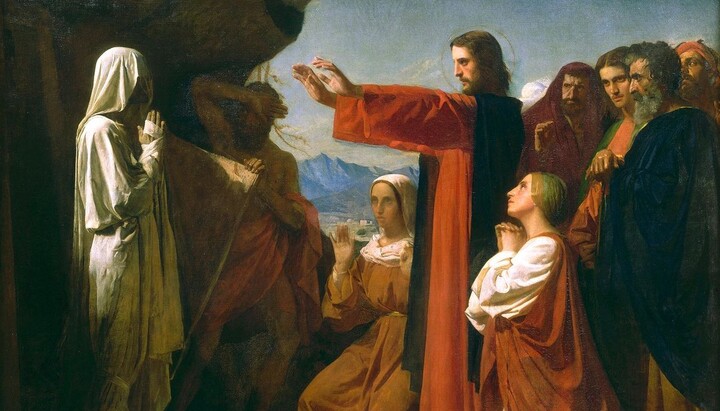
The Resurrection of Lazarus. Photo: wikimedia.org
The Gospel narrative of the resurrection of Lazarus raises many questions for me – questions for which there are no answers. I can assume – and I believe I wouldn’t be far from the truth – when I say that the greatest labor and feat awaiting each of us is dying. A person does not go through it passively. The soul and the body endure unprecedented strain: emotional, physical, psychological, and more. This is what dying through illness looks like.
As we know from the Gospel, Lazarus was sick and died. He walked through that narrow, tormenting corridor leading from one reality to another. And then a Voice called him to retrace his steps. This Voice did not ask; it commanded: “Lazarus, come forth.” And within that commanding voice, one could hear the notes of weeping…
Lazarus had no choice. He had to re-enter that body which had already become foreign to him. He had to climb back into its heavy spacesuit that would again bind his soul with pain, aging, suffering, and the burdens of care. Yes, his sisters would undoubtedly rejoice at the miracle, and the neighbors would marvel. But was Lazarus himself happy about it?
I think not. He understood that it would only be a short time before he had to take that road once again. Once more, he would have to walk the heavy path of death.
Theological interpretations, as brilliant in their allegory as they are dusted with doctrinal sophistication – those speaking of the resurrection of the inner man or the triumph of grace over the letter of the law – do not warm my heart. That’s not what I want to hear. In all this erudite philosophical eloquence, there is no simple human understanding of essence. Somewhere hidden between the letters of God’s Word lies a mystery. And that mystery is steeped in the tears of the Savior at Lazarus’s tomb. Yes, I know what the saints have said about how one should understand those tears. But their words have not warmed my soul. There is something else – something known only to Christ and Lazarus himself, and they have chosen to remain silent about it.
When you go to a sick person with medicine that is guaranteed to heal him, you do not cry. You rejoice because at last your friend will be free of his torment. You encourage his family and friends with a smile, saying, “Everything will be fine now.” You are happy because you carry the light that will bring happiness not only to your friend, but to everyone who loves him. By human logic, that is what Christ should have felt as He went to resurrect Lazarus.
But what we see is a very different picture. Christ weeps. The resurrection of Lazarus was not a joyous event for Him. The Savior felt no joy over prolonging the soul’s prison sentence in the body. Neither Christ nor Lazarus rejoiced at this miracle. But it had to be done. It was necessary for the mission for which the Lord came into this world. It was essential to visibly demonstrate the impossible – to those who followed Jesus and to the generations who would read about this event in the Gospel.
The Son of God summoned Lazarus from the beyond so that he could continue his path as a martyr for Christ. After his resurrection, no one ever saw a smile on Lazarus’s face again.
Christ weeps rarely in the Gospels – only three times. That is why we must approach His tears with utmost attention.
The first time the Savior weeps is when He looks upon Jerusalem, knowing the fate that awaits this great city. It is the cry of helpless maternal love. Like a mother weeping when she realizes she can no longer help her child. Her heart breaks because she can do nothing. The pain is even greater if the mother knows that this suffering could have been avoided. Yet she also knows that what is to come – will come. The weeping of Christ over Jerusalem is the helpless cry of God before human freedom.
“How often I wanted to gather your children together, as a hen gathers her chicks under her wings, but you were not willing…”
The last time the Savior weeps is in the Garden of Gethsemane, before His Crucifixion. This too is the weeping of the universal Man – Christ. Note that in this Gethsemane struggle, there is not a trace of heroic pathos. The Lord does not say to the Father: “Thank You for deeming Me worthy to suffer for the salvation of humankind! What an honor this is! I am overjoyed by this privilege!”
Some emotionally charged preachers, pacing back and forth across the stage with Bibles in hand, would have preferred to hear such words from Christ in Gethsemane. But no – everything here is simple, human, close to our own hearts. The Savior feels pain, fear, abandonment, and something akin to despair. But He endures, because at the center of His life is the Heavenly Father. Christ lived in love and faithfulness to Him and knew that He could and must entrust Himself to the Father entirely.
The tears of Christ in Gethsemane are, to me, far more relatable and heartwarming than all the later heroic literature about the early Christian martyrs. In that garden, there wept a soul very dear to me – so human and sincere. There Christ is closer to us than in any other passage of the Gospel narrative. He is not an impassive absolute. His human soul is akin to ours in everything. And I begin to believe that God looks at me, in all my weakness, just as He looked at the adulterous woman, the weeping widow who lost her son, or Peter who betrayed Him.
The Savior even calls Judas “friend” during that final poisonous kiss. Even toward this betrayer, Christ’s attitude is entirely different from what we hear in the church hymns of Holy Wednesday. And that gives my heart far more room to love Christ than all the curses hurled at Judas in later liturgical writings. The Lord truly is Love – great, unconditional, and merciful. How beautiful that is!
The first and last weepings of Christ are clear and understandable. They need no additional interpretation. But between them stands His weeping at the tomb of His friend Lazarus. And this, I think, is not at all what many exegetes would have us believe. Here lies a mystery – one that cannot be explained with words, but the heart, as always, sees more deeply.
Read also
The Time of the Soul's Ripening
Modern society has turned youth into a cult and calls old age a period of "living out one's days." The Christian view reveals the deep spiritual meaning of one's later years.
Faith is not a checker piece in a spectator sport
Arguments about faith on social media increasingly resemble no-holds-barred fights. We turn to a saint who, sixteen centuries ago, knew how to speak to those interested only in turning theology into a combat arena.
The metropolitan who fought with a pen
St. Cyprian of Kyiv was robbed, expelled, and barred from his see. He answered with letters, books, and canons – and before his death, forgave everyone.
Loneliness under one roof
Spouses can share a home for years, raise children, and faithfully attend church – yet remain strangers to each other.
The cross – the deepest healing of the human soul
Emotional exhaustion and anxiety have become a way of life. Ancient Christian tradition offers an unexpected way out – embracing one's own cross.
The Prophet Elisha and the mystery of the Bethel massacre
The story of the prophet Elisha and the two bears seems to be the harshest in the Bible. But in reality, it carries a profound theological meaning.