SBU just proved the UOC is Ukrainian – who’s been lying all along?
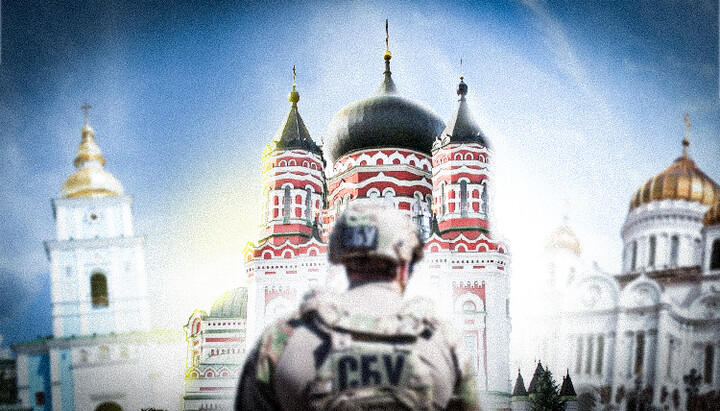
When the narrative breaks down, the contradictions speak louder than the propaganda. Photo: UOJ
On April 22, 2025, Ukraine’s Security Service (SBU) published a surprising announcement on its official Facebook page. The agency reported charges against fourteen “high-ranking officials” of the Russian Orthodox Church (ROC) who, according to the SBU, aided in the takeover of Ukrainian churches in temporarily occupied territories.
These “officials” are hierarchs who served on the ROC’s Holy Synod between 2022 and 2024. The SBU claims they orchestrated the Synod’s decision to “annex” the dioceses of Dzhankoi, Berdyansk, Rovenky, and Kherson – all of which belonged to the Ukrainian Orthodox Church (UOC) – and replaced their bishops with individuals “loyal to Moscow.”
From this official announcement, three important points emerge:
- The churches that were seized are identified as Ukrainian, not Russian;
- The dioceses in question were joined to the ROC – implying they did not previously belong to it;
- New bishops “controlled by Moscow” were installed – suggesting the previous bishops (from the UOC) were not under such control.
Now let’s compare that with the claim made in the Religious Studies Examination of the UOC Statute on Governance conducted by the State Service of Ukraine for Ethnopolitics and Freedom of Conscience (DESS) in a document dated January 27, 2023:
“The UOC stands in a part-to-whole ecclesiastical-canonical relationship with the ROC. The UOC is not an independent (autocephalous) Church in relation to the ROC. Nor does it possess autonomous status recognized by other Churches. Therefore, from the perspective of ecclesiology and canon law, the UOC is a structural subdivision of the ROC with certain rights of self-governance but without independent canonical subjectivity. … The current activity or inactivity of the UOC’s highest governing bodies indicates that the UOC remains subordinate to the ROC.”
In other words, the DESS’s official expertise contradicts the basis of the SBU’s criminal charges. If we believe the DESS report, then the ROC couldn’t have “taken over” those dioceses – because they already belonged to it. Likewise, the bishops replaced by “Moscow-controlled” figures were supposedly under Moscow’s authority anyway.
This religious expertise is an official legal document. Yet the claim that the UOC is part of the ROC is echoed by numerous politicians, public figures, and church leaders. Here are just a few examples:
OCU "Archbishop" Mark of Kropyvnytskyi and Holovanivsk: “Everyone understands that the UOC (MP) is not independent – it’s merely part of the ROC.”
MP Mykola Kniazhytskyi: “The UOC MP hasn’t severed its canonical ties with the ROC and continues to be a ‘self-governing body with broad autonomy’ within the ROC.”
MP Nataliia Pipa: “The UOC’s charter says changes must be coordinated with its parent body – i.e., Moscow. It’s not a church but a structure controlled by the FSB.”
And yet, the SBU – which rigorously prosecutes pro-Russian narratives – has now effectively endorsed a key anti-Russian narrative: that the UOC is not part of the ROC. So what does that mean?
It means that those promoting the idea that the UOC is part of the ROC are, in fact, spreading pro-Russian narratives. These narratives support the Kremlin’s claim that the ROC has full rights over dioceses and parishes in Ukraine. They undermine the SBU and make its current charges look absurd – because if the UOC really is part of the ROC, then the ROC didn’t “seize” anything. It merely restructured its own organization.
So what is this narrative – if not a Kremlin talking point?
Following this logic, the SBU must now seriously consider prosecuting the authors of the DESS expertise and every official or commentator who continues to promote the claim that the UOC is a subordinate structure of the ROC. They should be charged under the same Criminal Code articles: Part 5 of Article 27 and Part 3 of Article 110 – aiding in efforts to alter Ukraine’s territorial integrity.
Either that, or the state must publicly declare the truth – that the UOC is an independent Church, governed by its own Synod and Charter, and not subordinate to the ROC in any way. But doing so would dismantle the entire narrative of a “Russian FSB Church in Ukraine,” a fiction that the authorities, media, and even the SBU have painstakingly built in recent years. That fiction was the basis for an entire law banning the Church of millions of Ukrainian citizens.
This situation is a textbook case of cognitive dissonance – or, to use a more humorous analogy, like the classic Jewish joke about the crucifix and the underwear: you can’t have it both ways.
But sadly, reason seems to be out of favor in high offices these days. Perhaps that’s just the times we have to live in.
Read also
The Council of Crete: a decade of unity in name only
Constantinople marked the anniversary of the Council of Crete with a theological conference in France. They spoke about the unity of Orthodoxy, although over the past years there has noticeably been less of it.
Yelensky’s plan: Why is DESS demanding what the UOC has already done?
DESS is demanding that the UOC take steps it has already taken, while offering no assurance that further demands will not follow. What is behind Yelensky’s ultimatum?
Why OCU hierarchy lacks canonical ordination: what Local Churches say
The OCU head refuses to address invalidity of his ordinations. But almost all Local Churches speak of it – even those that recognized the OCU.
Why nation-first advocates do not call for peace
Ukraine’s population is declining by nearly one million people a year, and experts are warning of the nation’s demographic extinction. Yet the leaders of the Orthodox Church of Ukraine (OCU) and the Ukrainian Greek Catholic Church (UGCC) continue to call for war and mobilization.
The deception that decided the fate of the Tomos
In 2008, the "Filaret problem" derailed Yushchenko's plan. In 2018, Poroshenko solved it in just one hour – with a police escort for the Greeks and verbal promises to Filaret.
Lawyers in the crosshairs: How UOC is being stripped of its right to defense
Activists harass UOC lawyers outside courthouses, call them “traitors” on air, and promise them a “warm welcome” at hearings. The Church’s right to a legal defense is at stake.