Saint John Chrysostom on Fate and Divine Providence
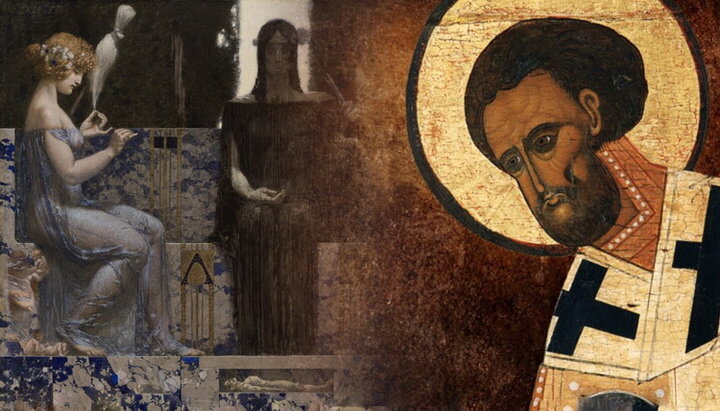
Did Saint John Chrysostom believe in fate? Photo: UOJ
Once, while reading the works of the Fathers of the Church, my attention was drawn to St. John Chrysostom’s homily “On Fate and Providence.” The topic is not only useful but undeniably fascinating. After all, we all love to hear something mysterious. And although Christians know that God has granted man free will, this freedom is not the same as arbitrariness. It cannot be understood as boundless permissiveness.
We will not delve into the subject of freedom itself – our purpose now is to speak of St. John. Let us only note that freedom is an inner reality belonging more to the realm of the spirit than to the body. Therefore, we cannot deny that countless external factors shape us as persons, influencing our views, preferences, and aspirations. These factors are not only natural or social laws, nor merely cultural or political surroundings, but also the field in which God’s providential activity unfolds. According to the definition of St. Philaret (Drozdov), God “preserves the being and powers of creatures, directs them toward good goals, assists every good, and restrains and redirects toward good the evil that arises from departing from what is good.”
St. John illustrates the idea of freedom as an inner gift – something a person may develop or, conversely, bury – with a vivid example. It is no secret that our life is full of anxieties and sorrows. But if we stop obsessing only over our own troubles, we will see that people suffer for entirely opposite reasons. Some grieve over poverty, others over wealth – for having money requires guarding it from loss or misuse. Some suffer because they cannot have children, others because they have many. One person strives for power and honors, doing everything to attain them, yet once he achieves his goal, he begins to long for silence and peace.
It is not sudden changes in circumstances that cause our anxieties and sorrows, but the state of our mind and heart.
“Observe the depth of this madness,” writes St. John. “For almost everyone laments not the same things, but the opposite things. And if the nature of circumstances were the cause of our grief, we would not grieve equally over opposite conditions.” The conclusion is clear: we are troubled not by events themselves, but by the condition of our inner world.
Here, of course, St. John speaks not of education in the academic sense, but of that inner peace in which the mind can rest regardless of the storms around it. This is difficult – he knows it – yet he offers another helpful example. He compares the soul to the body: just as the body can be strengthened during peaceful periods to endure future hardships, so too the mind and soul can be fortified. As for the methods, St. John does not list them – because every Christian knows them well. The only question is whether we waste the time given for this “training.”
Now, concerning fate or destiny. St. John’s attitude toward these concepts is decidedly negative. But before turning to his conclusions, let us recall a few essential points. When people with at least some semblance of faith face misfortune, they often seek the cause outside themselves. Those far from the Church – and sometimes even believers – collapse under pressure and begin to blame God. But such a response, as Chrysostom aptly notes, does not heal the wound – it only adds another.
The second way people try to “explain” their troubles – is by blaming the activity of evil forces that tempt, deceive, and trouble a person. But this option is hardly better than the first, for it undermines confidence in God’s goodness and omnipotence. In essence, St. John equates this supposed tyranny of demons with the tyranny of fate – something utterly unacceptable for a Christian: “All of this is filled with blasphemy. Truly, confusion and disorder arise not from the course of events, but from a soul disposed in a certain way, which, even if it were to enjoy exceedingly favorable circumstances, would derive no benefit until it corrects the disorder within itself.”
In fact, St. John regards belief in fate as a form of blasphemy and speaks of the most dreadful punishments awaiting those who refuse to repent of such a mindset and amend their lives.
Turning away from fate, St. John writes, should be as natural and self-evident as turning away from any other sin. And he illustrates his point with a striking example. Suppose a man commits adultery. Imagine how absurd it would be if, in court, he tried to justify himself by appealing to “biological instinct,” claiming the instinct acted, not he himself. No reasonable person would accept such an excuse, for the cause of the sin lies not in the instinct – though it exists – but in the individual’s own will, by which instincts can be restrained. Note that no human court, in any era, has ever accepted “fate” as a defense.
Personal will – the deliberate effort of the will – is precisely the essential instrument through which a person can attain inner peace that is not shaken by any external storm. People have always been judged as free beings: “No one who has appealed to fate as justification has ever been acquitted: not a criminal in court, nor a servant in a household, nor children in school, nor apprentices in workshops whenever they have failed in their duties.”
Free will – the personal effort of the will – is what enables a person to obtain inner peace unshaken by outward storms.
Belief in fate distorts not only the notion of guilt but also of virtue. If everything is predestined, there can be no merit. A person becomes a puppet in the hands of blind forces. Ultimately, one who believes in fate inevitably shifts blame onto God.
“This is worse than any sin,” writes St. John. “The devil labors to make us negligent in virtue, inclined to vice, and to make us accuse God of what we ourselves commit – thus corrupting our soul and our tongue under the guise of self-defense.”
* * *
In our day there is no shortage of fortune-tellers, witches, astrologers, and “destiny readers.” Many people believe their tales: “Nothing depends on you… such is your fate…” Yet even elementary logic – let alone Christian teaching – exposes the absurdity of such thinking. Thanks to St. John Chrysostom’s reflections, we see clearly that faith in fate destroys accountability, obscures God’s providence, and robs a person of the will to struggle for virtue.
What is essential is to place the right accents in our spiritual life. Then we will acquire the peace we long for – and have nothing to fear.
Read also
Brother of tax collector and brother of Lord
The Gospel is silent about the son of Alphaeus, and commentators have argued for centuries over who he was. And the Church commemorates two apostles named James in close proximity.
Prayer commemorations instead of loving embraces
At every Orthodox wedding, the choir sings a hymn to the martyrs. For families separated by war, these words carry a special meaning.
Honest atheism vs. spiritual hypocrisy
The 70th anniversary of Albert Camus’s Nobel Prize recalls an uncompromising challenge to Christianity. An honest unbeliever brings theology back to the mystery of the Cross.
The valley of trouble and the gateway of hope
One soldier buried an expensive cloak and some gold beneath his tent. Because of this, all Israel lost a battle. Why did one man’s sin bring disaster upon an entire nation?
From love spells to bishop's throne
Antioch’s most powerful sorcerer sent demons against a devout young Christian woman three times – and failed every time. In the end, a demon himself revealed the truth that led to his conversion.
The Weeping Queen of Blachernae
On the night of the Feast of the Protection, only two people witnessed the miracle in the Church of Blachernae. Everyone else prayed and saw nothing. Yet they, too, received grace.