Media slander Metropolitan Longin using “fictional narrative”
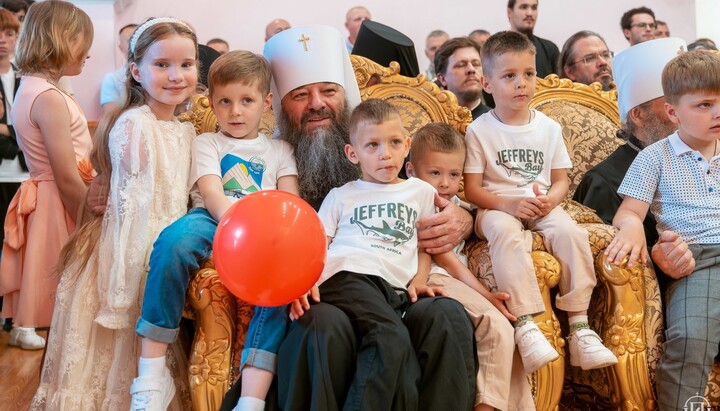
Metropolitan Longin with children. Photo: UOC Press Service
On May 21, 2025, a number of Ukrainian media platforms released false reports targeting Metropolitan Longin of Bancheny, basing their claims on a so-called “video investigation” by photographer Edgar Kalancha. Outlets such as Espreso, Obozrevatel, News Telegraf, and others claimed that the orphanage at the Bancheny Monastery was involved in drug trafficking, operated as a brothel, subjected children to beatings and broken bones, and that nuns consumed alcohol with the children.
The video features Kalancha interviewing anonymous individuals with concealed faces who present themselves as former residents of the orphanage in Bancheny.
However, none of the media outlets published the disclaimer that Kalancha included at the start of his video.
In it, Kalancha states that “all references to individuals, events, or organizations are fictional or interpreted from open sources in the form of satire, hypothesis, or artistic assumption.”
“All events described in the material should be regarded as fictional, hyperbolic, or a form of critical analysis within the framework of freedom of speech and expression. Any resemblance to real persons or events is coincidental or results from the interpretation of publicly available information,” Kalancha declared, further emphasizing that he “does not take responsibility for the conclusions viewers may draw.”
Thus, Kalancha’s materials may be viewed as fictional narratives intended to defame Metropolitan Longin of Bancheny.
The orphanage at the Bancheny Monastery began in 1992 when Hieromonk Michael (later Metropolitan Longin) adopted a six-month-old girl infected with HIV.
Originally located on the grounds of the Holy Ascension Monastery in the village of Bancheny, the orphanage was later moved to a purpose-built complex in the village of Molnytsia, Hertsaiv district, Chernivtsi region, four kilometers from the monastery. This complex was consecrated on September 29, 2002, by Metropolitan Volodymyr of Kyiv and All Ukraine.
The Bancheni orphanage holds the official status of a “family-type children’s home.” Its distinctive feature is that all children are either adopted or under the legal guardianship of Metropolitan Longin. The number of children steadily grew: from around 50 in the early 2000s to about 250 by 2010, and according to data from 2020, the monastery was caring for 415 children.
Among the residents are a significant number of children with special needs, including severely disabled children and those living with HIV. The monastery provides comprehensive care for them, including medical support.
Caregivers include nuns from the nearby Boyany Convent (also founded by Metropolitan Longin), as well as professional educators and caretakers. The orphanage offers proper housing, hygiene, education, and healthcare.
In 2022, following the start of the Russian invasion of Ukraine, the Bancheny Monastery and its orphanage took in over 110 orphans from the Kramatorsk Baby Home. According to Metropolitan Longin, the monastery has hosted approximately 8,000 internally displaced persons from eastern Ukraine.
Read also
Upper Lavra court hearing postponed
The next court hearing in the Upper Lavra case has been scheduled for November 3.
UOC priest blesses ambulances at Kamianske medical center
A UOC priest in Kamianske blessed ambulances for a medical facility and wished its doctors God's help in their work.
Dumenko to German ambassador: Law targeting UOC also applies to other groups
Epifaniy Dumenko sought to defend Ukraine’s law restricting religious organizations during a meeting with the German ambassador.
Activists bused to court hearings in UOC cases, media say
A minibus has been spotted transporting protesters to and from courthouses where UOC cases are being heard.
Firefighters save historic UOC church from fire in Zakarpattia
A fire broke out at a UOC church in the Tiachiv district, damaging the altar and church furnishings.
Volyn Eparchy faithful collect six tons of aid for Sviatohirsk Lavra
Believers in Volyn collected food and warm clothing for people displaced by the war who have found shelter at Sviatohirsk Lavra.