Authorities to create a new body to combat anti-Semitism, Jews oppose it
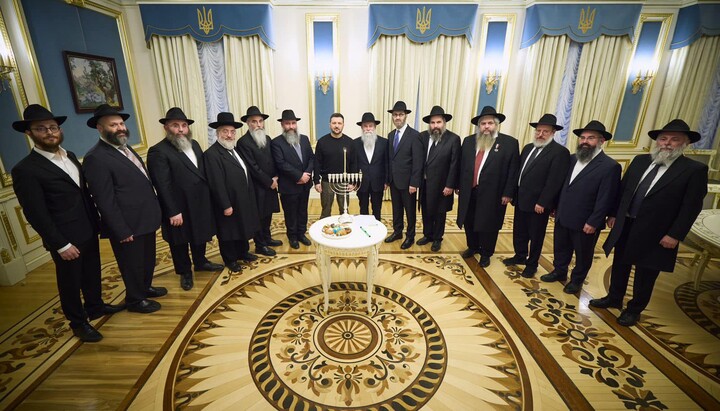
Rabbis with Zelensky at the Office of the President. Photo: OP website
The United Jewish Community of Ukraine opposed the government Bill No. 13366, which provides for the creation of the position of a special coordinator for combating anti-Semitism.
The essence of the conflict
The Cabinet of Ministers of Ukraine initiated a bill to amend the law "On Prevention and Counteraction to Anti-Semitism in Ukraine," proposing to establish the position of a special coordinator on prevention and counteraction to anti-Semitism. It is planned to create a central executive body that will coordinate activities in this area.
The head of the State Service for Ethnopolitics and Freedom of Conscience (DESS), Viktor Yelensky, played a key role in drafting the main documents. It was under his leadership that the conceptual foundations of the new body were developed. This body is intended to be granted broad coordinating powers in the field of combating antisemitism. According to the authors' vision, the new coordinator will be tasked with monitoring, analyzing, and coordinating the efforts of various state agencies in countering antisemitic manifestations.
However, it is the United Jewish Community of Ukraine (UJCU) that considers this initiative inappropriate and not in the interests of Ukrainian society.
In an official statement on June 13, the UJCU emphasizes: “Ukrainian legislation already contains a clear definition of antisemitism – it has been adopted by the Verkhovna Rada, is based on international standards, and is in effect.”
Counterarguments
The Jewish community presents several significant arguments against the creation of a new body:
Duplication of functions. According to the UJCU, the proposed powers of the coordinator essentially duplicate the existing functions of the State Service for Ethnopolitics and Freedom of Conscience (DESS).
Absence of a systemic problem. The community claims that "the problem of anti-Semitism in Ukraine is not systemic, ideological, or widespread, unlike in some EU countries".
Risk of reverse effect. "Adding another 'punitive' body seems artificial and may have the opposite effect – provoking distrust and a new wave of tension in society," warns the UJCU.
The UJCU emphasizes that the current law of 2021 functions effectively: "All incidents in practice have long been qualified by the police as anti-Semitism, not as hooliganism."
The Jews appealed to the people's deputies with a call to reject Bill No. 13366 as one that "does not bring real benefits in the fight against anti-Semitism and may harm the processes of interethnic understanding in Ukraine".
Earlier, the UOJ wrote about the anti-Semitic background of Viktor Yelensky.
Read also
Upper Lavra court hearing postponed
The next court hearing in the Upper Lavra case has been scheduled for November 3.
UOC priest blesses ambulances at Kamianske medical center
A UOC priest in Kamianske blessed ambulances for a medical facility and wished its doctors God's help in their work.
Dumenko to German ambassador: Law targeting UOC also applies to other groups
Epifaniy Dumenko sought to defend Ukraine’s law restricting religious organizations during a meeting with the German ambassador.
Activists bused to court hearings in UOC cases, media say
A minibus has been spotted transporting protesters to and from courthouses where UOC cases are being heard.
Firefighters save historic UOC church from fire in Zakarpattia
A fire broke out at a UOC church in the Tiachiv district, damaging the altar and church furnishings.
Volyn Eparchy faithful collect six tons of aid for Sviatohirsk Lavra
Believers in Volyn collected food and warm clothing for people displaced by the war who have found shelter at Sviatohirsk Lavra.