Greek theologian questions the validity of OCU’s priesthood
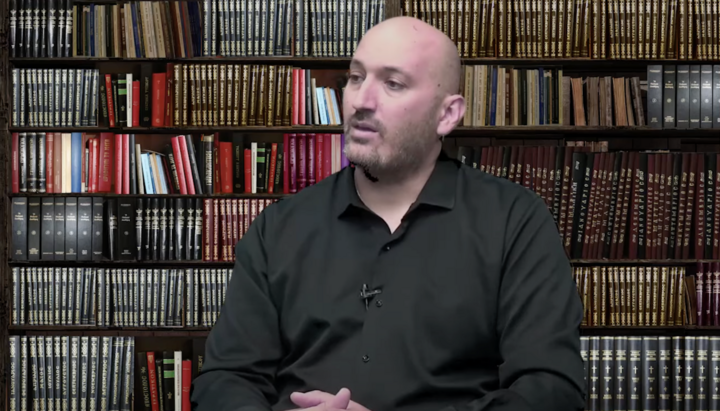
Greek theologian Vasilios Touloumtzis. Photo: YouTube channel Εστία Πατερικών Μελετών
Greek theologian Vasilios Touloumtzis, a doctoral student in theology, presented a detailed analysis of the Ukrainian church question, casting doubt on the canonicity of the so-called Orthodox Church of Ukraine (OCU) from the perspective of Orthodox ecclesiology, the UOJ in Greece reports.
On the YouTube program For Altars and Hearths, the researcher focused on a central question: “Are the clergy of this new Ukrainian church structure truly priests? Is there demonstrable and canonical apostolic succession?”
Touloumtzis recalled that the OCU was created in 2018 by merging two schismatic groups: the organization of former Metropolitan Filaret, who was deposed and anathematized by the Moscow Patriarchate in the 1990s, and the traditionally schismatic “self-ordained clergy with questionable church legitimacy.”
In 2019, the Ecumenical Patriarchate of Constantinople granted this union a Tomos of autocephaly, recognizing the new structure as an independent local church.
According to the Greek theologian, “the essential problem is not the recognition of autocephaly itself, but the church status of this new structure.” The lack of canonical ordination among some clergy before their break with the canonical Church is, he argued, “a central ecclesiological problem.”
He pointed out that the union of schismatic groups and the granting of the Tomos happened “without first establishing this criterion.”
Touloumtzis argued that Constantinople’s position “introduces elements of Western ecclesiology – where communion with the pope is sufficient to validate church reality – rather than the Orthodox patristic tradition, which sets clear and unalterable canonical boundaries.”
The researcher noted that only four of the fifteen autocephalous Orthodox Churches have recognized the OCU – all Greek-speaking: the Ecumenical and Alexandrian Patriarchates, the Churches of Greece and Cyprus. This, he said, “raises questions about the decision-making process and ethnophyletist criteria.”
He was particularly critical of the Church of Greece, whose synodal decision “was not put to a vote and completely ignores the critical ecclesiological issue.”
“The Ukrainian question is not merely political or geostrategic. It is, in essence, ecclesiological,” Touloumtzis concluded. In his view, if the validity of the priesthood of those forming the OCU cannot be demonstrated, then “all other questions – about autocephaly, recognition, and canonicity – are secondary.”
The researcher urged: “If we strive for the unity of Orthodoxy, we are obliged not to ignore the foundations of our church tradition.”
Earlier, the UOJ reported that at a theological conference in Piraeus, Touloumtzis delivered a paper sharply criticizing Constantinople’s decision to grant autocephaly to the OCU.
Read also
Upper Lavra court hearing postponed
The next court hearing in the Upper Lavra case has been scheduled for November 3.
UOC priest blesses ambulances at Kamianske medical center
A UOC priest in Kamianske blessed ambulances for a medical facility and wished its doctors God's help in their work.
Dumenko to German ambassador: Law targeting UOC also applies to other groups
Epifaniy Dumenko sought to defend Ukraine’s law restricting religious organizations during a meeting with the German ambassador.
Activists bused to court hearings in UOC cases, media say
A minibus has been spotted transporting protesters to and from courthouses where UOC cases are being heard.
Firefighters save historic UOC church from fire in Zakarpattia
A fire broke out at a UOC church in the Tiachiv district, damaging the altar and church furnishings.
Volyn Eparchy faithful collect six tons of aid for Sviatohirsk Lavra
Believers in Volyn collected food and warm clothing for people displaced by the war who have found shelter at Sviatohirsk Lavra.