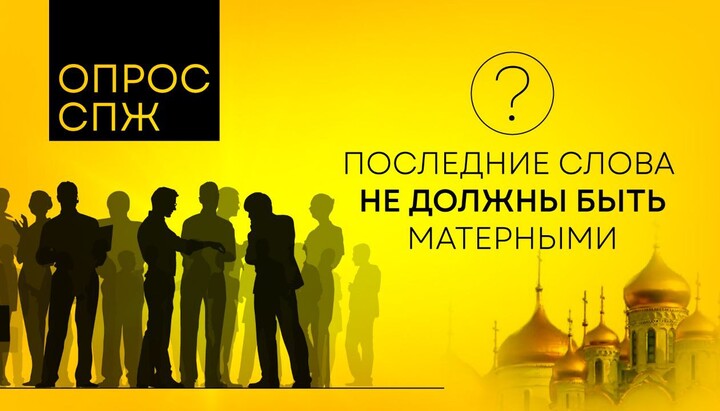
"The last words should not be obscene": Ukrainians' attitude to profanity
Ukrainian society has not lost the ability for complex thinking. Photo: UOJ
The use of profanity in Ukraine has reached significant proportions. Swearing is heard from the mouths of politicians and diplomats, deputies and officials. It is used in advertising, on television, printed in newspapers, and widely represented on social networks.
Profanity is especially common in videos about missile strikes and military reports. Moreover, obscene messages to the aggressor sometimes become a symbol of patriotism, appearing on postage stamps and T-shirts.
But how do ordinary Ukrainians feel about such "legitimization" of profanity? The Union of Orthodox Journalists decided to find out by asking city residents three questions:
- Do you swear? If so, in what situations?
- Do you think swearing is acceptable during war? In what situations?
- When you find yourself in a stressful situation (hit your finger with a hammer, stumbled, saw a missile strike), what do you say? And how would you feel about your words if it were the last moment of your life?
What the UOJ survey revealed
The survey results revealed an interesting picture.
Despite the widespread presence of profanity in the public space, most respondents demonstrated a commitment to traditional values and a careful attitude towards words.
People have not switched to swearing as the main form of communication.
Many admitted that they sometimes use "strong" expressions in extreme situations, but they clearly understand the boundaries of what is acceptable. The answers to the final question about "last words" were particularly telling. People seriously considered this and often changed their attitude towards swearing, realizing that these words could be their final ones in life.
"In what I find you, in that I will judge you"
The third question was the most significant from a spiritual point of view. Many for the first time considered: what if the words that slip out in a critical moment really become the last? War clearly demonstrates how real sudden death from a missile, shell, or terrorist attack can be.
The words of the Lord come to mind: "In what I find you, in that I will judge you". With what words a person meets their death, with those they will stand before God.
Sadly, the recordings of the "black boxes" of falling planes most often contain precisely obscene language.
Why do these words slip out from people's mouths seconds before death? Because they have absorbed them throughout their lives, making them a part of themselves. Saint Apostle Paul warns: "Do not let any unwholesome talk come out of your mouths, but only what is helpful for building others up according to their needs, that it may benefit those who listen." (Eph. 4:29). It's not about the sounds themselves, but the intention and emotions we invest in them.
Swearing as a path to primitivism
The legitimization of profanity is not just a lowering of cultural standards. It is a dangerous trend leading to the intellectual impoverishment of society. When a person gets used to expressing all emotions and assessments with two or three "strong words," their vocabulary catastrophically shrinks.
George Orwell in the dystopia "1984" talks about the introduction of so-called "Newspeak" - a language with a minimal set of words. The goal is simple: a person who does not have literary words to express complex thoughts cannot formulate these thoughts. Thus, they become easily controlled.
"Don't you see that the aim of Newspeak is to narrow the range of thought? In the end, we shall make thoughtcrime literally impossible, because there will be no words in which to express it", Orwell warns.
A person accustomed to expressing their attitude to the surrounding world only with obscene words unknowingly loses the ability for complex thinking. They begin to mechanically repeat imposed slogans and narratives, becoming completely controllable.
What does the Church say?
The Church is categorically against swearing, and here's why:
Firstly, obscene words are strongly associated with anger, malice, insult - in the most extreme degrees. In the Sermon on the Mount, Christ warned: whoever says to their brother "fool" (in anger, with the desire to humiliate), "shall be in danger of hell fire" (Matt. 5:22). Swearing is pronounced precisely in such a context to express rage and humiliation.
Secondly, swearing desecrates the most sacred: marital relations, childbirth, human bodily dignity. The Church sanctifies marital communication with a special Sacrament, while profanity turns it into an object of ridicule and mockery.
Thirdly, the very word "mat" comes from "mother" – the most precious for every person. Profanity is directed against motherhood as such. And if we remember that Christ on the Cross called the Mother of God the mother of all believers, swearing becomes even more blasphemous.
The Holy Fathers are also unanimous in condemning profanity, calling foul language "rotten seeds" (St. John of Kronstadt) and "the mother of all passions" (St. John Climacus).
Hope for common sense
The results of the UOJ survey give hope. Despite the total propaganda of profanity in the media and politics, ordinary Ukrainians maintain common sense and understanding of the boundaries of what is acceptable. They have not succumbed to the primitivization of language, nor have they lost the ability for complex thinking.
It is especially telling that the question about “last words” made many people think seriously. People realize that there are things more important than momentary emotions. There are words that one would be ashamed to face before God.
The war will end sooner or later. But the words we say shape us as individuals and as a nation.
How and what we say determines the kind of people we become in this temporary life and what baggage we carry into eternal life. Will we preserve our Christian identity, or will we turn into a primitive society thinking in slogans?
Our survey showed: the final choice has not yet been made. And this inspires optimism.
Read also
Brother of tax collector and brother of Lord
The Gospel is silent about the son of Alphaeus, and commentators have argued for centuries over who he was. And the Church commemorates two apostles named James in close proximity.
Prayer commemorations instead of loving embraces
At every Orthodox wedding, the choir sings a hymn to the martyrs. For families separated by war, these words carry a special meaning.
Honest atheism vs. spiritual hypocrisy
The 70th anniversary of Albert Camus’s Nobel Prize recalls an uncompromising challenge to Christianity. An honest unbeliever brings theology back to the mystery of the Cross.
The valley of trouble and the gateway of hope
One soldier buried an expensive cloak and some gold beneath his tent. Because of this, all Israel lost a battle. Why did one man’s sin bring disaster upon an entire nation?
From love spells to bishop's throne
Antioch’s most powerful sorcerer sent demons against a devout young Christian woman three times – and failed every time. In the end, a demon himself revealed the truth that led to his conversion.
The Weeping Queen of Blachernae
On the night of the Feast of the Protection, only two people witnessed the miracle in the Church of Blachernae. Everyone else prayed and saw nothing. Yet they, too, received grace.