Venerable Anthony is an example of prayer and quiet self-sacrifice – Primate
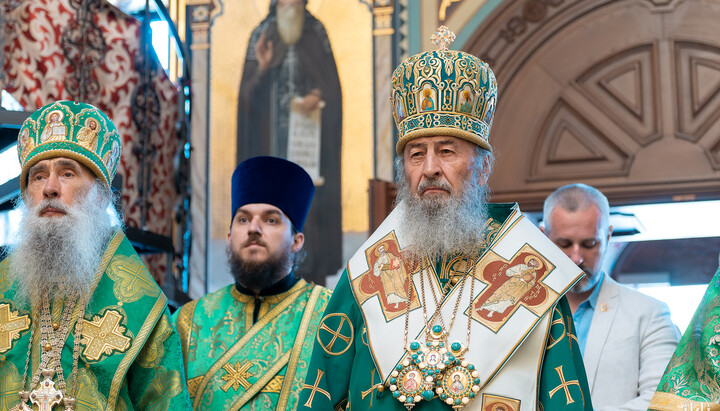
His Beatitude Metropolitan Onuphry. Photo: UOC
During the Divine Liturgy on the feast day of Venerable Anthony of the Caves, His Beatitude Metropolitan Onuphry delivered a sermon about the life and spiritual labors of the founder of monasticism in Rus’. This was reported by the Information and Education Department of the UOC.
“Venerable Anthony is one of the great saints who adorn the heavenly firmament of the Church. His holiness shone on this hill, in this place, in this city, on our land. It shone like a bright dawn showing many people the path that leads to God, to Heaven, to eternal salvation,” His Beatitude noted.
He reminded the faithful that St. Anthony, having received monastic tonsure on Mount Athos and having been instructed in monasticism by experienced monks of the Holy Mountain, was called to “bring the fire of monastic life” to his homeland. His Beatitude emphasized that “monasticism is the highest spiritual discipline – understanding God, understanding His will, and uniting with God.”
Metropolitan Onuphry recounted that in Kyiv, Venerable Anthony began his ascetic labors in the very place where, through his efforts, the Pechersk Monastery would soon arise.
“When the number of brethren increased, Venerable Anthony appointed Venerable Barlaam as abbot. He himself withdrew into seclusion, for he loved to pray in solitude and to remain hidden from human eyes and attention,” the Archbishop noted, adding that the saint in his lifetime preferred to remain unseen by people and to be alone with God.
The life of the founder of monasticism in our land was marked by many sorrows. As His Beatitude Onuphry pointed out, Venerable Anthony endured persecution on multiple occasions. One reason was that in the saint’s time, the princes often quarreled among themselves, and each wanted the saint to take his side.
“But the saint stood on God’s side. He wanted everyone to live in peace, to love one another, not to be at enmity, but to do God’s will in love and patience,” the Primate explained.
Although nearly a thousand years have passed since the life of Venerable Anthony of the Caves, “the memory of the righteous does not perish, for they live with the Lord. And this saint of God remains for us today a model of how to love God, how to love one another, how to forgive, how to pray and fast, so as to prepare oneself for the Eternal Kingdom which the Lord brought, gifted, and restored to mankind through His Incarnation, His Passion, and His Glorious Resurrection.”
His Beatitude wished that, through the prayers of Venerable Anthony, the Lord would bless our land and people, help overcome the trials of this life, and grant us eternal salvation in the Heavenly Kingdom.
As previously reported by the UOJ, the Primate of the UOC presided over the celebrations on the feast day of Venerable Anthony of the Caves.
Read also
OCU cleric describes how UOC church was “politely seized” in Cherkasy region
An OCU cleric acknowledged on video that a village church in the Cherkasy region had previously belonged to the UOC before being “politely seized” and reopened.
Metropolitan Onuphry sends greetings to Kyiv Theological Academy conference
The UOC Primate addressed participants in the 18th conference of the Kyiv Theological Academy and Seminary, dedicated to the 430th anniversary of St. Peter Mohyla's birth.
Court orders TRC to remove transgender woman from military register
A Dnipropetrovsk administrative court ruled that a TRC’s refusal to remove a transgender woman from the military register constituted discrimination.
Pope Leo, King Charles unite in "Christian fraternity"
The head of the Church of England has granted the Pope the honorary title of “Confrater” as a symbol of “spiritual fellowship and ecumenical friendship.”
UCCRO, WCC discuss possible OCU membership in World Council of Churches
A World Council of Churches delegation visited Kyiv to learn about the activities of Dumenko’s organization as part of its review of the OCU’s membership application.
BOC Patriarch: Bartholomew cannot be anathematized without conciliar decision
Patriarch Daniel said that no Local Orthodox Church has anathematized the Patriarch of Constantinople, warning that misguided zeal can lead people to place themselves above the Church.