A dialogue with Elder Joseph: “Man’s purpose is to find God”
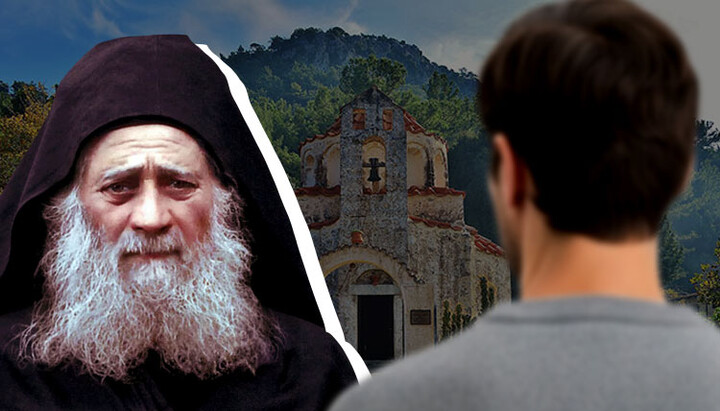
Like a skilled mountaineering guide, the elder points us toward the rocky summit of holiness as the goal of Christian life. Photo: UOJ
The previous dialogue with the Elder focused on the right attitude toward prayer. He emphasized that true prayer should give birth in the soul to deep feelings: love, grace, and tenderness. But conscious prayer requires a clear understanding of its aim. And that vision comes when we answer the fundamental question:
What is the meaning of life?
This age-old question has tormented thinkers of all eras. Individual philosophers and entire schools of thought have dedicated endless discourse and treatises to it, each attempting to lift the veil of mystery surrounding God’s or the universe’s intent for mankind and the purpose of earthly life.
With the passing of time, people's conceptions of life’s meaning have changed.
The philosophers of antiquity associated meaning with the pursuit of virtue, happiness, and perfection. The modern world inherited from them the desire to “live for pleasure” (hedonism) and “live in harmony with oneself” (Stoicism). As Ecclesiastes rightly says, “There is nothing new under the sun” (Eccl. 1:9).
Medieval philosophy gave the question a Christian framework. St. Augustine and Thomas Aquinas taught that man is called to the knowledge and worship of God in order to prepare the soul for eternity.
The Enlightenment shifted the focus. With the rise of science and faith in man’s “omnipotence” (think Nietzsche’s Übermensch), reason and self-determination became central. René Descartes declared: “I think, therefore I am.”
By the 20th century, civilization had shifted once again. Many came to believe there was no external, objective meaning to life. Instead, each person, being free, could assign their own meaning. Thus existentialism was born.
Postmodernism has further cemented the model of “man as master of life.”
Even today, society remains divided between “lovers of God” and “fighters against God.”
The first live for eternity. The second live only for earthly pleasures – and ridicule Christians, whom they see as “not of this world.”
So – what is the meaning of life?
We pose this crucial question to Elder Joseph the Hesychast, and hear his answer:
“The purpose of man, once born into this life, is to find God.” But he adds: “Man cannot find God unless God first finds him.”
What profound words from a spirit-bearing elder! Our entire life must be a constant search for God’s will – but that search will never succeed unless God Himself helps us.
How does God find us?
When and how does God find us?
When He chooses. But it inevitably happens at some point in life – so that on Judgment Day, no one can say they were never visited by God.
The issue is that we often fail to recognize that visitation – or stubbornly resist God’s intervention in our routine and sinful lives.
Like it or not, God will eventually meet each of His children face to face – whether in joy or in suffering. More often, it happens in suffering.
As Elder Joseph says:
“The passions have blinded the eyes of our soul, and we do not see. But when our all-good God turns His gaze upon us, we awaken as if from sleep and begin to seek our salvation.”
Elder Joseph on three types of grace
What happens when a person finally understands the true meaning of life and finds God? This marks the beginning of the most mysterious part of the spiritual journey – communion with God. It begins with heartfelt prayer and ends in the soul being filled with divine grace.
The Elder explains:
“The spiritual state is divided into three stages, and grace acts in man in a corresponding threefold way.”
This is a remarkable insight from the depths of Elder Joseph’s prayerful experience. Grace, though always flowing from the same Source – our Creator and Lord – differs in how it acts upon the human soul.
Let us listen as the Elder unfolds this teaching:
“The first grace is the cleansing grace. It is also called the grace of action and feeling, because the one praying feels the divine movement within. This grace stirs a person to repentance.”
The Athonite elder emphasizes that this first grace is not something we can attain by our own will – it is a gift from God. Even the desire for spiritual life is already a gift of grace. But to receive further grace from the Lord, one must recognize and repent of one’s sins. If ignored, this divine calling can fade quickly.
However, if a person humbly receives this first grace and begins to cleanse the soul with tears of repentance, the Lord will soon grant them the second grace. What is it?
“The next grace is the illuminating grace. Through it, a person receives the light of divine knowledge and ascends to the contemplation of God.”
Despite how desirable this may sound, for most of us this stage remains out of reach – not because we don’t deserve it (the path is open to all), but because we lack the spiritual discipline and experience to climb so high in prayer. The Elder cautions that this illuminating grace is given only to advanced hesychasts under the guidance of an experienced spiritual father.
Finally, the third state described by Elder Joseph is:
“The overshadowing grace – sanctity of the soul. After all the preceding stages, this is the grace that brings perfection – a great gift!” the Elder exclaims.
St. Joseph the Hesychast had every right to speak of such high and inaccessible spiritual things, for he himself burned with love for God and received abundant gifts of grace from Him.
But what do his words mean for us – weak and spiritually lazy people, to whom only the first, cleansing grace seems attainable?
Like a skilled mountaineering instructor, the Elder points us to the rocky summit of holiness as the goal of the Christian life. And we – every time we see that summit – must humbly begin by overcoming the smaller obstacles: our everyday sins. In return, God grants us the cleansing grace. And even this modest grace becomes a tangible and healing touch of God’s hand upon our wounded souls.
As for the fullness of God’s presence – we will surely experience it.
But later – when we meet Him face to face beyond the boundary of this earthly life.
For now, we take our leave of Abba Joseph, having agreed to continue our dialogue next time with a conversation about the methods of spiritual struggle against various temptations.
The Elder sees us off with these words: “Remember, once the action of prayer endures in you for a long time – your soul will enter into paradise!”
Read also
Prayer commemorations instead of loving embraces
At every Orthodox wedding, the choir sings a hymn to the martyrs. For families separated by war, these words carry a special meaning.
Honest atheism vs. spiritual hypocrisy
The 70th anniversary of Albert Camus’s Nobel Prize recalls an uncompromising challenge to Christianity. An honest unbeliever brings theology back to the mystery of the Cross.
The valley of trouble and the gateway of hope
One soldier buried an expensive cloak and some gold beneath his tent. Because of this, all Israel lost a battle. Why did one man’s sin bring disaster upon an entire nation?
From love spells to bishop's throne
Antioch’s most powerful sorcerer sent demons against a devout young Christian woman three times – and failed every time. In the end, a demon himself revealed the truth that led to his conversion.
The Weeping Queen of Blachernae
On the night of the Feast of the Protection, only two people witnessed the miracle in the Church of Blachernae. Everyone else prayed and saw nothing. Yet they, too, received grace.
Deadly spiral of human hatred
The tragedy of Lebanon's civil war lays bare how dehumanization and fear can turn human beings into monsters.