My mortal thoughts
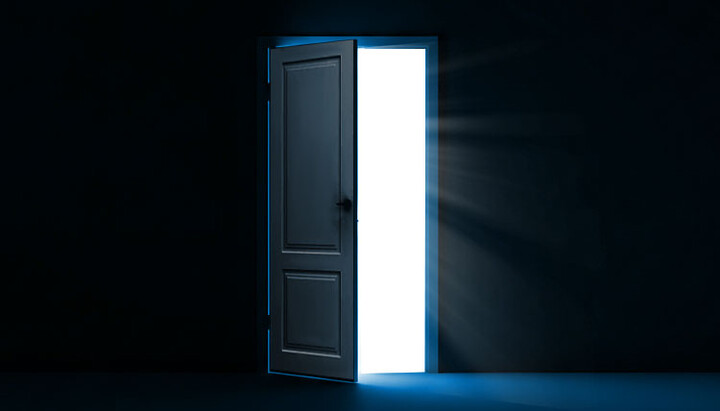
Everyone will enter the door of death and will not come back. Photo: UOJ
My mortal thoughts. Mortal not in the sense that they are deadly, but in the sense of the deep reflections that death awakens in me.
Death: Two facets of life
The Dormition of the Mother of God is a feast centered around the event of death. An event both tragic and festive at the same time. It has two facets, two opposing colors. Death as the path of all people, even the greatest and purest, and as the gift of life that has conquered death.
Birth and death are the most important and most independent events of our lives.
If you have come into this world, then be ready to leave it. And no alternative is offered to us in either case.We come from an unknown place and go to an unknown destination. Everyone will enter the door of death and will not come back. Its hinges are arranged in such a way that it opens only in one direction.
Of course, various “ancient legends” and modern revelations of those who supposedly have been there and returned, all this is still up in the air. But the universal human intuition of all nations suggests that behind this door there is something that cannot be expressed in words or written with a pen. And we take it at face value. But to knock on this door and ask to speak with someone who has entered there is impossible. Therefore, our faith in God is directly connected with the belief in the immortality of the soul.
Regardless of the quality of human life, the end is the same for everyone - a lifeless body and a soul that has disappeared to an unknown place (for those who believe in it, of course).
In my observations, the worldview model does not particularly influence the attitude towards death.
I have seen atheists who were sick and died calmly and almost without despair. And I have seen believers who fell into deep depression, were afraid, trembled like a leaf. Observing myself, I can say that my fear of death lives in me regardless of my religious beliefs. I cannot influence it with either the power of my will or the power of faith. It is present in me as an integral part of my being.
Death as a meaning-forming element
Perhaps it is good that a person does not know what is behind that door. If we knew, we would have no incentive to develop, improve, fight evil, and ourselves. And in general, there would be no freedom, only inevitability, like in a chess game where we see that in the end, there will still be a checkmate.
On the other hand, our life would not be so interesting, it would turn into a simple and boring script that we know by heart in advance. No surprises, no unexpected twists, no heroic deeds or tragedies. Nothing. Just a monotonous and boring existence. I think this is not a very interesting game for God, and He would not start it. After all, He does not play alone, He enters into a dialogue with a person. And God is not interested in a scenario where a person would be just a puppet in His hands.
A person is always a co-author, and co-authorship is freedom.
We do not have a pre-written script on how to live. We write the script of our life ourselves, and God only edits it later. Or rather, He sees a person not as he is now, but as he will be when the whole system is finally assembled. How interesting it would be for me to see what it should turn out to be in the end!
Afterword
After graduating from university, I had no new ideas or thoughts about death. By that time, various books on this topic had begun to appear. Raymond Moody, Elisabeth Kübler-Ross, and other modern writers led all souls to a fairy-tale, beautiful paradise. Orthodox literature was grimly restrained and mainly frightened with ordeals and hellish torments. Catholics did the same, but with the hope that eternal torments could somehow be redeemed. Eastern religions said that most likely, you would have to stew in this earthly sauce for more than one life, and not necessarily in human form. Only atheists gave the most positive forecasts – they promised to turn everyone off forever.
I am sure of one thing – all our ideas about death are insignificant and have no relation to the reality where the river of time carries us.
Nevertheless, the finiteness of earthly existence is the main meaning-forming element of our life. And the universal religious experience of humanity says one thing – our world and our life are like a supermarket: here you can choose whatever you want, but do not forget that a cashier awaits you at the exit. And you will have to pay for everything. If people took this truth seriously, the world would become completely different. But for now, that’s not the case.
Read also
The Time of the Soul's Ripening
Modern society has turned youth into a cult and calls old age a period of "living out one's days." The Christian view reveals the deep spiritual meaning of one's later years.
Faith is not a checker piece in a spectator sport
Arguments about faith on social media increasingly resemble no-holds-barred fights. We turn to a saint who, sixteen centuries ago, knew how to speak to those interested only in turning theology into a combat arena.
The metropolitan who fought with a pen
St. Cyprian of Kyiv was robbed, expelled, and barred from his see. He answered with letters, books, and canons – and before his death, forgave everyone.
Loneliness under one roof
Spouses can share a home for years, raise children, and faithfully attend church – yet remain strangers to each other.
The cross – the deepest healing of the human soul
Emotional exhaustion and anxiety have become a way of life. Ancient Christian tradition offers an unexpected way out – embracing one's own cross.
The Prophet Elisha and the mystery of the Bethel massacre
The story of the prophet Elisha and the two bears seems to be the harshest in the Bible. But in reality, it carries a profound theological meaning.