Germany sees dramatic rise in Orthodox Christians amid Ukrainian migration
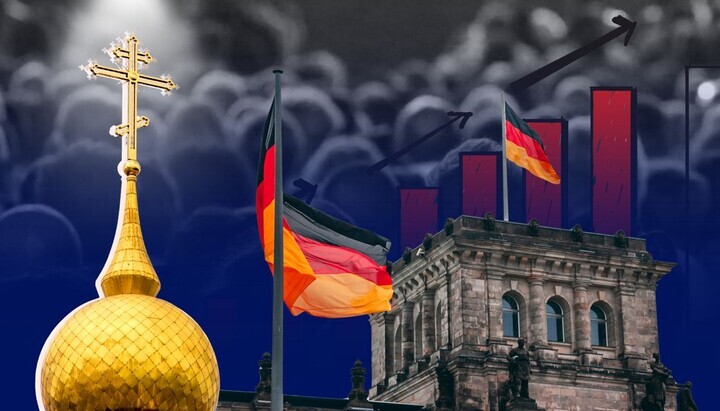
Orthodox numbers are rising in Germany. Photo: UOJ in Germany
Orthodoxy in Germany is experiencing a period of active growth, largely due to mass migration from Ukraine, and is increasingly integrating into German culture, no longer perceived solely as a “religion of the diaspora,” UOJ in Germany reports.
According to statistics from the Evangelical Church of Germany (EKD), about 3.8 million Orthodox Christians lived in the country in 2024, while Bishop Emmanuel Christopoulos of the Ecumenical Patriarchate estimates the figure at 4 million – up to 5% of the population.
“Orthodox confession is an enormous potential in this country. Such a number of believers cannot simply be pushed aside. And they cannot be spoken of as a minority. We are no longer a church of the minority, and this is no longer a migrants’ church,” Bishop Emmanuel said.
The key factor behind this growth has been the massive influx of Ukrainians due to the war. The vast majority of the approximately 1.3 million Ukrainians who have arrived in Germany since March 2022 are Orthodox Christians, significantly boosting the total number of Orthodox in the country.
Many Ukrainian faithful are joining existing parishes under different jurisdictions – Serbian, Russian, Romanian, and sometimes Greek. In many places, UOC parishes are also being established.
Remarkably, Orthodoxy is attracting not only migrants but also native Germans, many of whom are converting. German-language Orthodox parishes are emerging across the country. Monasteries play a special role in this process: the monastery in Unterufhausen near Fulda, under the Serbian Patriarch, conducts its monastic and liturgical life in German, exploring and cultivating the deep roots of Orthodoxy in Germany. The monastery also houses a specially created icon, The Synaxis of the Saints of the German Lands, depicting saints who lived on German soil before the Great Schism.
This Orthodox growth contrasts sharply with the crisis of traditional German churches. According to ZDF, in 2024 the Roman Catholic Church counted 19.8 million members (23.7% of the population), with membership steadily declining. The Evangelical Church of Germany had about 18 million members in the same year, losing about 345,000 people through church resignations. Fewer than 50% of Germans now belong to one of the two traditional confessions – 20% fewer than in 1991 after reunification.
The society German-Language Orthodoxy in Central Europe (DOM e.V.) is actively working to root Orthodoxy in German culture and has created a cartographic overview of worship places where liturgies are celebrated fully or partially in German.
“Orthodoxy has long been not only the faith of the diaspora but a solid component of today’s German culture and is increasingly shaping society,” German media note.
Earlier, it was reported that a regional congress of Ukrainian Orthodox youth was held in Berlin.
Read also
Metropolitan Onuphry congratulates Georgia on 1,700 years of Christianity
The Primate of the UOC sent a message to Patriarch Shio III on the anniversary of Christianity becoming the state religion in Georgia.
Zakarpattia marks 25th anniversary of Alexis of Carpatho-Russia's glorification
An all-night vigil was served at St. Nicholas Monastery in the village of Iza-Karputlash to celebrate the 25th anniversary of the glorification of St. Alexis of Carpatho-Russia.
DESS finds Balta Eparchy of UOC affiliated with ROC
Yelensky-headed state service said it found signs of affiliation of the Balta Eparchy Administration of the UOC with the ROC.
Upper Lavra court hearing postponed
The next court hearing in the Upper Lavra case has been scheduled for November 3.
UOC priest blesses ambulances at Kamianske medical center
A UOC priest in Kamianske blessed ambulances for a medical facility and wished its doctors God's help in their work.
Dumenko to German ambassador: Law targeting UOC also applies to other groups
Epifaniy Dumenko sought to defend Ukraine’s law restricting religious organizations during a meeting with the German ambassador.