Charlie Kirk: The life and murder of an American Christian politician
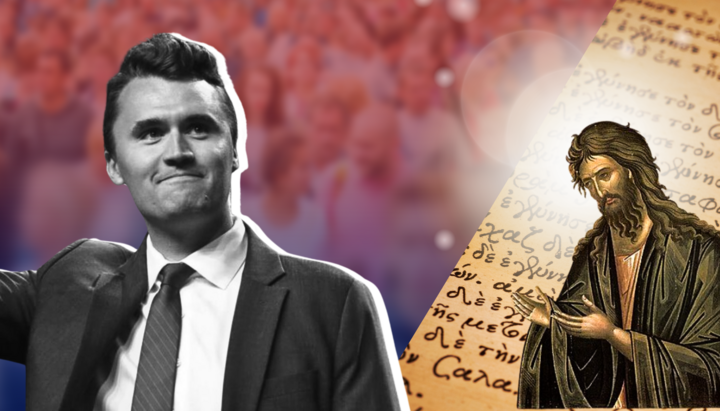
Charlie Kirk. Photo: UOJ
In the United States, one of the most prominent conservative activists of recent years – Charlie Kirk – was tragically killed. He was shot during an event on the campus of Utah Valley University, where he had been speaking as part of the “American Return Tour.” Investigators have classified the crime as politically motivated.
Investigators have classified the attack as politically motivated. According to police, shots were fired from the roof of a nearby building. The gunfire caused panic among students, and one bullet struck Kirk fatally.
The UOJ in Germany analyzes the personality of the slain politician.
Who was Charlie Kirk?
Charlie Kirk (1993–2025) was an American publicist and the founder of Turning Point USA, an organization promoting conservative values, free-market principles, and limited government intervention in schools and universities.
For years, he was a central figure in the American conservative movement, appearing regularly on television, at universities, rallies, and across social media.
His views
Kirk openly defended traditional Christian values. Among the issues he championed were:
- the defense of marriage and family;
- criticism of LGBT ideology being imposed on society;
- the protection of women’s rights in sports.
He was especially uncompromising on the participation of transgender individuals in women’s sports, firmly opposing biological males competing in female categories. He also sharply criticized policies granting transgender people access to women’s restrooms and locker rooms.
“Truth does not depend on opinion. Men cannot be women. The Christian faith gives society truth and meaning,” Kirk declared in one of his speeches.
Kirk and Christianity
“I have been a Christian for nearly my whole life, and it is the most important thing to me,” he said in an interview. “The most important thing in my life is the Gospel of Jesus Christ and the effort to get people to speak openly and honestly again about their faith. I am simply amazed at how some people are afraid to share their faith in Jesus Christ, in God, in the Bible, and the truth of the Bible – and that is why I am a Christian.”
In his view, “one reason we are going through a constitutional crisis is that we no longer have a Christian nation – but we still have a Christian form of government, and those are incompatible. You cannot have freedom without a Christian people.”
In one of his final social media posts before his death, Kirk wrote: “Jesus defeated death so that you can live.”
After his murder, Donald Trump said in his tribute that “Charlie was a deeply faithful man.” Israeli Prime Minister Benjamin Netanyahu noted that Kirk “fought against lies and defended Judeo-Christian civilization.”
A symbolic coincidence
It was profoundly symbolic that Kirk’s murder took place on the very day when the Church remembers the Beheading of John the Baptist – the great prophet who fearlessly denounced sin, including the unlawful marriage of King Herod. John was killed for the truth he proclaimed without fear.
And on this very same day, a modern publicist who openly defended Christian values and stood against the destruction of traditional foundations also met his death.
Kirk and Ukraine
In February 2025, Charlie Kirk sharply rebuked Volodymyr Zelensky, who had thanked the U.S. for its support:
“We do not support you. Next time show a little respect. You are an ungrateful, petulant creature, cursed and responsible for more than a million deaths.”
Shortly afterward, in a speech, he criticized the war in Ukraine:
“You must ask a very simple question: who benefits from peace, and who benefits from war? The people of Ukraine benefit from peace. The people of America benefit from peace. Humanity benefits from peace. But who benefits from war? The military-industrial complex, the oligarchs of Ukraine’s ruling class. We should reopen diplomatic channels with the Russian Federation. There is a temptation to simply say that Russia is America’s great enemy. But we made them our enemy. Instead, we should try to drive a wedge into the Russian-Chinese communist marriage. The Russo-Ukrainian war was largely unnecessary. There was a peace agreement on the table.”
For such statements, Ukraine’s Center for Countering Disinformation accused Kirk of “repeatedly spreading Russian propaganda narratives.”
Influence and legacy
Despite his youth, Kirk became an influential voice in conservative politics. He managed to draw public attention to issues often ignored by the political establishment: the crisis of the traditional family, the influence of radical leftist ideologies in education, and the essential role of religion in public life.
His murder sparked outrage across America. The Governor of Utah and several federal politicians called it a “political assassination” and a grave blow to freedom of speech.
Conclusion
Charlie Kirk entered history as a man unafraid to speak his convictions openly, defending the Christian faith in an age of intensifying pressure from liberal culture. His death has become a stark symbol of the dangers faced by leaders of the conservative movement in the United States.
Read also
The Council of Crete: a decade of unity in name only
Constantinople marked the anniversary of the Council of Crete with a theological conference in France. They spoke about the unity of Orthodoxy, although over the past years there has noticeably been less of it.
Yelensky’s plan: Why is DESS demanding what the UOC has already done?
DESS is demanding that the UOC take steps it has already taken, while offering no assurance that further demands will not follow. What is behind Yelensky’s ultimatum?
Why OCU hierarchy lacks canonical ordination: what Local Churches say
The OCU head refuses to address invalidity of his ordinations. But almost all Local Churches speak of it – even those that recognized the OCU.
Why nation-first advocates do not call for peace
Ukraine’s population is declining by nearly one million people a year, and experts are warning of the nation’s demographic extinction. Yet the leaders of the Orthodox Church of Ukraine (OCU) and the Ukrainian Greek Catholic Church (UGCC) continue to call for war and mobilization.
The deception that decided the fate of the Tomos
In 2008, the "Filaret problem" derailed Yushchenko's plan. In 2018, Poroshenko solved it in just one hour – with a police escort for the Greeks and verbal promises to Filaret.
Lawyers in the crosshairs: How UOC is being stripped of its right to defense
Activists harass UOC lawyers outside courthouses, call them “traitors” on air, and promise them a “warm welcome” at hearings. The Church’s right to a legal defense is at stake.