The Life-Giving Resurrection: An autumn feast of Paschal joy
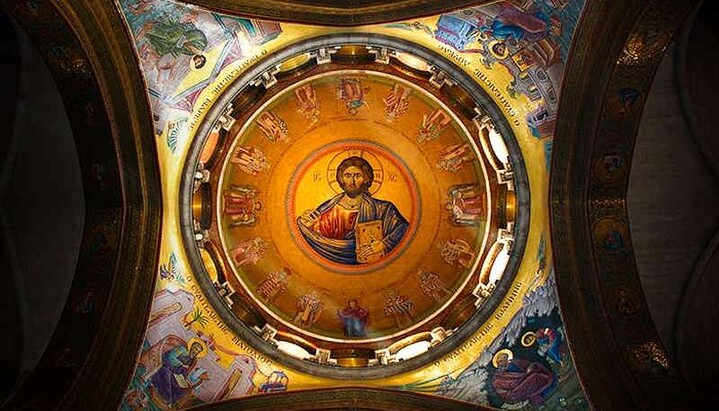
The renewal of the Church of the Resurrection is a direct participation in Christ’s victory over death. Photo: dishupravoslaviem
The history of this feast is deeply instructive for us, Christians of the 21st century. About forty years after the Lord’s Ascension, the prophesied destruction of Jerusalem took place. The Jewish historian Josephus Flavius left us a terrifying account of how in A.D. 70 the Roman general – later Emperor – Titus, while suppressing the Jewish revolt, laid waste to the Holy City and demolished the Temple, shaking the spiritual foundation of the chosen people.
From ruin to renewal
The Crucifixion of Christ did not pass without consequence for the enemies of the faith. After the second Jewish uprising, during the reign of Emperor Hadrian in 135, a new Roman city was built on the ruins of Jerusalem – Aelia Capitolina – into which Jews were forbidden to enter. The holy places of the Christians were deliberately desecrated and turned into centers of pagan worship. On Golgotha – the place of the Lord’s Crucifixion – a temple to the goddess Venus was erected; over the Holy Sepulchre a shrine to Jupiter was built. Where the Most Pure Blood of the Savior had been shed, debauched orgies were now performed and sacrifices to idols were offered.
It is hard to imagine what life was like for the Christians of that time, who, seeing this sacrilege, continued to pray to the one true God and Savior. In the midst of lawlessness they preserved in their hearts the faith that this dreadful trial would one day end.
And the Lord quenched the spiritual thirst of His faithful children. Upon the Byzantine throne ascended the Equal-to-the-Apostles Emperor Constantine. His devout mother, the holy Empress Helena, already advanced in years, undertook a pilgrimage to the Holy Land with the purpose of restoring the ruined Christian shrines.
Through her initiative excavations were carried out, and in a miraculous manner the Life-Giving Cross of the Lord was found, as well as the Holy Sepulchre and the place of Golgotha. Then Saint Helena ordered the construction of a magnificent church complex on the site of Christ’s Crucifixion, Burial, and Glorious Resurrection.
The building took ten years under the direction of the Empire’s best architects. And so, on September 13 (old style), 335, the rite of Dedication of the Church was performed – an event of truly universal significance. Fathers who had only recently participated in the First Ecumenical Council gathered for the celebration, together with hierarchs from Bithynia, Thrace, Cilicia, Cappadocia, Syria, Mesopotamia, Phoenicia, Arabia, Palestine, and Egypt, accompanied by throngs of faithful. It was not merely a feast, but the visible triumph of the Church, which after three centuries of persecution had at last received freedom.
The spiritual significance for today
This long-awaited feast has lost none of its relevance for us today. Do we not now live in an age of new, inner paganism – an age of moral decay?
Alas, even while enjoying the abundance of outward religious freedom, we often lose our inner spiritual freedom. The craving for the satisfaction of the flesh, the cult of comfort and selfishness, have eclipsed in our eyes the desire to serve God and His Law.
As a result, we see pagan shrines being built side by side with Orthodox monasteries and churches, while in nightclubs and on the glowing screens of smartphones there are spectacles compared to which Salome’s unchaste dance seems like a childish game. The world is again raising up a shrine of Venus upon the Golgotha of our hearts.
And yet – the moment the peal of church bells breaks through the noise of the world drowned in passions and vanity, the moment we step over the threshold of the temple – the words of Elder Paisios of the Holy Mountain become clear: in the end, the final word in the judgment of mankind will belong to God.
The Church, like the renewed Church of the Resurrection, abides in this world as the immovable witness of another reality, another Kingdom.
Now autumn has come, nature is fading, casting upon us melancholy and reminders of the transience of all that is earthly. But anyone who entered the temple last night or this morning unexpectedly touched the springlike, life-giving joy of Pascha.
By tradition, on this day the divine services are conducted according to the Paschal rite. And this is no accident – for the Dedication of the Church of the Resurrection is nothing less than a direct participation in Christ’s victory over death.
The consecration of the House of God is a foreshadowing of the future renewal of all creation, when God will be “all in all.”
Therefore, setting aside every worldly care, every shadow of autumn gloom and the burdens of daily life, let us lift our souls to the Divine Throne, forgive one another every offense, and greet one another once again with the ever-living, ever-radiant exclamation:
CHRIST IS RISEN! INDEED HE IS RISEN!
Read also
The Time of the Soul's Ripening
Modern society has turned youth into a cult and calls old age a period of "living out one's days." The Christian view reveals the deep spiritual meaning of one's later years.
Faith is not a checker piece in a spectator sport
Arguments about faith on social media increasingly resemble no-holds-barred fights. We turn to a saint who, sixteen centuries ago, knew how to speak to those interested only in turning theology into a combat arena.
The metropolitan who fought with a pen
St. Cyprian of Kyiv was robbed, expelled, and barred from his see. He answered with letters, books, and canons – and before his death, forgave everyone.
Loneliness under one roof
Spouses can share a home for years, raise children, and faithfully attend church – yet remain strangers to each other.
The cross – the deepest healing of the human soul
Emotional exhaustion and anxiety have become a way of life. Ancient Christian tradition offers an unexpected way out – embracing one's own cross.
The Prophet Elisha and the mystery of the Bethel massacre
The story of the prophet Elisha and the two bears seems to be the harshest in the Bible. But in reality, it carries a profound theological meaning.