On canons and the “breath of the Church”
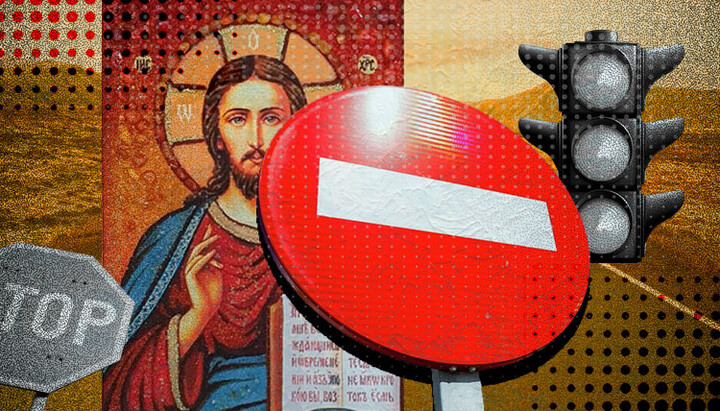
Rules must not obscure the Living God. Photo: UOJ
Since late September 2025, a discussion has been unfolding among hierarchs of the Ukrainian Orthodox Church. Initially, the debates – held in absentia – concerned the possible benefits and dangers of granting the UOC autocephalous status. Later, the hierarchs began debating whether the Council in Feofania was held freely or under pressure from the authorities.
Throughout these often emotional discussions, various opinions have been voiced: about Church history, its structure, relations with the state, and, notably, about the canons. One Ukrainian hierarch, speaking of Christ’s love, stated that “canons are the breath of the Church, and whoever preserves them fulfills his pastoral duty.” Let us examine this statement more closely.
Traffic and traffic rules: difference
Canons are rules. And in most cases, rules restrict, warn, or forbid.
For example, there is traffic, movement, and there are traffic rules. When followed, these rules help a driver reach his destination faster and more safely. But they cannot replace the movement itself. If you know all the rules perfectly but never move, the rules will not bring you any closer to your destination. Can the rules of the road be called the “breath” of drivers? No. They make life easier but do not replace it.
The same is true in the Church. There are rules – not only canonical prescriptions, but also liturgical ones. For instance, there are rules for conducting services known as the Typikon, which meticulously regulates the order of worship, the sequence of prayers, and special circumstances – for example, how to serve the Annunciation if it coincides with Holy Saturday. But can we say that the Typikon is the breath of the Liturgy? No. The breath of worship is prayer – that which unites a person with the Holy Spirit. “Come and dwell in us…” we say, addressing the Holy Spirit, not the Typikon.
So too with the Church’s canons. They organize her life, restrain what is incompatible with that life, and warn against what threatens to destroy it. But they are not that life itself. Their function is protective, auxiliary. But why did these rules arise at all?
Why build a fence around a garden?
Rules do not appear at the dawn of the Church’s life, but as a response to Her illnesses – they are born where there is danger of losing the breath of the Spirit, of breaking living communion with God.
The first Christians lived without a multitude of statutes and regulations, because they were united by the power of love, by fervent faith, and by the presence of the Holy Spirit. Moreover, at the First Apostolic Council in Jerusalem, many Old Testament regulations were abolished, and only the most essential were retained: “For it seemed good to the Holy Spirit and to us to lay upon you no greater burden than these necessary things…” (Acts 15:28–29).
But as faith cooled over time, as disputes, abuses, and human passions arose within the Church, the need emerged to protect what was alive.
Thus, rules appeared – like a fence around a garden. A fence does not give life to the trees, but protects them from beasts. And if a man cares only for the fence, forgetting the trees and their fruit, the garden will die. But if there is no fence at all, wild animals will come and destroy everything.
Returning to the analogy of the road: rules became necessary when people, moving from horses to automobiles, stopped respecting each other, ceased to yield the way, and began risking lives for the sake of speed or convenience.
So it is with the Church’s canons. They did not arise when the Church lived in apostolic simplicity, but when the number of those with “driver’s licenses” (formal members of the Church) grew, while the number of those truly living in the freedom of Christ’s Gospel diminished.
Church rules began to appear when Christians moved from inner freedom to bondage to passions; when they stopped seeking the grace of the Holy Spirit and began seeking ways to arrange life according to their own desires.
Then boundaries were needed – to remind where the path to God ends and the path to perdition begins.
One of the renowned Russian canonists, Bishop Ioann (Sokolov), illustrates this through the example of St. Gregory the Wonderworker. During a barbarian invasion of Pontus, Christians behaved no better than pagans: they plundered peaceful homes, seized property, shared spoils with the invaders, and some even ransomed their fellow Christians taken captive. In response, St. Gregory issued a series of canonical rules.
When Christians realized that instead of the Gospel, bishops, priests, and the faithful alike were guided by ambition, politics, egoism, and passions, the need for rules arose – as external supports for those tempted to outsmart “the simplicity that is in Christ” (cf. 2 Corinthians 11:3).
Thus, the rules are not the breath of the Church, but her attempt to preserve the breath of the Gospel amid human fallenness.
In the ideal world of apostolic simplicity, the Church would not need them.
Did the Church not “breathe” freely when there were no canons of the Fourth Ecumenical Council, no Pedalion, no decisions of the Quinisext Council, no rules of St. Gregory the Wonderworker? She did. But that breath was often obstructed – by human weakness, pride, and folly. The canons merely helped to clear the air, but they never replaced it.
The danger of mistaking the mask for breathing
Rules are needed for a deeply ill organism – as a respirator is needed for someone with diseased lungs. Sometimes, without it, the patient would die. But the mask is not the breath itself. And when the body is healthy, it is better to remove it and breathe freely.
The danger begins when the rules themselves are perceived as life – when a person can no longer breathe without the mask. When, instead of striving for the Holy Spirit and life in Christ, one seeks only to act “properly,” “according to the rule,” “according to the letter” – one already cuts oneself off from the living breath of the Church. Such a person may know the Typikon, the fasting rules, and the Church canons perfectly, yet not know the love of Christ. He may keep order strictly, yet lose the presence of God, for whose sake that order was given.
When form becomes more important than essence, when observance turns into an end in itself, faith imperceptibly turns into religious automatism. Thus living breath becomes rules of breathing – without air; prayer becomes the execution of prescriptions, without heart or communion with God.
Yes, rules are necessary – first and foremost to protect the garden of the Church from the goats of Satan. But a Christian who lives by the Spirit observes the rules not out of fear of breaking the law, but out of love, so as not to destroy the life within. He sees the rules not as a prison, but as protection – not as a substitute for the Spirit, but as a help for the Spirit to act freely within us.
Therefore, we may say that the Church’s canons are care for breathing, but not the breath itself. They appear when something threatens life, to remind us: “Here is the boundary – beyond it lies not the Kingdom of God, but the chaos of human desire.”
We too often strive for the letter rather than the Spirit, for rules rather than for God. Rules must not obscure the Living God for whose sake they were written. They are meant to ease the way toward Him. That – and nothing else – is their true purpose, which some of us forget.
Who and why forgets this – will be the subject of the next article.
Read also
Honest atheism vs. spiritual hypocrisy
The 70th anniversary of Albert Camus’s Nobel Prize recalls an uncompromising challenge to Christianity. An honest unbeliever brings theology back to the mystery of the Cross.
The valley of trouble and the gateway of hope
One soldier buried an expensive cloak and some gold beneath his tent. Because of this, all Israel lost a battle. Why did one man’s sin bring disaster upon an entire nation?
From love spells to bishop's throne
Antioch’s most powerful sorcerer sent demons against a devout young Christian woman three times – and failed every time. In the end, a demon himself revealed the truth that led to his conversion.
The Weeping Queen of Blachernae
On the night of the Feast of the Protection, only two people witnessed the miracle in the Church of Blachernae. Everyone else prayed and saw nothing. Yet they, too, received grace.
Deadly spiral of human hatred
The tragedy of Lebanon's civil war lays bare how dehumanization and fear can turn human beings into monsters.
Woe to expectant mothers – or to those of little faith?
God commanded one prophet not to have children, yet told his people in exile to bear sons and daughters. What does this apparent contradiction tell us today?