“A humble monk” in a bishop’s mantle: What's behind Dumenko’s visit to Athos
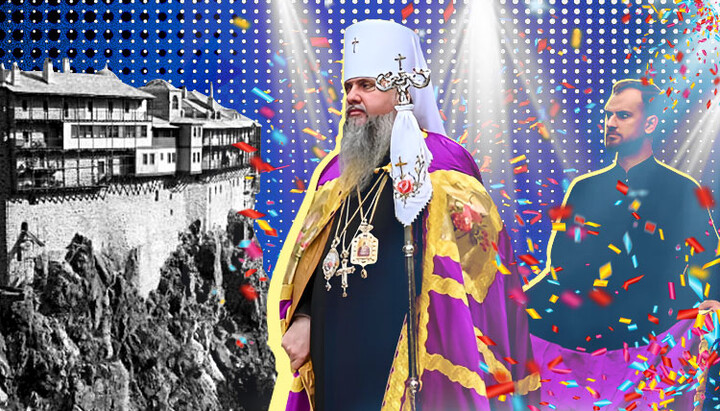
Monks were not allowed to express protest against Dumenko’s visit to Athos. Photo: UOJ
At the beginning of October 2025, the head of the OCU, Epifaniy Dumenko, made a four-day visit to Mount Athos. The OCU leader described his visit as an “ordinary pilgrimage” and explained that he came to the Mountain as a “humble monk”.
However, judging by photographs showing Dumenko wearing a bishop’s mantle and by reports from Athonite sources that access to Karyes (the administrative capital of Athos) was restricted during his visit, there was little trace of genuine humility.
At the same time, most Athonite monks took this visit with serious concern – after all, it was the first time in the entire existence of the so-called OCU that its head had set foot on the Holy Mountain. Yes, Ukrainian media presented this fact as an unequivocal "victory" of the OCU representatives over the Athonite brotherhood, which had resisted Dumenko’s presence in the “Domain of the Mother of God” for six years. Epifaniy’s visit was called "historic" and broadcast live, and overall, everything was done to create the impression among the average Ukrainian that Athos was “ours”. But, in reality, things are not quite so.
Who initiated the visit?
Dumenko’s trip to Athos did not originate from the Athonite monks but from the order of the Ecumenical Patriarchate, under whose jurisdiction the Athonite monasteries fall. This is a key point – the monks themselves did not invite him.
According to the Greek outlet Romfea, a few days before Dumenko’s arrival the Holy Community of Mount Athos made it clear that it would not receive him officially, attempting to avoid tension within the Athonite brotherhood. Reports indicated that many monasteries, despite pressure from hierarchs of the Ecumenical Patriarchate, refused to host the OCU leader.
The itinerary of the visit was kept secret, and of the twenty monasteries on Athos, only two – Xenophontos and Pantokrator – expressed willingness to receive Dumenko.
Sources from the Holy Mountain also stated that, to prevent possible protests, the Holy Community planned an unofficial visit to a few “compliant” monasteries. Then, with the help of Metropolitan Apostolos of Melitene, the “pilgrimage” was extended to two or three more monasteries and the Holy Epistasia. The goal was to take the right photos and announce that “Athos recognizes the OCU.”
It was evident long before the trip that this was not a personal pilgrimage but an attempt to legitimize the OCU’s presence in the sacred space of Athos – a place revered for a thousand years as the bastion of spiritual struggle and canonical purity.
The route and entourage
Officially, the visit was coordinated in advance with Patriarch Bartholomew. Dumenko arrived on October 9, accompanied by Metropolitan Apostolos of Melitene, the Patriarchate’s representative assigned to escort the delegation throughout the trip, and Alkiviadis Stefanis, the governor of Mount Athos and former Greek defense minister.
Such an entourage spoke for itself: “pilgrimage” of this kind would have been impossible without administrative backing. The presence of a state official beside the OCU head clearly suggested pressure on the monastic community.
During several days, Dumenko visited the monasteries of Xenophontos, Iviron, New Esphigmenou, Simonopetra, Pantokrator, Stavronikita, and the Skete of Saint Elijah – all known, to varying degrees, for loyalty to the Phanar.
It should be emphasized that the Holy Community of Mount Athos, the supreme governing body representing all twenty monasteries, refused to receive Dumenko officially.
His meeting in Karyes took place only at the level of the Epistasia – the executive council of four rotating monastery representatives.
To outsiders, this may have looked like an official reception, but Athonites know the difference: the Protat represents the entire Mountain, while the Epistasia is merely its current administrative team. A reception by the Epistasia is a gesture of courtesy, not recognition. Even within the Epistasia, not all members agreed to meet Dumenko.
The refusal of the Holy Community to receive him officially clearly indicated Athos’ position: the Holy Mountain is not ready to recognize the OCU leader. This was its response to the attempt to impose a “new church reality.”
Reaction of the Athonite brotherhood
The reaction of the Athonites was, in many ways, expected. The overwhelming majority of monks preferred to avoid personal meetings with the OCU delegation. Even in the monasteries that Dumenko did manage to visit, the atmosphere was far from welcoming.
For example, his service at the Elijah Skete of the Pantokrator Monastery was extremely sparsely attended, with only his entourage and a few monks from the skete taking part.
Moreover, according to Athonite reports, twenty monks at the Vatopedi Monastery declared they would leave if Abbot Ephraim agreed to host Dumenko. A similar situation arose at the Great Lavra, where attempts were made to persuade the abbot to “dialogue” with the OCU, but the brethren firmly refused. As a result, Dumenko’s itinerary was revised. These events demonstrated that Athonite monasticism is not yet ready to become an instrument of “church politics.”
This was confirmed by an open letter from Athonite kellion-dwellers (who vastly outnumber the monastery monks), in which they protested Dumenko’s visit. The document stated that the head of the OCU and his delegation do not belong to the canonical Church, and that the monasteries which concelebrated with him had "spiritually surrended."
The monks called the event a “fall” and warned of a “spiritual contagion” that would spread “like gangrene through concelebrations and common prayers” with those who had accepted Dumenko. They stressed that everyone who allowed such actions bears personal responsibility before God.
The letter also mentioned external pressure: during the visit, central Athos was sealed off by security services to prevent possible protests by the monks. Athonites themselves said Dumenko’s arrival was a true test of faithfulness – one not all endured.
What was it really about?
In fact, Epifaniy’s visit to Athos had no spiritual meaning.
The head of the OCU did not go there to pray but to create the illusion that his structure is a legitimate part of the Orthodox world and that its presence on the Holy Mountain is natural. For this purpose, the Ecumenical Patriarchate used loyal monasteries as a kind of foothold for “quiet” influence.
To achieve this, the Ecumenical Patriarchate relied on loyal monasteries as footholds of “quiet influence.” After Athos officially refused to receive Dumenko in both 2021 and May 2025, the Phanar adopted a new strategy: to introduce the topic of “Ukrainian autocephaly” gradually, through its subordinate monasteries.
Thus, Dumenko’s visit became an act of pressure on the Athonite brotherhood, an attempt to draw the Holy Mountain into a political game under the guise of ecclesiastical diplomacy.
For the Ecumenical Patriarchate – especially given the stance of other Local Churches – it was crucial to show that Athos “accepts” the new reality. Even if only a few monasteries cooperated, the information campaign was made as loud as possible to create the illusion that Athos is open to the OCU. Meanwhile, the monks’ boycott was portrayed as the stance of a “small marginal group” unwilling to adapt to “current realities.”
But most Athonites look not at Dumenko’s words, but at his deeds – the seizures and desecrations of churches, the violence against believers, the profanation of holy sites. For them, the question of recognizing the OCU is not political but spiritual: can those who behave as enemies of the Church be present in the Garden of the Mother of God? The answer, for any monk formed in the patristic tradition, is clear: no.
Conclusions
To be fair, there are some on Athos who show a degree of loyalty toward the OCU. Their motives vary: respect for the Ecumenical Patriarchate, personal sympathy for Patriarch Bartholomew, material interests (it is no coincidence that Ukrainian businessman Mykola Matsola – main sponsor of the Simonopetra Monastery – accompanied Dumenko), and even “Greek solidarity.” These sentiments cannot be ignored – they are indeed present on the Holy Mountain.
Monasticism has always been the guardian of the Church’s purity. When monks cease to distinguish between truth and political loyalty, between Church canons and worldly solidarity, the very foundation of their vocation collapses. Hence the saying heard on Athos: “Humility without truth becomes betrayal.”
Outwardly, Dumenko’s visit passed without open conflict. But neither he nor his entourage regard it as a true victory – Athos made it too clear that, despite all pressure, it still stands firm. The form of pressure, however, is changing: instead of breaking Athos, they now seek to lull it into complacency.
And though some have already “fallen asleep,” others believe this trial may yet awaken the Holy Mountain – reminding it of its true purpose: to guard the purity of the Church, not to seek the comforts of the world.
Read also
The Council of Crete: a decade of unity in name only
Constantinople marked the anniversary of the Council of Crete with a theological conference in France. They spoke about the unity of Orthodoxy, although over the past years there has noticeably been less of it.
Yelensky’s plan: Why is DESS demanding what the UOC has already done?
DESS is demanding that the UOC take steps it has already taken, while offering no assurance that further demands will not follow. What is behind Yelensky’s ultimatum?
Why OCU hierarchy lacks canonical ordination: what Local Churches say
The OCU head refuses to address invalidity of his ordinations. But almost all Local Churches speak of it – even those that recognized the OCU.
Why nation-first advocates do not call for peace
Ukraine’s population is declining by nearly one million people a year, and experts are warning of the nation’s demographic extinction. Yet the leaders of the Orthodox Church of Ukraine (OCU) and the Ukrainian Greek Catholic Church (UGCC) continue to call for war and mobilization.
The deception that decided the fate of the Tomos
In 2008, the "Filaret problem" derailed Yushchenko's plan. In 2018, Poroshenko solved it in just one hour – with a police escort for the Greeks and verbal promises to Filaret.
Lawyers in the crosshairs: How UOC is being stripped of its right to defense
Activists harass UOC lawyers outside courthouses, call them “traitors” on air, and promise them a “warm welcome” at hearings. The Church’s right to a legal defense is at stake.